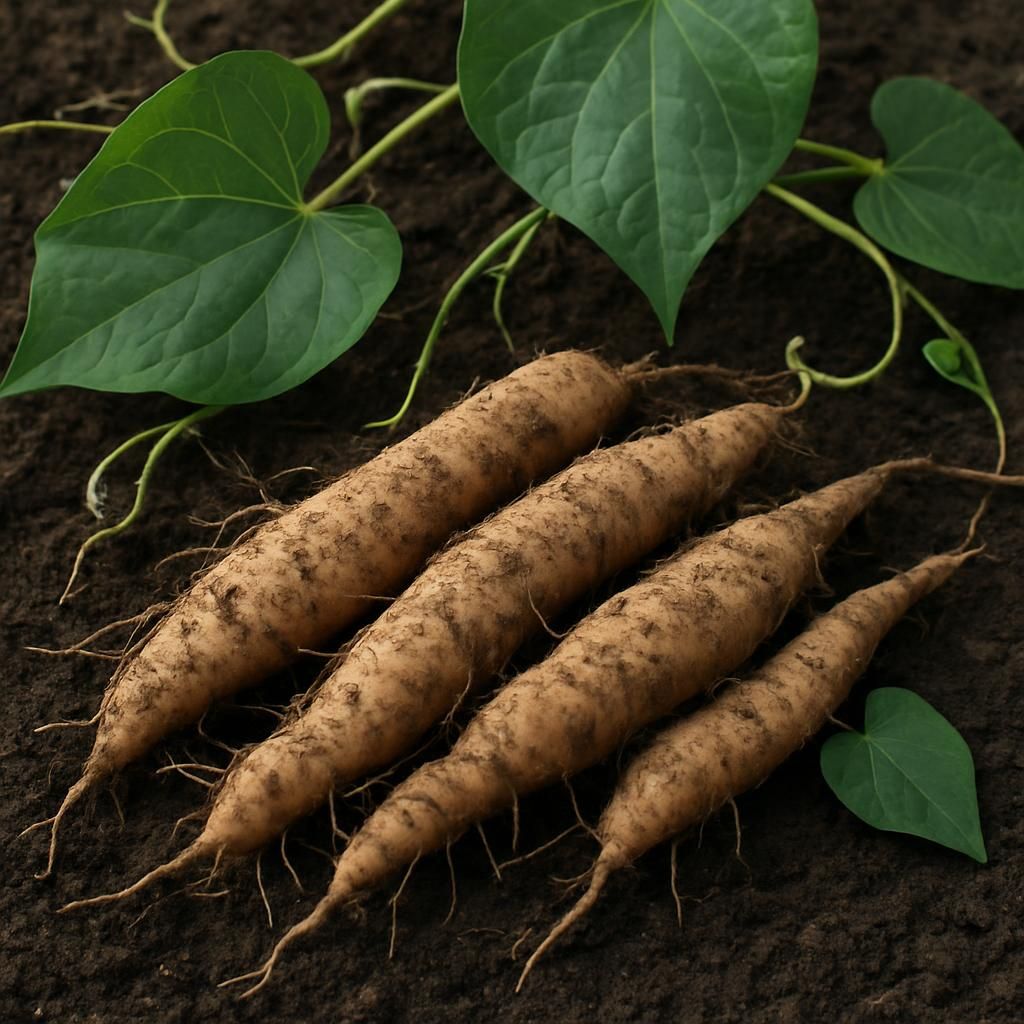
Introduction to Wild Yam Root
Wild yam root (Dioscorea villosa) is a native North American perennial vine belonging to the Dioscoreaceae family. The plant produces elongated, tuberous rhizomes that have been harvested for centuries by indigenous communities and later adopted by herbalists for their diosgenin content, a precursor used in early steroid synthesis. Today it is grown both for its medicinal rhizomes and as a resilient, low-input crop that thrives in woodland-edge and agroforestry systems.
The vine climbs vigorously using twining stems that can reach 3–5 meters in length, requiring sturdy support such as trellises, fences, or living trees. Its heart-shaped leaves and small greenish-yellow flowers appear in late spring, while the underground rhizomes mature over 2–4 growing seasons. Because the crop is slow to establish but long-lived once planted, it is particularly suited to permaculture and regenerative farming operations seeking perennial production with minimal annual tillage.
Commercial interest has grown due to increasing demand for organic, wild-simulated medicinal herbs. Yields of 0.8–1.5 kg of fresh rhizome per mature plant are realistic under good management, with dried product commanding premium prices in the herbal supplement market.
Botanical Profile of Wild Yam Root
Dioscorea villosa is a dioecious species, meaning individual plants are either male or female. Female plants produce small winged capsules containing flat, wind-dispersed seeds, although most commercial propagation relies on rhizome division. The rhizome is irregular, knotty, and covered with a thin, light-brown corky skin that darkens with age. Internally the flesh is white to pale cream and contains high levels of starch and steroidal saponins.
The plant exhibits a vining growth habit with slender, twining stems that die back to the ground each winter. Leaves are alternate, cordate to ovate, 5–10 cm long, with prominent palmate venation. Small axillary flowers appear from May through July. The species is adapted to deciduous forest understories and edge habitats where it receives dappled light and consistent moisture.
Soil, pH, and Climate Requirements for Wild Yam Root
Wild yam performs best in well-drained yet moisture-retentive soils rich in organic matter. It tolerates a range of textures but declines in heavy clay or waterlogged conditions. The ideal pH is slightly acidic to neutral.
| Parameter | Ideal Range | Notes |
|---|---|---|
| Soil Type | Loamy to sandy loam | High organic matter content preferred |
| Soil pH | 5.5 – 7.0 | Avoid strongly alkaline soils |
| Temperature Range | 15–30 °C daytime | Hardy to –20 °C once established |
| Annual Rainfall | 900–1500 mm | Supplemental irrigation in dry spells |
| Light | Partial shade to full sun | 30–50 % shade optimal in southern regions |
| Elevation | Sea level to 1200 m | Performs well in temperate to subtropical zones |
The plant benefits from consistent moisture during the active growing season but requires excellent drainage during dormancy to prevent rhizome rot.
Step-by-Step Planting & Propagation
- Site Preparation: Clear competing vegetation and incorporate 5–8 cm of well-rotted leaf mold or compost into the top 20 cm of soil. Install permanent trellis systems before planting.
- Propagation Material: Use 8–10 cm sections of healthy rhizome containing at least two viable buds (eyes). Divisions are best taken in early spring before new shoots emerge.
- Planting Depth and Spacing: Plant rhizome pieces 8–10 cm deep and 30–45 cm apart in rows 1.2–1.5 m wide. Orient buds upward.
- Support Installation: Provide 1.8–2.4 m tall trellising or allow vines to climb into low-branched trees or shrubs.
- Initial Watering: Water thoroughly after planting and maintain even moisture until new shoots are 15 cm tall.
- Mulching: Apply 5–8 cm of hardwood bark or leaf mulch to suppress weeds and conserve soil moisture.
Care & Maintenance regimes for Wild Yam Root
Consistent attention to water, fertility, and canopy management during the first three seasons determines long-term productivity.
| Growth Stage | Watering Schedule | Fertilizer Application | Pruning & Training Schedule |
|---|---|---|---|
| Establishment (Yr 1) | 25 mm/week; keep top 10 cm moist | 5 cm compost tea monthly April–August | Train vines weekly to trellis; remove weak shoots |
| Vegetative (Yr 2–3) | 20–25 mm/week if rainfall <15 mm | 2–3 kg/m² aged manure or 4-2-4 organic blend spring | Pinch terminal growth at 2 m to encourage branching |
| Mature Production | Deep soak every 10–14 days | Top-dress 3 cm compost each spring; avoid high N | Cut back dead vines to 5 cm above ground after frost |
Avoid over-fertilization, which promotes excessive foliage at the expense of rhizome development. Monitor soil moisture with tensiometers or finger tests to prevent both drought stress and waterlogging.
Pests, Diseases & Organic Management
Wild yam is relatively pest-resistant but can be affected by several common issues. Aphids and Spider Mites occasionally colonize new growth during hot, dry periods. Slugs may damage emerging shoots in spring. The most serious disease concern is Root Rot caused by Phytophthora or Pythium species in poorly drained soils.
Organic control begins with cultural practices: maintain 30 cm spacing between vines for airflow, avoid overhead irrigation, and rotate planting sites every 8–10 years. Neem oil or insecticidal soap applied at the first sign of aphids provides effective suppression. Slug pressure is reduced by removing mulch from the immediate planting zone during cool, wet springs. For root rot prevention, plant on raised beds or slopes and incorporate 10 % biochar by volume into heavy soils.
Harvesting, Curing & Optimal Storage
Rhizomes reach harvestable size after three full growing seasons. Harvest in late autumn after the first hard frost when foliage has senesced. Carefully dig around the plant with a spading fork, lifting the entire rhizome mass intact. Wash soil from the surface with a low-pressure hose and allow to air-dry for 24 hours.
Curing consists of storing the cleaned rhizomes in a shaded, well-ventilated area at 15–18 °C and 70–75 % relative humidity for 7–10 days. This process reduces surface moisture and initiates wound healing. For long-term storage, cut rhizomes into 5 cm sections, dry at 35–40 °C until brittle (moisture <10 %), and store in airtight containers away from light. Properly cured and dried product retains potency for up to three years.
Companion Planting for Wild Yam Root
Wild yam integrates well into multi-layered perennial systems. Compatible companions include Ginger and Turmeric planted in the same bed for efficient use of vertical space and shared moisture needs. Low-growing Thyme or Yarrow planted along row edges provides aromatic pest deterrence and attracts beneficial insects. In woodland settings, pair with Black Cohosh (not in wiki list) or ferns beneath partial canopy trees such as Pecan or Walnut. Avoid planting near aggressive spreaders such as Mint that can outcompete young yam vines.
Success with wild yam depends on patience, proper site selection, and long-term soil stewardship. When these fundamentals are observed, the crop delivers reliable medicinal yields with minimal external inputs.