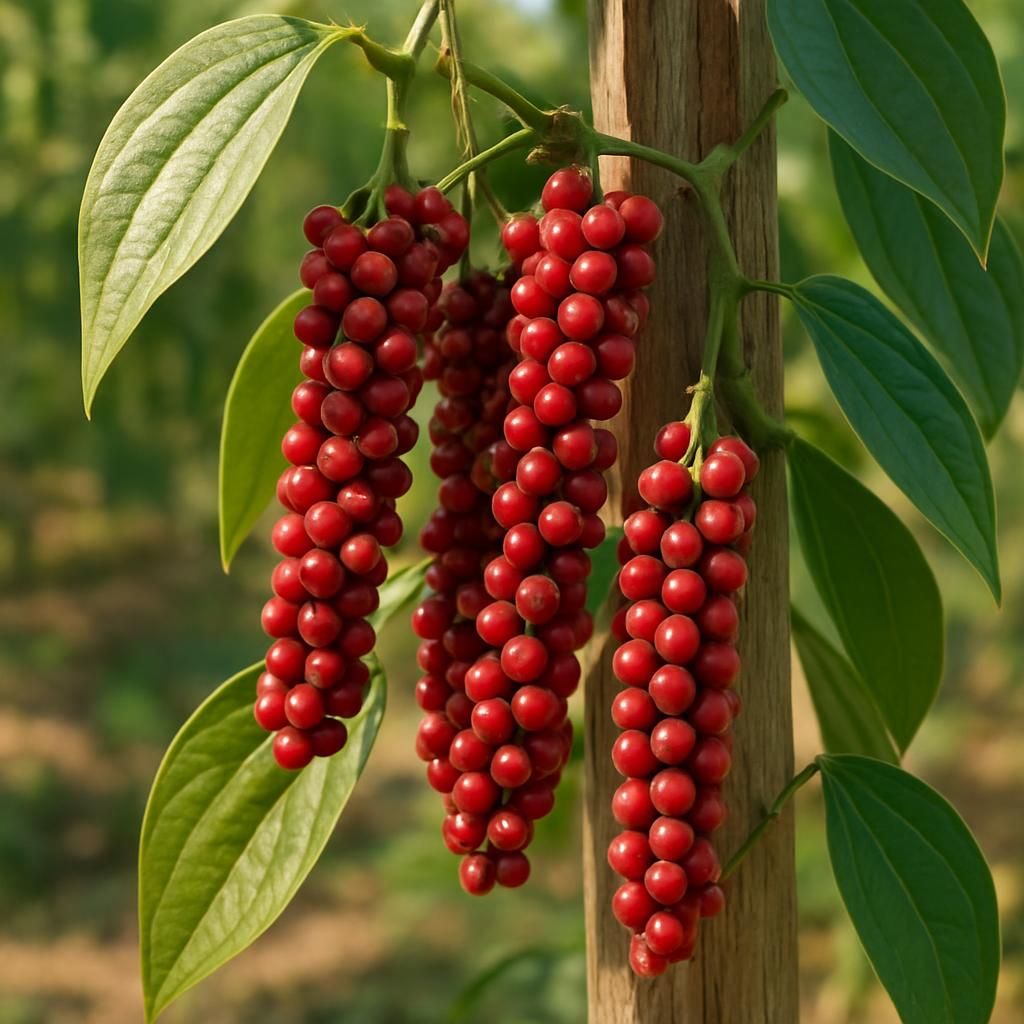
Introduction to White Pepper (Muntok)
White Pepper (Muntok) is a high-value spice crop originating from the Bangka-Belitung Islands of Indonesia, where the Muntok variety has earned international recognition for its clean, sharp flavor profile and consistent quality. Unlike Black Pepper, which uses immature green berries dried with the skin intact, white pepper is produced from fully mature red berries whose outer layer is removed through retting or mechanical decortication. This process delivers a lighter color and subtler heat that chefs and food processors prefer for light-colored sauces, seafood dishes, and processed meats.
Commercial production of White Pepper (Muntok) requires a long-term commitment, with vines taking three to four years to reach full bearing but then remaining productive for 15–20 years under good management. Global demand continues to rise as consumers seek clean-label spices free from artificial additives, positioning Muntok white pepper as a strategic export crop for tropical smallholders and plantation operators alike.
Botanical Profile of White Pepper (Muntok)
Piper nigrum is a perennial woody climber belonging to the Piperaceae family. The Muntok cultivar is distinguished by vigorous growth, large leaves, and clusters of 50–80 berries per spike. Vines develop aerial roots at each node that cling to supports, allowing the plant to reach 4–5 meters in height when trained on living or dead standards. Flowers are minute, unisexual, and wind-pollinated, forming on pendulous catkins that mature into drupes containing a single seed (the peppercorn).
The Muntok type exhibits moderate tolerance to shade during establishment but demands full sun once mature for optimal berry set and essential oil development. Leaves are alternate, ovate, and dark green with prominent venation; the plant produces both orthotropic (vertical) and plagiotropic (lateral) branches that influence pruning strategy and yield distribution.
Soil, pH, and Climate Requirements for White Pepper (Muntok)
Successful cultivation begins with matching site conditions to the vine’s physiological needs. Muntok white pepper performs best on deep, well-drained loamy soils rich in organic matter. Heavy clay or waterlogged soils promote root diseases and should be avoided or heavily amended.
| Parameter | Ideal Range | Notes |
|---|---|---|
| Soil Type | Sandy loam to clay loam | Deep profile (>1 m) with good drainage |
| Soil pH | 5.5 – 6.8 | Slightly acidic; lime if below 5.0 |
| Organic Matter | 3–5 % | Incorporate compost or green manure |
| Annual Rainfall | 2000 – 3000 mm | Even distribution; supplemental irrigation in dry spells |
| Temperature Range | 20 – 32 °C | Optimal growth 25–28 °C; frost intolerant |
| Relative Humidity | 70 – 90 % | High humidity favors flowering and berry set |
| Altitude | 0 – 800 m a.s.l. | Lower elevations yield larger berries |
| Light Requirement | Full sun after year 2 | 30 % shade during first 12 months |
Step-by-Step Planting & Propagation
Site Selection & Preparation: Choose a gently sloping field with eastern or northeastern exposure. Clear weeds, incorporate 10–15 t ha⁻¹ well-rotted farmyard manure, and establish contour drains.
Support Standards: Install living standards such as Gliricidia sepium or dead standards (concrete or wooden poles) at 2.5 m × 2.5 m spacing. Living standards should be planted 12 months in advance.
Propagation Material: Select healthy, 8–10 node cuttings from orthotropic shoots of 2–3-year-old vines. Each cutting should have at least three leaves and be 30–40 cm long.
Nursery Phase: Root cuttings in polybags containing a 2:1:1 mix of topsoil, sand, and compost under 50 % shade. Maintain 80 % humidity; roots develop in 6–8 weeks.
Field Planting: Transplant 6–8-month-old seedlings at the base of each standard during the onset of monsoon rains. Plant two seedlings per standard for insurance.
Initial Training: Tie the main shoot to the support every 30 cm. Remove side shoots below 1 m to encourage vertical growth.
Care & Maintenance regimes for White Pepper (Muntok)
Consistent cultural practices are essential for sustained productivity. The following table summarizes water, fertilizer, and pruning schedules for mature vines (year 4 onward).
| Operation | Frequency | Rate / Method |
|---|---|---|
| Irrigation | Every 7–10 days in dry season | 20–30 L vine⁻¹ via drip or basin; maintain soil moisture at 60 % field capacity |
| Fertilizer (NPK) | 3 split applications/year | 200 g 15-15-15 + 100 g urea + 50 g MOP per vine; apply at base and incorporate lightly |
| Organic Manure | Twice yearly | 5 kg well-rotted FYM or 2 kg vermicompost per vine mixed into top 10 cm soil |
| Micronutrients | Annually at flowering | Foliar spray of 0.5 % ZnSO₄ + 0.2 % Borax + 0.5 % MgSO₄ |
| Pruning | Post-harvest & pre-monsoon | Remove dead wood, water shoots, and plagiotropic branches below 1 m; tip laterals at 1.2 m |
| Mulching | Continuous | 10 cm layer of coconut husk or leaf litter within 1 m radius of vine |
| Weed Control | Monthly during rainy season | Manual slashing or spot application of glyphosate between rows |
Pests, Diseases & Organic Management
White Pepper (Muntok) is susceptible to several insect pests and soil-borne pathogens. Regular scouting and integrated management are critical.
Major pests include Aphids, Mealybugs, Scale insects, and Thrips. These sap-sucking insects cause leaf distortion and transmit viruses. Release of predatory lady beetles and lacewings, combined with neem oil sprays (0.5 %), provides effective biological control.
Diseases of economic importance are Phytophthora foot rot, Fusarium wilt, and Anthracnose. Improve drainage, avoid overhead irrigation, and apply Trichoderma harzianum at 5 g L⁻¹ as a soil drench every six months. Copper-based fungicides are permitted in organic systems during severe outbreaks but should be rotated with bio-fungicides.
Nematode pressure from Root-knot nematodes can be reduced by intercropping with Marigold and solarizing beds for 4–6 weeks before replanting.
Harvesting, Curing & Optimal Storage
Berries reach physiological maturity 6–7 months after flowering when they turn bright red. Selective harvesting of individual spikes is preferred to maximize quality. Pick early in the morning to minimize field heat.
Post-harvest processing for white pepper involves two primary methods:
- Retting: Submerge ripe berries in clean running water for 7–10 days until the pericarp softens and can be rubbed off. Rinse thoroughly and sun-dry to 10–12 % moisture.
- Mechanical Decortication: Use abrasive rollers followed by washing and drying in solar or mechanical dryers at 45–50 °C.
Store dried white peppercorns in food-grade jute bags lined with polyethylene at 10–12 % moisture and 60 % RH. Maintain cool (below 25 °C), dark conditions. Vacuum-sealed retail packs extend shelf life to 24 months while preserving volatile oils.
Companion Planting for White Pepper (Muntok)
Strategic companion planting enhances biodiversity, improves microclimate, and disrupts pest cycles. Coconut palms provide natural standards and partial shade during establishment. Leguminous cover crops such as Pigeon pea and Clover fix atmospheric nitrogen and suppress weeds.
Aromatic herbs including Thai Basil and Rosemary repel aphids and thrips while attracting pollinators. Marigold borders reduce nematode populations through allelopathic root exudates. Avoid planting Tomato or Eggplant nearby, as they share susceptibility to Phytophthora and may increase disease pressure.
For additional guidance on organic soil management and seasonal transitions, see The Forgotten Art of Fall Soil Revival: 8 Organic Strategies for Small Farm Resilience.