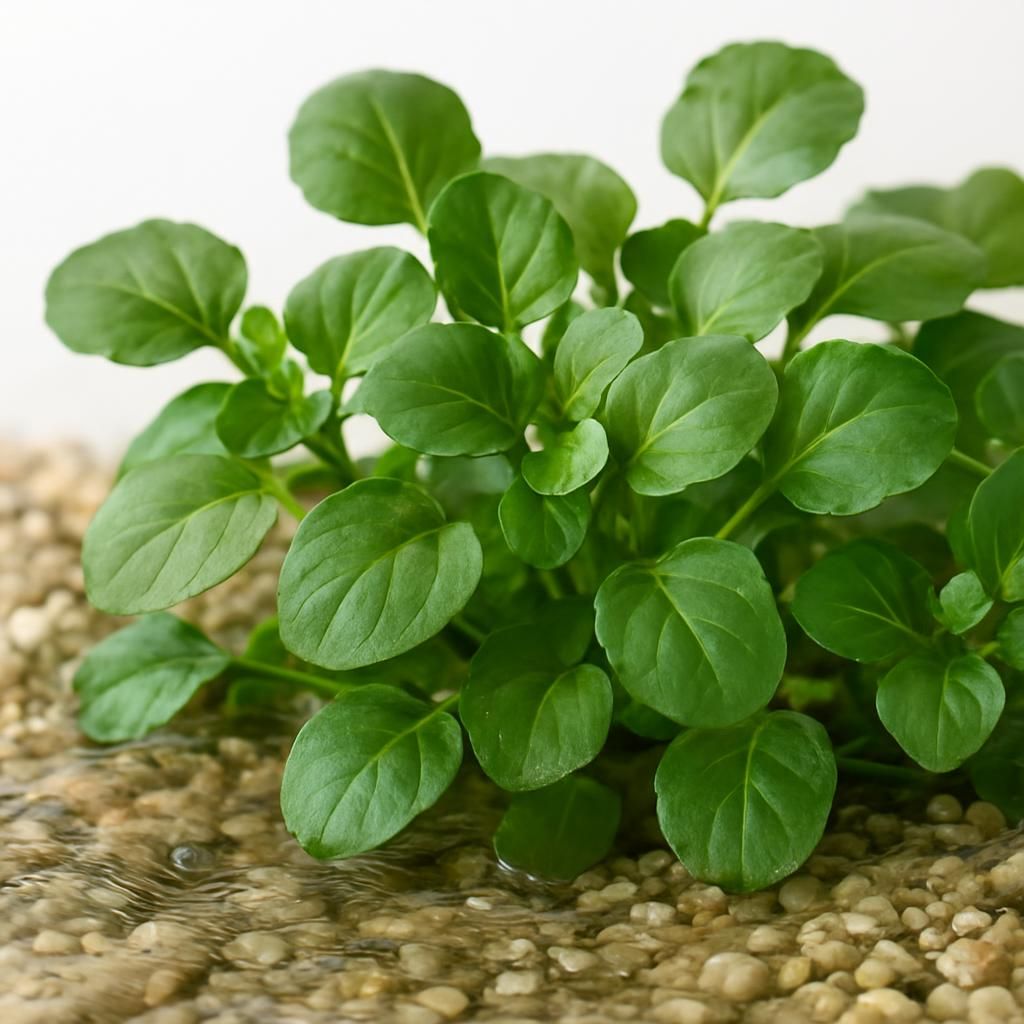
Introduction to watercress
Watercress (Nasturtium officinale) is a semi-aquatic leafy green belonging to the Brassicaceae family. Native to Europe and Asia, it has been cultivated for centuries for both culinary and medicinal uses. Its crisp, peppery flavor and high levels of vitamins A, C, and K make it a staple in salads, soups, and garnishes worldwide. Commercial growers value watercress for its rapid growth cycle and ability to produce multiple harvests from a single planting when managed correctly.
Watercress is distinct from other leafy greens because it requires constant moisture and prefers cooler temperatures. It grows naturally along streams and springs, making it ideal for hydroponic, aquaponic, or traditional flooded-bed systems. With proper management, watercress can reach harvestable size in as little as 30–45 days from seeding or cutting. Its shallow root system and tolerance for partial shade further increase its versatility across climates.
Botanical Profile of watercress
Watercress is a creeping or floating herbaceous perennial that develops hollow, succulent stems and compound leaves with 3–11 oval leaflets. The plant produces small white flowers with four petals arranged in a cross shape, typical of the mustard family. Under favorable conditions it can reach 30–60 cm in height while spreading laterally through nodal rooting.
The species is diploid (2n = 32) and reproduces both sexually via seed and vegetatively through stem cuttings. Leaves contain glucosinolates that contribute to the characteristic pungency and potential health benefits. Because watercress is a cool-season crop, flowering is triggered by lengthening days and rising temperatures above 20 °C, after which leaf quality declines.
Soil, pH, and Climate Requirements for watercress (MUST INCLUDE A MARKDOWN TABLE OF IDEAL CONDITIONS)
Watercress demands consistently moist to saturated growing media and cool temperatures. It performs best when water temperatures remain between 10–18 °C. Soil or substrate should be rich in organic matter yet well-aerated to prevent anaerobic conditions. Slightly alkaline conditions favor nutrient uptake and reduce disease pressure.
| Parameter | Ideal Range | Notes |
|---|---|---|
| Soil Type | Loamy or sandy loam | High organic content preferred |
| pH | 6.5–7.5 | Slightly alkaline improves iron availability |
| Water Temperature | 10–18 °C | Critical for preventing bolting |
| Air Temperature | 10–20 °C | Growth slows above 22 °C |
| Light | Full sun to partial shade | 6–8 hours direct light optimal |
| EC (hydroponic) | 1.0–1.8 mS/cm | Maintain steady nutrient solution |
| Spacing | 10–15 cm between plants | Closer spacing increases yield per m² |
Step-by-Step Planting & Propagation
Watercress is most reliably propagated from stem cuttings taken from vigorous mother plants. Select healthy shoots 8–12 cm long with several nodes. Remove lower leaves and insert cuttings 3–5 cm deep into moist sand or rockwool cubes. Roots typically form within 7–10 days when kept at 15–18 °C and high humidity.
Direct seeding is also possible but slower. Sow seeds on the surface of a fine, moist seedbed or floating rafts at a rate of 1–2 g/m². Maintain constant moisture; germination occurs in 5–7 days at 12–16 °C. Thin seedlings to 10–15 cm spacing once true leaves appear.
For commercial beds, prepare shallow trenches or concrete channels lined with 5–10 cm of clean gravel or sand. Flood the system with 2–5 cm of flowing water to simulate natural spring conditions. Transplant rooted cuttings or seedlings at the two-true-leaf stage. Maintain gentle water movement to oxygenate roots and prevent stagnation.
Care & Maintenance regimes for watercress (MUST INCLUDE A MARKDOWN TABLE OF WATER, FERTILIZER, AND PRUNING SCHEDULES)
Consistent water quality and nutrient supply are essential. Monitor pH and EC weekly in recirculating systems. Apply a balanced, low-nitrogen fertilizer during vegetative growth, switching to higher potassium formulations two weeks before expected harvest to improve flavor and shelf life.
| Task | Frequency | Details |
|---|---|---|
| Water Exchange | Daily trickle or weekly 20–30 % flush | Maintain dissolved oxygen >6 mg/L |
| Fertilizer | Every 7–10 days | 100–150 ppm N, 50 ppm P, 150–200 ppm K; chelated iron every 14 days |
| Pruning/Harvest | Every 3–4 weeks | Cut tops at 15–20 cm; leave 5 cm stubble for regrowth |
| Weeding | Weekly | Hand-remove competitors; avoid herbicides near water |
| Pest Scouting | Twice weekly | Check undersides of leaves for Aphids and Slugs |
Pests, Diseases & Organic Management
Common pests include Aphids, Slugs, and Spider Mites. Aphids cluster on new growth and can be controlled with insecticidal soap or neem oil. Slugs thrive in constantly moist environments; reduce populations with beer traps or iron-phosphate baits placed along bed edges.
Diseases are primarily fungal or bacterial. Pythium and Phytophthora cause root rot when water is stagnant or temperatures exceed 20 °C. Improve circulation and lower nutrient solution temperature to manage outbreaks. Downy mildew appears as yellowing upper leaf surfaces with gray sporulation beneath; remove infected foliage and increase airflow. Organic copper sprays provide limited protection when used preventively.
Harvesting, Curing & Optimal Storage
Harvest watercress when stems reach 15–25 cm and leaves are dark green and turgid. Cut above the second node to encourage rapid regrowth. Early morning harvest minimizes wilting. Rinse thoroughly in chilled, chlorinated water (50–100 ppm) to reduce microbial load.
Immediately cool harvested bunches to 0–2 °C using forced-air or hydrocooling. Pack in perforated plastic bags or clamshells lined with absorbent pads. Under 95–100 % relative humidity and 0–2 °C, watercress maintains quality for 7–10 days. Avoid ethylene-producing fruits during storage to prevent yellowing.
Companion Planting for watercress
Watercress benefits from association with other moisture-loving crops. Lettuce and Spinach provide light shade and reduce evaporation. Aromatic herbs such as Thyme and Rosemary deter aphids when planted along bed margins. Avoid heavy feeders like Tomato that compete for nutrients and increase disease risk.
In aquaponic systems, watercress pairs well with Tilapia or other herbivorous fish whose waste supplies nitrogen. Rotate beds with Rice or Taro in flooded systems to break disease cycles and improve soil structure. Always maintain at least 30 cm between watercress and taller companion plants to ensure adequate light penetration.