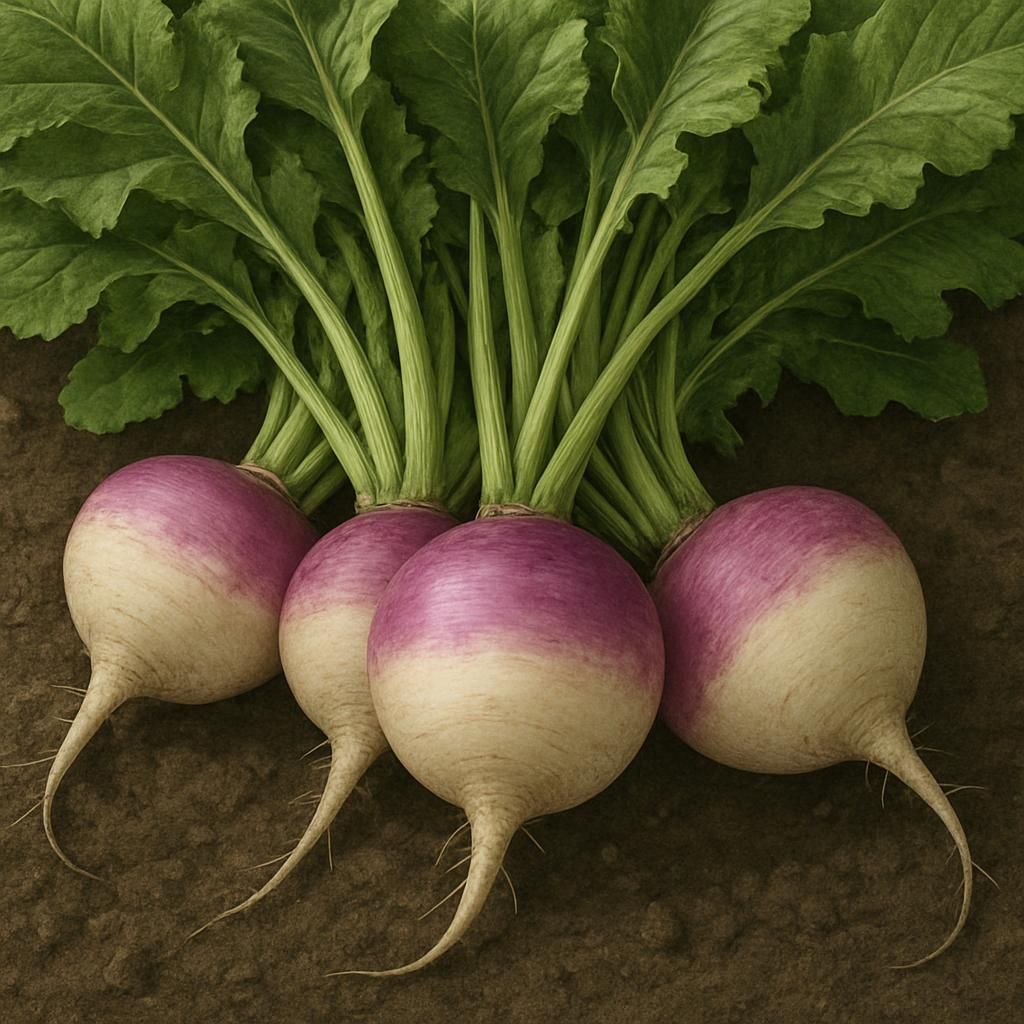
Introduction to Turnip (Purple Top White Globe)
Purple Top White Globe turnip is a classic cool-season root crop that matures in 55–65 days, making it ideal for spring and fall plantings. Its smooth, round roots feature bright purple shoulders above soil level and creamy white bases beneath, delivering a tender, mildly sweet flavor when harvested at 2–4 inches in diameter. Gardeners value the variety for its reliable performance, dual-purpose greens, and adaptability to both home gardens and small-scale commercial production.
Because turnips belong to the Brassicaceae family, they share many cultural requirements with Cabbage and Radish. The variety is also a popular choice for cover cropping and livestock forage thanks to its rapid growth and nutritious foliage. In many temperate regions, Purple Top White Globe is sown successively from early spring through late summer for continuous harvests.
Botanical Profile of Turnip (Purple Top White Globe)
Turnips are biennial plants grown as annuals for their swollen hypocotyl-root. The Purple Top White Globe cultivar produces a uniform globe-shaped root averaging 3–5 inches across at maturity. Leaves are dark green, slightly hairy, and form a compact rosette above the crown. Flowers, if allowed to develop in the second year, are typical four-petaled Brassicaceae blooms in bright yellow.
Roots accumulate sugars in cool weather, improving flavor after light frosts. The edible greens are rich in vitamins A, C, and K and can be harvested young as microgreens or mature as cooking greens. Seed pods are long, slender siliques containing small, round, reddish-brown seeds.
Soil, pH, and Climate Requirements for Turnip (Purple Top White Globe)
Turnips prefer loose, fertile, well-drained soils free of stones that can deform roots. Heavy clay soils should be amended with compost or aged manure to improve structure and drainage.
| Parameter | Ideal Range | Notes |
|---|---|---|
| Soil Type | Sandy loam to loam | Avoid compacted or stony soils |
| Soil pH | 6.0–7.0 | Slightly acidic to neutral |
| Temperature (Day) | 60–70 °F (15–21 °C) | Optimal for root swelling |
| Temperature (Night) | 45–55 °F (7–13 °C) | Enhances sweetness |
| Frost Tolerance | Light frost beneficial | Improves flavor; protect seedlings |
| Soil Moisture | Consistent, never waterlogged | Critical during root enlargement |
Step-by-Step Planting & Propagation
Site Selection & Preparation: Choose a sunny location receiving at least 6 hours of direct light. Remove weeds and incorporate 2–3 inches of well-rotted compost. Perform a soil test and adjust pH if below 6.0 with agricultural lime.
Sowing Method: Direct seed ½ inch deep in rows 12–18 inches apart. Thin seedlings to 3–4 inches within the row once true leaves appear. For baby turnips, sow more densely and harvest at 1–2 inches.
Timing: In cool climates, sow 2–3 weeks before the last frost for spring crops and again 8–10 weeks before first fall frost. In warmer zones, plant in late summer or early fall for winter harvests.
Succession Planting: Sow new rows every 2–3 weeks until 60 days before hard frost to maintain steady supply.
Care & Maintenance regimes for Turnip (Purple Top White Globe)
Consistent moisture and balanced fertility prevent woody or bitter roots. Mulch with 2–3 inches of straw or shredded leaves to retain moisture, suppress weeds, and moderate soil temperature.
| Task | Schedule | Details |
|---|---|---|
| Watering | 1 inch per week; more in heat | Keep soil evenly moist; avoid overhead late day |
| Fertilizer | Side-dress with 10-10-10 at 3 weeks | Light nitrogen focus early; reduce after bulbing |
| Pruning/Thinning | Thin to 3–4 inches at 2–3 leaf stage | Prevents crowding and improves root size |
Monitor for nitrogen deficiency (yellow older leaves) and correct promptly. Avoid high-nitrogen fertilizers once roots begin to swell to prevent excessive top growth.
Pests, Diseases & Organic Management
Common pests include flea beetles, cutworms, and aphids. Floating row covers installed at planting provide excellent physical exclusion. Handpick cutworms at dusk or apply Bacillus thuringiensis (Bt) as needed.
Diseases such as clubroot and Alternaria leaf spot can be managed with 3–4 year crop rotations, resistant varieties, and removal of infected debris. Maintain good airflow and avoid overhead irrigation to reduce foliar diseases. Beneficial nematodes and diatomaceous earth offer additional organic control for soil-dwelling pests.
Harvesting, Curing & Optimal Storage
Harvest when roots reach 2–4 inches in diameter for best flavor and tenderness. Pull gently or use a garden fork to loosen soil. Greens may be cut separately 2 inches above the crown for a second flush of leaves.
Cure harvested turnips in a shaded, well-ventilated area for 1–2 hours to dry surface moisture. Store at 32–40 °F (0–4 °C) and 90–95% humidity; roots keep 4–6 months in perforated plastic bags or root cellar conditions. Smaller turnips can be bunched and refrigerated for 1–2 weeks.
Companion Planting for Turnip (Purple Top White Globe)
Turnips pair well with Onion, Garlic, and aromatic herbs that deter flea beetles. Avoid planting near other brassicas to reduce shared pest and disease pressure. Nasturtium serves as a trap crop for aphids while Marigold repels nematodes.
Interplanting with Lettuce or Radish maximizes space and provides quick ground cover. Deep-rooted companions such as Carrot help break up compacted soil for better turnip development.