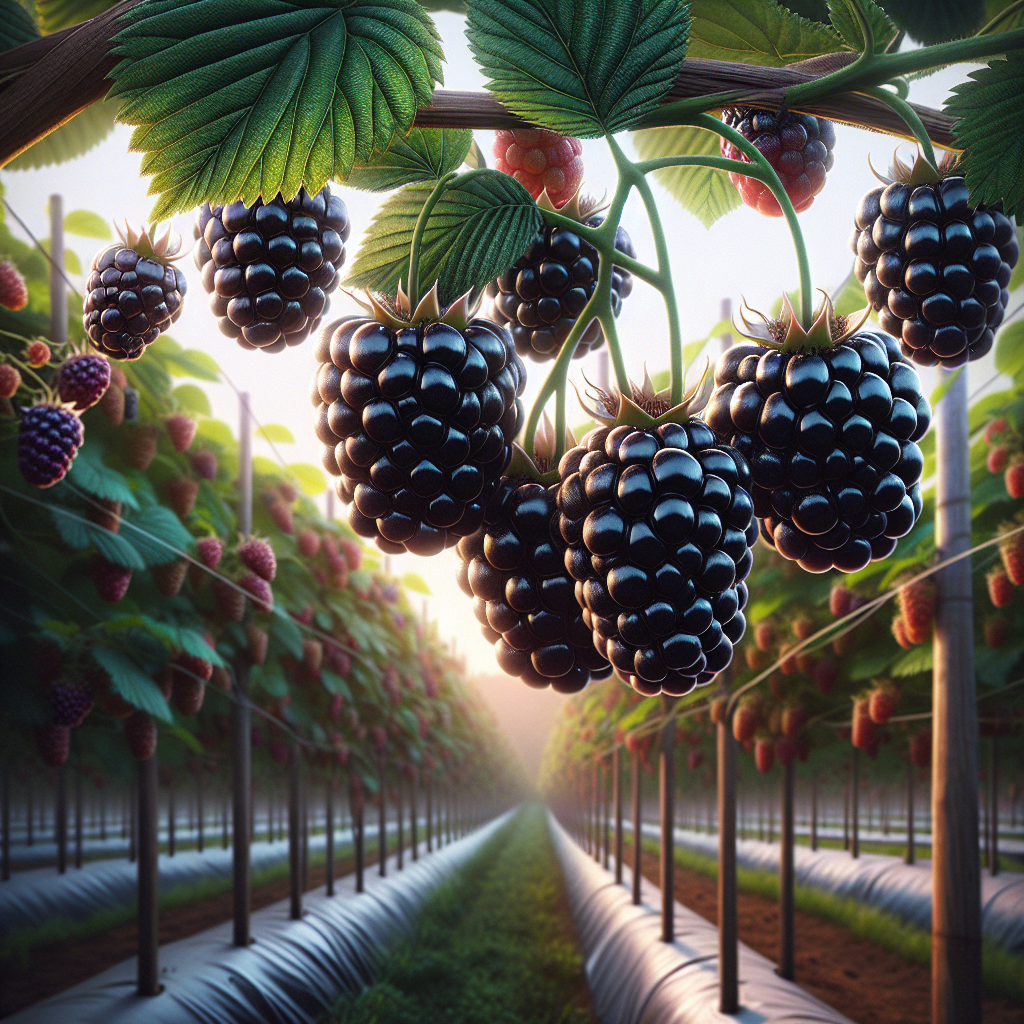
Introduction to Triple Crown Blackberry
Released by the USDA breeding program in cooperation with Pacific Northwest breeders, this thornless cultivar earned its name from the three traits that made it stand out: flavor, vigor, and productivity. It is one of the benchmark fresh-market blackberries in North America because it combines large berries with a notably sweet, low-acid profile and fewer handling injuries than many older thorny types.
It is classified as a semi-erect thornless blackberry, which means the canes are too vigorous and long to remain tidy without support, but they are not as strictly upright as erect cultivars. Mature plants routinely send primocanes 10 to 15 feet long in fertile soil, and unmanaged hedgerows quickly become tangled, shaded, and disease-prone. For that reason, this variety performs best when grown as a trained trellis crop rather than a neglected bramble patch.
Triple Crown is especially prized for eating fresh, making jam, freezing, and farm stand sales. Compared with many blackberries that lean heavily tart, the berries can develop rich sweetness when harvested fully black and slightly softened. Growers accustomed to the general habits of Blackberry will recognize the same floricane-fruiting cycle, but this cultivar is more vigorous than many backyard growers expect and rewards precision in pruning and nutrition.
Its main strengths are fruit quality, thornlessness, and strong yield potential. Its limitations are equally important to understand: it can be less winter hardy than the toughest blackberry cultivars, overly vegetative in rich soils, and somewhat soft for long-distance shipping if harvested dead-ripe. In climates with severe winter lows or hot droughty summers, site selection and irrigation management determine whether the planting becomes exceptional or merely average.
Botanical Profile of Triple Crown Blackberry
This cultivar belongs to the Rosaceae family, the same broad family that includes apples, peaches, strawberries, and raspberries. Blackberries are aggregate fruits made up of many drupelets clustered around a core; unlike raspberries, the receptacle remains inside the fruit when picked, which helps give blackberries their characteristic solid berry structure.
Triple Crown is a floricane-fruiting blackberry. In year one, the plant produces vegetative canes called primocanes. These primocanes store carbohydrates, harden off, and overwinter. In year two, those same canes become floricanes, produce lateral branches, flower, fruit, and then die after harvest. Successful production depends on managing both generations at once: the current season's primocanes for next year's crop and the fruiting floricanes for the present crop.
Canes are thornless, but "thornless" does not mean spineless in texture; young tissues can still be slightly rough and vigorous enough to whip during training. Leaves are compound, typically with three to five leaflets, medium to dark green, and coarsely serrated. Flowers are white to pale pinkish-white, usually opening in late spring to early summer depending on region. Pollination is improved by bee activity, though the cultivar is self-fertile and does not require another blackberry for fruit set.
The fruit is typically large, elongated to rounded, glossy black, and borne on laterals along floricanes. Sugar accumulation increases significantly in the final ripening stages, so berries that look black but remain firm and dull-tasting are often not fully mature. Triple Crown is known for a longer harvest window than many cultivars, often extending four to six weeks under favorable conditions.
Roots are perennial and crown-forming rather than annually replaced. Most feeder roots occupy the top 8 to 18 inches of soil, which explains why mulch and even moisture are so important. Because the root zone is relatively shallow, the plants are sensitive both to drought stress and to saturated, oxygen-poor soils.
Soil, pH, and Climate Requirements for Triple Crown Blackberry
This cultivar performs best in deep, well-drained loam or sandy loam with high organic matter and good internal drainage. Ideal soil pH is 5.8 to 6.5. It tolerates slightly more acidity, but when pH drops below about 5.5, nutrient imbalances can reduce vigor, particularly calcium and magnesium availability. Above roughly 6.8, iron and manganese can become less available, leading to pale new leaves and reduced growth.
Drainage is non-negotiable. Blackberry roots need oxygen, and standing water for even 24 to 48 hours in warm weather can injure feeder roots. If you dig a planting hole 12 inches deep and fill it with water, that water should drain away within several hours, not remain pooled the next day. Heavy clay soils can still be used if rows are raised 8 to 12 inches and amended with composted organic matter, but avoid creating a "bathtub" planting hole lined with compacted clay.
Organic matter around 3 to 5 percent is ideal for balancing moisture retention and aeration. Incorporate well-finished compost before planting, but do not overdo nitrogen-rich manures. Excessive fertility produces long succulent canes that are harder to harden off before winter and can shade fruiting wood. For commercial-style plantings, a pre-plant soil test is essential; blackberry nutrition is easiest to correct before the row is established.
Climate preference is temperate with warm summers and moderate winter cold. Triple Crown is generally best adapted to USDA zones 5 through 9, but its performance is strongest in zones 6 through 8 where winter lows are less likely to damage buds and canes. In zone 5, choose a protected site and expect occasional winter injury. In zone 9, afternoon heat and water stress can reduce berry size and soften fruit quality unless irrigation and mulch are excellent.
Full sun is ideal: at least 6 to 8 hours of direct light daily, with 8 to 10 hours producing the highest sugar and best cane maturity. In very hot inland climates, slight afternoon shade can protect berries from sunscald, but too much shade causes weak canes, poor flower bud development, and increased disease pressure.
Moisture should remain consistently moderate. Aim for soil that feels cool and slightly damp 3 to 4 inches below the surface, not muddy and not powder-dry. As a practical field benchmark, the top inch may dry between irrigations, but the root zone below should remain uniformly moist during flowering and berry fill. Water stress at these stages results in small berries, crumbly drupelets, poor flavor, and reduced primocane growth for next season.
Wind protection matters more than many growers realize. Strong winds can break tender primocanes, interfere with pollination, increase evapotranspiration, and cause thornless canes to chafe against trellis wires. Planting near a windbreak, while still preserving airflow, often improves both fruit set and cane survival.
For broader site preparation concepts, especially around organic matter and structure, see soil health tips.
Step-by-Step Planting & Propagation
Start with certified disease-free nursery stock. Tissue-cultured plugs or dormant bare-root plants are both suitable, though dormant plants are often easiest to establish in early spring. Avoid digging wild blackberries for transplanting; they commonly carry viruses, crown gall, and latent root problems.
- Choose a full-sun site with excellent air drainage and no recent history of tomatoes, peppers, potatoes, raspberries, or other cane fruits in the last 3 to 4 years. This rotation break reduces carryover of verticillium and other soilborne issues.
- Test soil 3 to 6 months before planting. Adjust pH to 5.8 to 6.5 and incorporate phosphorus, potassium, sulfur, lime, or compost as indicated by the test.
- Prepare a weed-free strip at least 3 to 4 feet wide. Perennial weeds such as bindweed, bermudagrass, or quackgrass become much harder to control after planting.
- Install trellis infrastructure before or at planting. A common system is a two-wire trellis with sturdy end posts and line posts every 20 to 30 feet. Place wires roughly at 3 feet and 5 feet high.
- Space plants 4 to 5 feet apart in rows 8 to 10 feet apart for good access, airflow, and cane training. In fertile soils, use wider spacing rather than narrower.
- Plant at the same depth the nursery stock grew previously. Set roots outward naturally, firm the soil, and water thoroughly to settle air pockets.
- Mulch immediately with 2 to 4 inches of clean straw, pine bark, wood chips, or leaf mold, keeping the mulch a few inches away from the crown to prevent rot.
After planting, cut damaged tops back lightly, but do not prune aggressively if the plant already has limited leaf area. During the first year, the goal is root establishment and primocane development, not fruit production.
Propagation is commonly done by tip layering because semi-erect blackberries root readily from cane tips. In late summer, bend a healthy primocane tip to the ground, bury the terminal 2 to 3 inches in moist soil, and anchor it. Roots and a new crown typically form within weeks. Detach and transplant during dormancy or the following spring. Root cuttings may also work, but tip layering preserves cultivar identity with high success and is simpler for small growers.
Care & Maintenance regimes for Triple Crown Blackberry
Irrigation should be measured, not guessed. Established plantings usually need about 1 to 2 inches of water per week from rainfall plus irrigation, with the higher end required during bloom, fruit swell, and hot dry weather. Drip irrigation is strongly preferred because it keeps foliage dry and delivers water directly to the shallow root zone. A practical target is to wet the soil 12 to 18 inches deep, then allow only slight drying before the next irrigation. Constantly soggy soil leads to yellowing lower leaves, weak growth, root decline, and sometimes a sour smell in the root zone. Drought stress shows up as dull leaves, reduced cane elongation, hard berries, and leaf margins that scorch in high heat.
Fertilization should support cane growth without pushing rank, disease-prone foliage. In the establishment year, a light spring application of nitrogen after new growth begins is usually sufficient. Mature plantings often respond well to 40 to 80 pounds of actual nitrogen per acre annually, split between early spring and just after harvest in lower-fertility soils. Backyard equivalent rates depend on soil test and fertilizer source, but the principle is the same: light, timed feeding is better than a single heavy dose. Stop high-nitrogen feeding by midsummer in colder climates so canes can harden before frost.
Pruning is the central management task for this cultivar. During the growing season, tip primocanes when they reach about 4 to 5 feet tall if grown on a vertical trellis, or once they exceed the manageable height of your support system. Tipping encourages lateral branching, which creates next year's fruiting wood. Laterals may also need shortening to about 12 to 18 inches in winter, depending on vigor and trellis space. If left unpruned, Triple Crown can produce excessively long laterals that shade themselves and reduce picking efficiency.
After harvest, remove spent floricanes at ground level as soon as practical. Do not leave dead fruiting canes in the row through winter; they harbor disease inoculum and crowd developing primocanes. Select the strongest 4 to 6 primocanes per plant or an equivalent number per linear foot of hedgerow, then tie or weave them onto the trellis. Remove weak, broken, late, or diseased canes.
Mulching is highly beneficial. A maintained mulch layer moderates soil temperature, reduces weed competition, protects shallow roots, and improves soil biology over time. However, keep mulch monitored for vole habitat in winter and avoid piling it against crowns.
Weed control is critical in the first two years. Blackberry roots compete poorly with perennial weeds for water and nutrients. Maintain a clean row strip through mulching, shallow cultivation, landscape fabric, or targeted organic methods. Avoid deep cultivation that damages roots.
Winter care depends on region. In colder sites, avoid exposed hilltops and encourage gradual hardening by reducing late-summer nitrogen and avoiding excessive late irrigation. In marginal climates, some growers lower and secure canes closer to the ground for protection, though this is less common in home plantings. Cane injury is often first noticed in spring when buds fail to break uniformly.
Pests, Diseases & Organic Management
The most common insect pests vary by region, but growers should watch for spotted wing drosophila, Japanese beetles, aphids, spider mites, redberry mite, cane borers, and stink bugs. spotted wing drosophila is especially serious because females lay eggs in ripening fruit, causing soft berries and larval contamination. The best organic defenses are frequent picking, strict sanitation, rapid cooling after harvest, exclusion netting where practical, and removing overripe fruit from the planting.
Japanese beetles skeletonize leaves and can scar fruit. Small plantings can be hand-collected in the morning into soapy water. Avoid traps close to the patch because they often attract more beetles than they catch. aphids and mites tend to flare in dusty, water-stressed conditions, so good irrigation and reduced plant stress are part of pest management.
Anthracnose, cane blight, spur blight, orange rust, crown gall, botrytis fruit rot, and phytophthora root rot are among the most important disease threats. Thornless blackberries can be particularly vulnerable to cane and foliar diseases when crowded. Good trellising, annual cane removal, drip irrigation, and disciplined pruning are the first line of defense.
Anthracnose appears as small purple lesions on young canes that enlarge and become gray-centered. cane blight often enters through wounds, especially after mechanical injury or poorly timed pruning. Botrytis becomes more severe under humid conditions and in dense canopies with poor airflow. Phytophthora is favored by waterlogged soils; once present, it is difficult to correct without improving drainage.
Organic management starts with prevention:
- Plant only certified clean stock.
- Use drip instead of overhead irrigation.
- Remove spent floricanes immediately after fruiting.
- Thin canes for airflow and light penetration.
- Sanitize pruners between suspect plants.
- Harvest frequently and remove cull fruit.
- Maintain mulch, but avoid crown burial.
- Keep the row free of volunteer brambles and wild Rubus nearby when possible.
Birds can become a major non-insect pest as berries darken. Lightweight netting installed just before ripening is often the most effective control. Deer may browse young canes heavily; fencing is the only consistently reliable long-term solution.
Harvesting, Curing & Optimal Storage
Fruit is ready when berries are fully black, plump, and detach with a gentle tug. For this cultivar, color alone is not enough; the best flavor develops when the berry loses its hard, under-ripe firmness and becomes slightly tender but still intact. Pick in the cool morning after dew has dried. Wet-picked berries have shorter shelf life and are more susceptible to mold.
Harvest every 2 to 3 days during peak season, and daily in hot weather if necessary. Overripe fruit left on the plant attracts pests and slows clean harvesting. Use shallow containers to avoid crushing lower berries. Because Triple Crown is excellent for fresh eating but not the firmest long-haul shipping berry, gentle handling makes a substantial difference.
There is no true curing stage as with onions or sweet potatoes, but postharvest cooling is essential. Move fruit to 32 to 34°F (0 to 1°C) as quickly as possible, ideally within an hour of picking for best quality retention. Relative humidity around 90 to 95 percent helps prevent shriveling, but free moisture on berries should be avoided. Under excellent conditions, fresh berries may store 4 to 7 days, though flavor is best within the first few days.
Do not wash berries until immediately before use unless processing at once. Washing before storage increases surface moisture and mold risk. For freezing, spread clean dry berries in a single layer on trays, freeze individually, then transfer to bags or containers. This preserves berry shape better than packing them wet into deep containers.
For preserves, fully ripe fruit gives superior sugar balance and aroma. Slightly underripe berries contain more pectin and acid, which can help jam set, so many processors blend ripeness stages for texture and flavor.
Companion Planting for Triple Crown Blackberry
The best companions are those that support pollinators, improve beneficial insect habitat, suppress weeds without smothering shallow roots, or occupy adjacent rather than competing root zones. Good choices include Thyme, Yarrow, and Clover.
Thyme works well along sunny row edges because it stays low, attracts beneficial insects when blooming, and does not create dense shade around the canes. Yarrow is particularly useful nearby, not directly crowding the crowns, because its umbels attract parasitoid wasps, hoverflies, and predatory insects that help moderate aphids and other small pests. Clover is best used in alleyways rather than right at the base of plants; it reduces erosion, supports pollinators, and can contribute nitrogen cycling, though it must be mowed so it does not compete for water.
Avoid aggressive companions directly within the root zone. Deeply competitive perennials, sprawling vegetables, and heavy feeders can reduce cane vigor and complicate harvesting. Keep at least a 12- to 18-inch vegetation-free strip around the crown area even when using beneficial companion species nearby.
Also avoid placing blackberries near wild brambles or crowded plantings of raspberries, which can increase disease and pest carryover. Aromatic insectary borders are useful, but airflow must remain high around the hedge. The right companion strategy supports ecology around the planting rather than turning the blackberry row itself into a mixed, tangled bed.