Definitive Diagnostic and Management Guide for Spur Blight
Introduction to spur blight
Spur blight, caused by the fungal pathogen Didymella tremulicola (formerly Physalospore a rborea or its anamorph Phoma exigua var. fuscicula), is a destructive disease that plagues bramble crops worldwide. This necrotrophic fungus specifically attacks the spurs—short, fruit-bearing branches on raspberry and blackberry canes—leading to blighting, girdling, and eventual death of infected tissues. First identified in the early 20th century in Europe, spur blight has since spread to North America, Asia, and other raspberry-growing regions, causing yield reductions of up to 50% in severe cases.
The disease thrives in temperate climates with high humidity, making it a particular threat to commercial berry farms and home gardens alike. Unlike powdery mildew, which produces white powdery growth, spur blight manifests as dark, necrotic lesions with distinctive purple margins, often accompanied by pycnidia (fungal fruiting bodies). Early detection is crucial, as infections weaken canes, reduce bud viability, and predispose plants to secondary issues like cane borers.
Understanding spur blight's biology is key to control. The pathogen overwinters in infected canes and buds, releasing spores during wet springs to infect new growth. This guide provides professional-grade diagnostics, lifecycle insights, organic treatments, and prevention strategies tailored for sustainable agriculture. By integrating these practices, growers can minimize losses and maintain healthy raspberry and blackberry plantations. For small farms optimizing operations, check out this blog on companion planting to enhance resilience against diseases like spur blight.
Identifying Symptoms & Damage
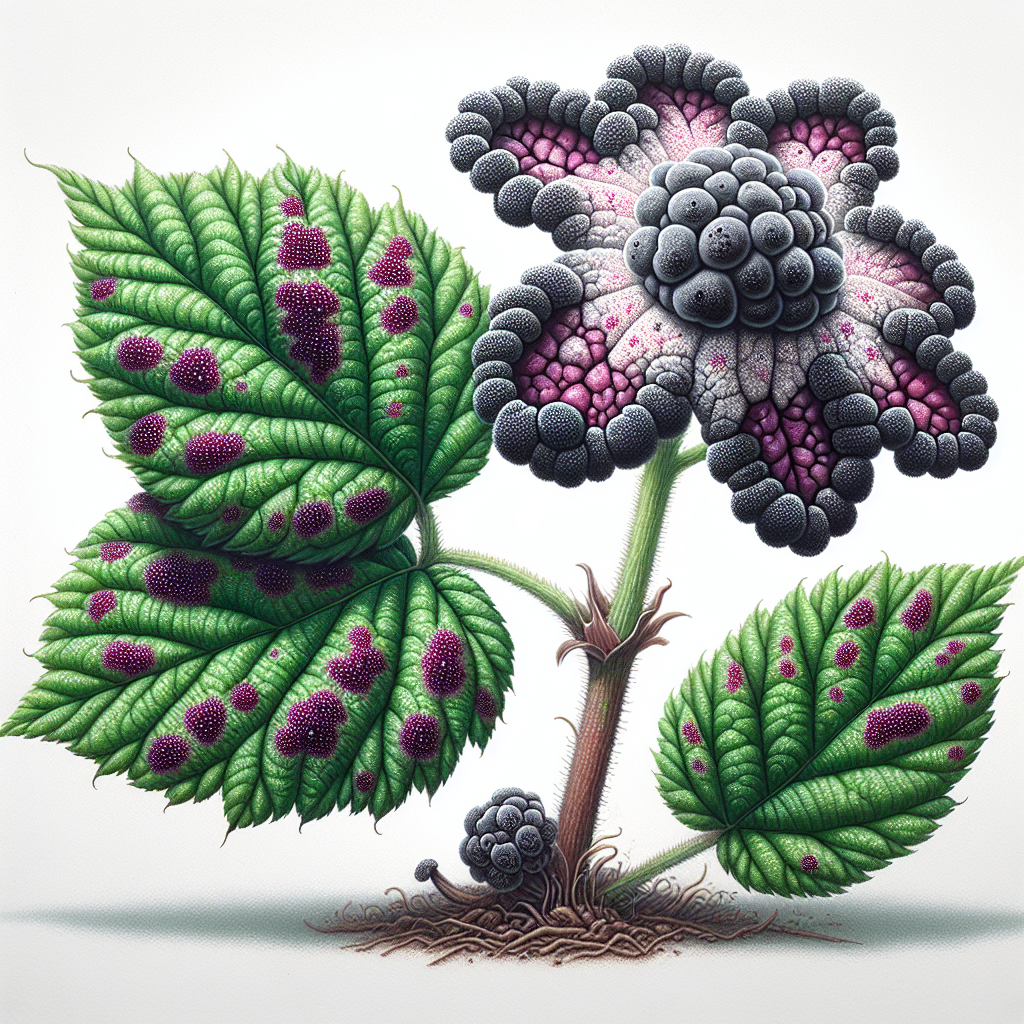
Accurate diagnosis begins with recognizing spur blight's hallmark symptoms, which appear primarily on one-year-old primocanes and two-year-old floricanes. Initial signs emerge in late spring to early summer as small, purplish-brown spots (1-2 mm) on young canes, often at leaf axils or bud bases. These lesions expand rapidly under moist conditions, forming characteristic rectangular or spindle-shaped blotches with well-defined, darker purple borders and grayish centers.
Affected spurs turn black and shrivel, failing to produce flower buds or fruit. On floricanes, infections girdle the cane, causing above-lesion tissues to wilt and die back. In advanced stages, tiny black pycnidia dot the lesions, releasing orange spore masses (conidia) during rain— a diagnostic giveaway distinguishing it from anthracnose, which produces sunken cankers.
Damage extends beyond aesthetics: blighted spurs yield no berries, slashing production by 20-50%. Weakened canes snap easily, increasing susceptibility to aphids and winter injury. In raspberry cultivars like Heritage or Meeker, symptoms often cluster at the base of fruiting laterals. For blackberries such as Chester or Triple Crown, lesions may fuse, encircling canes entirely.
Secondary symptoms include leaf yellowing above girdles and premature defoliation, mimicking Verticillium wilt. To confirm, slice infected canes longitudinally: vascular browning and pycnidia confirm spur blight. Yield impacts are severe in dense plantings—untreated fields lose entire rows. Economic thresholds vary: prune if >10% spurs affected pre-bloom.
Lifecycle and Progression of spur blight
Spur blight follows a polycyclic lifecycle synchronized with bramble phenology. The pathogen overwinters as stromata and pycnidia in dead buds, bark, and cane lesions from the previous season. In spring (bud swell, ~10-15°C), rain activates conidia release, splashing onto new primocane growth up to 1-2 meters.
Primary infections occur May-June via conidial germination in free water (6+ hours at 15-25°C). Hyphae penetrate through stomata or wounds, colonizing cortical tissues. Lesions mature in 7-14 days, producing secondary conidia for local spread. By mid-summer, pseudothecia form in old lesions, maturing into ascospores for long-distance dispersal via wind/rain.
Disease progression peaks during wet summers, with 2-3 cycles per season. On summer-bearing raspberries, floricanes bear the brunt post-harvest; everbearing types suffer repeated hits on primocanes. Latency period shortens with temperature/humidity: 5 days at 20°C vs. 20 days at 10°C. Overwinter survival exceeds 80% in blighted debris.
In blackberry systems, progression is faster due to trailing growth trapping moisture. Scouting timelines: inspect post-rain at bud break, pre-bloom, and post-harvest. Progression models predict epidemics when RH>85% for 48+ hours.
Environmental Triggers & Risk Factors
Spur blight epidemics hinge on prolonged leaf wetness (8-12 hours) and mild temperatures (15-25°C). High humidity from dense canopies, poor airflow, or overhead irrigation is the primary trigger—splashing rain disseminates 90% of inoculum. Cool, wet springs favor primary infections; warm, humid summers drive secondary cycles.
Risk factors include susceptible varieties (e.g., summer-bearing raspberry like Latham), high nitrogen fertility promoting succulent growth, and wounding from Japanese beetles or mechanical injury. Overcrowded plantings (>1m row spacing) trap moisture; acidic soils (pH<6) stress plants, enhancing susceptibility.
Climate change exacerbates risks: increased storm frequency boosts splash dispersal. In the Pacific Northwest, 70% infection rates correlate with >500 rain hours annually. Weed competition and root-knot nematodes weaken vigor, indirectly favoring disease.
Organic Control & Treatment Plans
Organic management emphasizes sanitation, cultural tweaks, and biofungicides. Step 1: Prune aggressively. Remove all infected canes post-harvest (by 90% fall), cutting 30cm below lesions and destroying debris (flame or bury). Thin canes to 6-8/inch for airflow.
Step 2: Fungicide rotations. Apply OMRI-listed copper (e.g., Cueva at 1-2 gal/A) or sulfur (e.g., Kumulus at 5-10 lb/A) at bud swell, pre-bloom, and post-harvest. Bacillus subtilis (Serenade) or Trichoderma (RootShield) suppress via competition. Rotate modes of action; 7-14 day intervals during wet periods.
Step 3: Boost resistance. Foliar calcium (1-2% Cal-Mag) strengthens cell walls; compost teas enhance microbiome. Mulch with straw (4-6 inches) to moderate soil moisture. Companion plant thyme or yarrow for biocontrol volatiles.
Integrated plans: Scout weekly; treat if 5% incidence. In trials, sanitation + copper yields 70% control vs. 30% fungicides alone. For everbearers, focus primocane treatments.
Preventing spur blight in the Future
Prevention is 80% of control. Select resistant cultivars: Boyne or Killarney raspberries, thornless blackberries like Ouachita. Site in full sun with well-drained, pH 6.0-6.5 soils; space 1.5-2m rows, 0.5m plants.
Annual practices: Trellis for ventilation; drip irrigate; avoid excess N. Fall cleanup removes 95% inoculum. Cover crops like clover suppress splash. Monitor with weather stations: act on 12-hour wetness alerts.
Long-term: Rotate fields 4-5 years; solarize soil pre-plant. Build soil organic matter (>4%) via cover crops. Educate workers on hygiene. IPM thresholds: prune at 5% buds affected.
Crops Most Affected by spur blight
Spur blight predominantly strikes Rubus idaeus (red raspberry) and Rubus fruticosus (blackberry), with raspberries most vulnerable. Summer-bearing reds like Heritage raspberry, Meeker raspberry, and Latham suffer highest losses. Everbearing types (Autumn Bliss) face dual-season hits.
Blackberries, especially trailing (Marionberry) and erect (Chester blackberry, Triple Crown blackberry), are impacted but less severely. Loganberries and boysenberries show intermediate susceptibility. Rare reports on currant or gooseberry, but Rubus spp. dominate.
Global hotspots: UK (30% losses), Pacific NW USA, New Zealand. Hybrids vary: primocane-fruiting resist better.