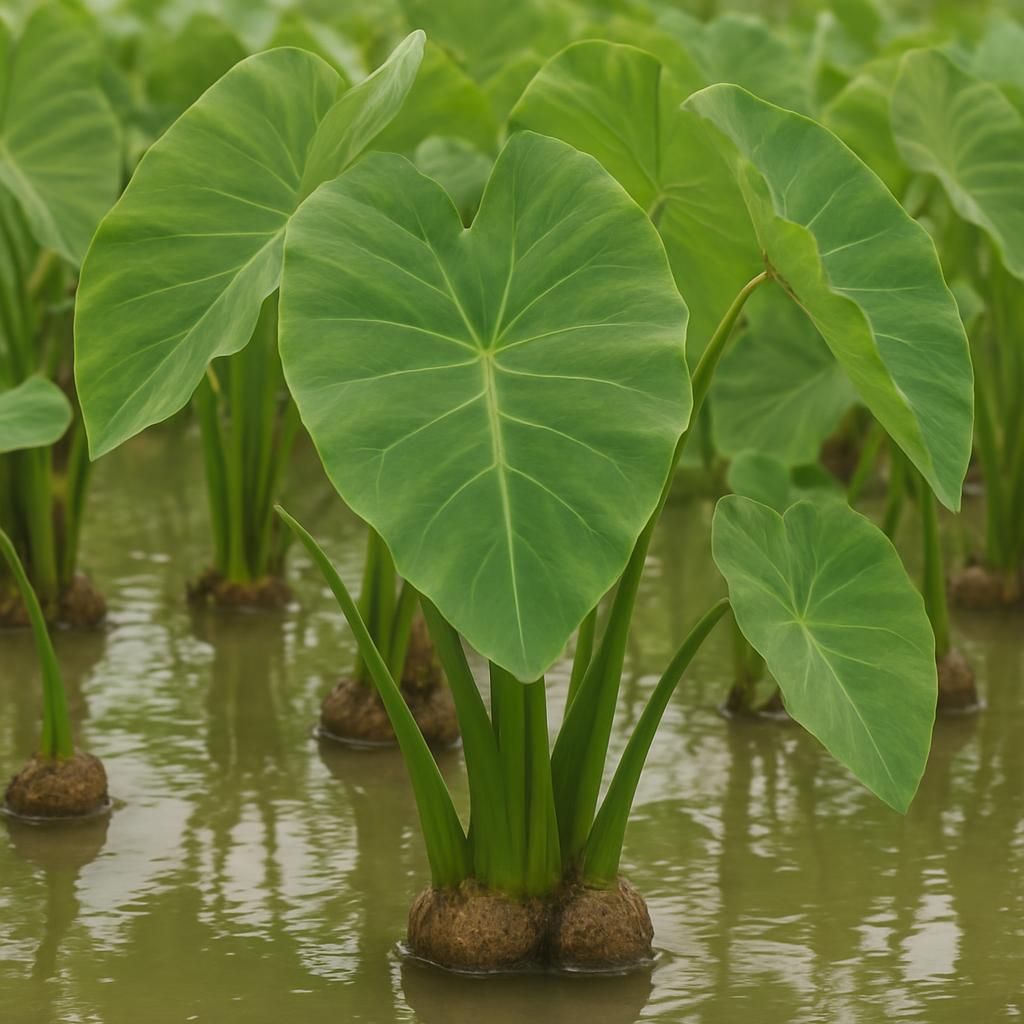
Introduction to Taro (Colocasia esculenta - Bun-long)
Taro (Colocasia esculenta - Bun-long) is a staple wetland crop grown for its large, edible corms that supply complex carbohydrates, dietary fiber, and potassium. Bun-long cultivars are selected for vigorous growth, high corm-to-plant ratio, and tolerance to both flooded paddies and raised-bed irrigation. Commercial growers value its 8–12 month cycle and reliable market demand in Pacific, Asian, and Caribbean communities. Successful production hinges on consistent moisture, fertile organic soils, and integrated pest management.
Botanical Profile of Taro (Colocasia esculenta - Bun-long)
Bun-long taro is a herbaceous perennial in the Araceae family. Plants produce large, heart-shaped leaves on long petioles arising from an underground corm. The corm is cylindrical to globose, 15–30 cm long, with a brown fibrous skin and white to cream flesh that turns purple when cooked. Bun-long types exhibit fewer stolons and larger mother corms than wild types, making them preferred for mechanized harvest. Flowering is rare under cultivation; propagation relies on vegetative cormels or setts.
Soil, pH, and Climate Requirements for Taro (Colocasia esculenta - Bun-long)
Taro thrives in deep, well-structured soils with high organic matter. The crop tolerates periodic flooding but performs best under controlled irrigation. Below are the ideal conditions presented in a structured table.
| Parameter | Ideal Range | Notes |
|---|---|---|
| Soil Type | Loamy clay or silty loam | High water-holding capacity preferred |
| Soil pH | 5.5–6.5 | Avoid alkaline soils; lime only if <5.0 |
| Organic Matter | 4–8 % | Incorporate compost or green manure |
| Temperature | 21–29 °C daytime | Frost sensitive below 10 °C |
| Annual Rainfall | 1500–2500 mm or equivalent irrigation | Consistent moisture critical |
| Elevation | 0–1500 m | Lower elevations yield larger corms |
Step-by-Step Planting & Propagation
- Select healthy, disease-free mother corms or cormels weighing 150–250 g.
- Cut setts with at least one viable bud; air-dry cut surfaces 24 hours to reduce rot.
- Prepare land by plowing to 30 cm and incorporating 10–15 t ha⁻¹ well-rotted manure.
- Form raised beds 1.2 m wide or flooded paddies with 10–15 cm water depth.
- Plant setts 5–8 cm deep at 60 cm × 60 cm spacing (27 800 plants ha⁻¹).
- Irrigate immediately after planting to settle soil around setts.
Care & Maintenance regimes for Taro (Colocasia esculenta - Bun-long)
Consistent water and balanced nutrition drive corm bulking. The schedule below outlines weekly or monthly tasks.
| Task | Frequency | Rate / Method |
|---|---|---|
| Irrigation | Daily or every 2 days | Maintain 5–10 cm standing water or drip at 25 mm wk |
| Fertilizer (N-P-K) | At planting & 8 weeks | 60-40-80 kg ha⁻¹ split; side-dress with 40 kg N |
| Compost / Manure | Pre-plant & mid-season | 5 t ha⁻¹ at 3 months |
| Weeding | Every 3–4 weeks | Hand or shallow cultivation; mulch with straw |
| Pruning / Leaf removal | As needed (after 5 months) | Remove senescing leaves to improve airflow |
Pests, Diseases & Organic Management
Major pests include Aphids, Root-knot nematodes, and Spider mites. Common diseases are Phytophthora leaf blight, Pythium corm rot, and Dasheen mosaic virus. Organic tactics begin with certified clean planting material and 3-year rotations with Rice or Sweet Potato. Neem oil (0.5 %) and Bacillus thuringiensis sprays control chewing insects. Soil solarization and marigold biofumigation suppress nematodes. Copper hydroxide (organic formulation) applied at first sign of leaf lesions limits Phytophthora spread.
Harvesting, Curing & Optimal Storage
Bun-long taro reaches maturity 8–10 months after planting when leaves begin to yellow. Lift corms carefully with a garden fork to avoid skinning. Cure harvested corms in shaded, well-ventilated sheds at 25–28 °C and 80–85 % RH for 5–7 days to heal wounds. Store at 10–13 °C and 85–90 % RH for up to 4 months; avoid temperatures below 7 °C to prevent chilling injury. For export, wash, grade by size, and pack in perforated crates lined with moist sphagnum.
Companion Planting for Taro (Colocasia esculenta - Bun-long)
Taro benefits from nitrogen-fixing and insectary companions. Interplant with Clover or Pigeon pea to supply 30–50 kg N ha⁻¹. Marigold and Nasturtium deter aphids and nematodes. Thai Basil attracts pollinators and beneficial wasps. Avoid planting with Potato or Tomato because of shared Phytophthora susceptibility. Banana provides shade in the first 3 months and wind protection in exposed paddies.