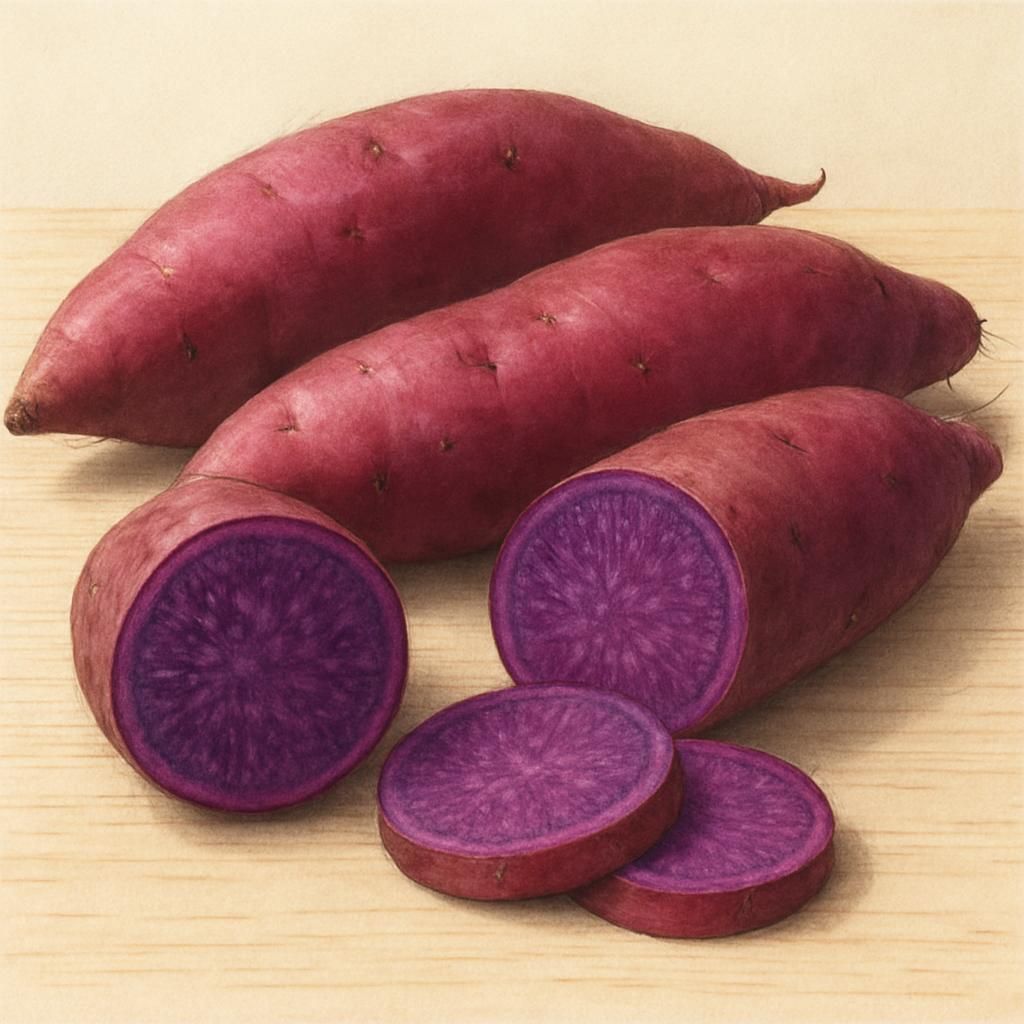
Introduction to Sweet Potato (Korean Purple)
Korean Purple sweet potato (Ipomoea batatas) stands out among root crops for its striking violet flesh caused by high concentrations of anthocyanins. These antioxidants deliver both visual appeal and functional food value, making the variety popular in health-conscious markets and gourmet kitchens. Originating from selective breeding programs in East Asia, Korean Purple combines the adaptability of traditional sweet potatoes with superior color retention after cooking.
Commercial and home growers alike value this cultivar for its moderate vine vigor, reliable storage life, and resistance to some common sweet potato disorders. The crop performs well in both temperate and subtropical climates when provided with well-drained soils and consistent warmth. This guide presents evidence-based practices drawn from university extension research and field trials to help producers achieve consistent, high-quality harvests.
Botanical Profile of Sweet Potato (Korean Purple)
Sweet potatoes belong to the Convolvulaceae family and are botanically distinct from true yams. Korean Purple produces trailing vines that root at nodes and develop storage roots 90–120 days after planting slips. The skin is smooth and reddish-purple, while the flesh maintains intense violet coloration even after baking or steaming.
The plant exhibits moderate drought tolerance once established but benefits from steady moisture during root bulking. Flowers are uncommon in commercial fields but, when present, are pale lavender and rarely set viable seed. Propagation is achieved vegetatively through slips or vine cuttings rather than true seed.
Soil, pH, and Climate Requirements for Sweet Potato (Korean Purple)
Korean Purple sweet potato demands loose, well-aerated soil to allow unrestricted root expansion. Heavy clay soils should be amended with organic matter or grown in raised beds. The crop is sensitive to waterlogging; saturated conditions quickly induce root rot.
| Parameter | Ideal Range | Notes |
|---|---|---|
| Soil Type | Sandy loam to loam | High organic matter improves structure |
| Soil pH | 5.8 – 6.5 | Avoid alkaline soils; lime only if below 5.5 |
| Temperature (Day) | 24 – 30 °C | Optimal photosynthesis and root bulking |
| Temperature (Night) | 18 – 22 °C | Supports carbohydrate translocation |
| Frost Tolerance | None | Plant after last frost; protect slips |
| Growing Season | 100 – 140 frost-free days | Longer seasons increase root size |
| Spacing | 30 cm between plants, 90 cm rows | Allows mechanical cultivation |
Step-by-Step Planting & Propagation
- Source disease-free stock: Purchase certified slips or produce your own by sprouting disease-free tubers in moist sand at 24–27 °C.
- Prepare slips: When sprouts reach 15–20 cm, twist them off the mother root and place bases in water or moist medium until adventitious roots form.
- Harden off: Gradually expose slips to outdoor conditions for 3–5 days before transplanting.
- Field preparation: Create raised beds or ridges 20–25 cm high to improve drainage and soil warming.
- Transplant: Set slips 10–15 cm deep at 30 cm in-row spacing when soil temperature reaches 18 °C at 10 cm depth.
- Water immediately: Apply 10–15 mm of water to settle soil around roots and reduce transplant shock.
Care & Maintenance regimes for Sweet Potato (Korean Purple)
Consistent care throughout the season ensures uniform root sizing and color intensity. Mulching with 5–7 cm of organic material suppresses weeds and moderates soil temperature.
| Activity | Schedule | Rate / Method |
|---|---|---|
| Irrigation | Weeks 1–4: every 3–4 days | 10–15 mm per application; maintain even moisture |
| Irrigation | Weeks 5–12: every 5–7 days | 20–25 mm; avoid waterlogging |
| Irrigation | Weeks 13–harvest: reduce 30 % | Allow top 5 cm to dry between waterings |
| Fertilizer (N-P-K) | Pre-plant: 40-60-80 kg/ha | Incorporate 5–10 cm deep; use composted manure |
| Fertilizer | Side-dress at 4 weeks: 20 kg N/ha | Apply in a band 10 cm from plants |
| Fertilizer | Side-dress at 8 weeks: 15 kg N/ha | Cease nitrogen after week 10 to promote bulking |
| Pruning | Week 6 and 10 | Remove terminal 10 cm of longest vines to redirect energy to roots |
Pests, Diseases & Organic Management
Korean Purple sweet potato faces pressure from several insect and pathogen threats. Aphids and whiteflies can transmit viruses; monitor weekly with yellow sticky traps. Spider mites appear during hot, dry spells—mitigate with overhead irrigation and predatory mites.
Soil-borne root-knot nematodes cause galling and yield loss. Rotate with marigold or sorghum cover crops and solarize beds when possible. Fungal Fusarium wilt and black rot are managed by using certified slips, avoiding wounding during harvest, and maintaining field sanitation.
Organic controls include neem-based sprays for soft-bodied insects, Bacillus thuringiensis for caterpillars, and copper formulations for bacterial leaf spots when incidence exceeds 5 % of foliage.
Harvesting, Curing & Optimal Storage
Harvest when vines begin to yellow and roots reach 5–8 cm diameter, typically 110–130 days after planting. Use a garden fork to loosen soil and lift roots carefully to avoid skinning.
Cure freshly harvested roots at 29–32 °C and 85–90 % relative humidity for 5–7 days. This process heals wounds and converts starches to sugars, intensifying flavor and color. After curing, store at 13–15 °C with 85 % humidity; avoid refrigeration which induces chilling injury and off-flavors.
Companion Planting for Sweet Potato (Korean Purple)
Korean Purple benefits from strategic pairings that enhance soil fertility and deter pests. Marigold roots exude compounds toxic to nematodes, making it an excellent border crop. Clover living mulch fixes nitrogen and suppresses weeds between rows.
Avoid planting near walnut trees whose juglone can inhibit vine growth. Pairing with okra provides vertical structure for vines while the taller crop shades soil and reduces moisture loss. Nasturtium serves as a trap crop for aphids, drawing them away from sweet potato foliage.
Stop Treating Tomato Blight Like a Spray Problem: Here Is What Works Better offers additional insights into integrated disease management that translate well to root-crop systems.