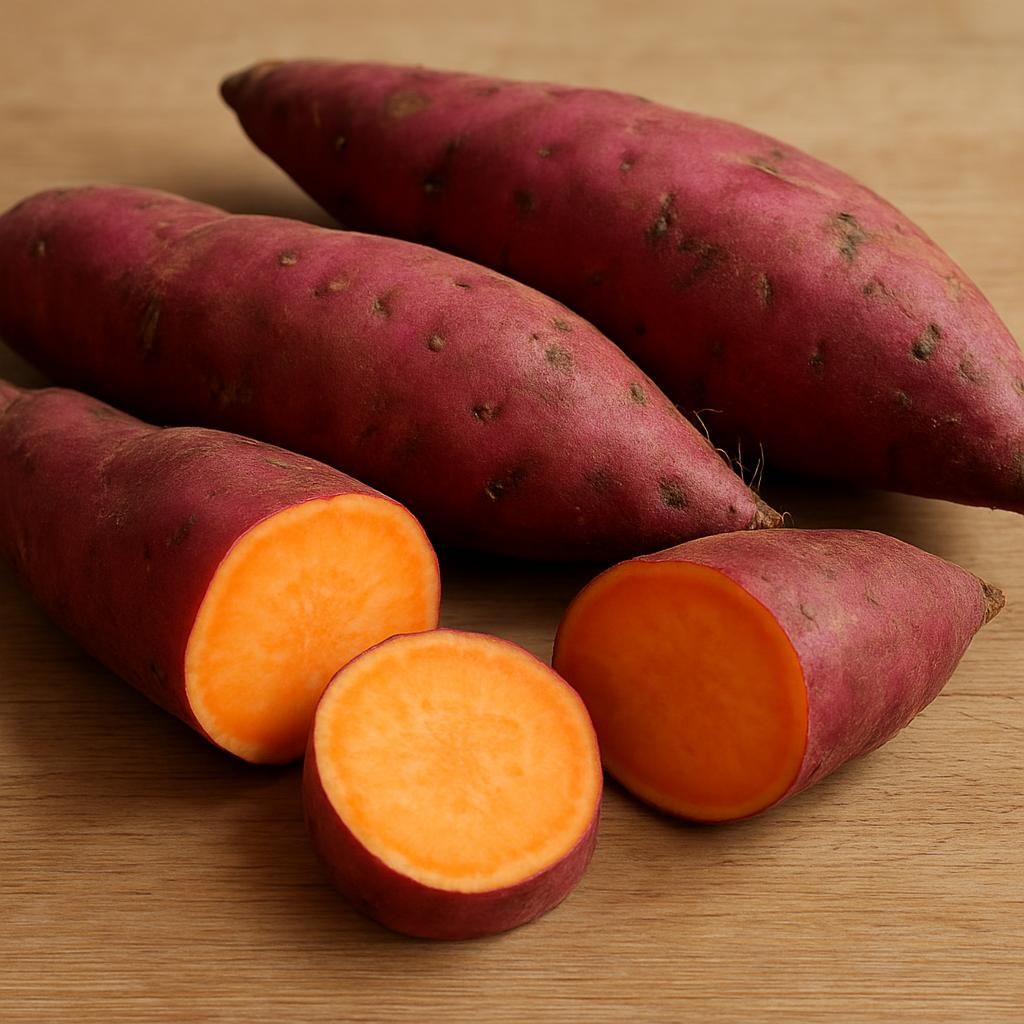
Introduction to Sweet Potato (Garnet)
Garnet sweet potato (Ipomoea batatas) is a warm-season perennial vine grown as an annual for its nutritious, sweet-flavored storage roots. The variety is distinguished by its garnet-red to purple skin and deep orange flesh that remains moist and sweet after cooking. Gardeners and commercial growers value Garnet for its reliable productivity, vibrant color, and high beta-carotene content.
This crop originated in the tropical Americas and has become a staple across subtropical and temperate growing regions worldwide. Sweet Potato cultivation supports food security and soil health when integrated into diverse rotations.
Botanical Profile of Sweet Potato (Garnet)
Garnet sweet potato belongs to the Convolvulaceae family. The plant produces long, trailing vines that root at nodes and form a dense canopy. Leaves are heart-shaped to lobed, typically green with occasional purple pigmentation on stems. Flowers are funnel-shaped and lavender to pale pink but rarely set seed in cultivation.
The edible portion consists of enlarged adventitious roots that develop from the underground stem. Garnet roots feature smooth to slightly rough skin and uniformly orange flesh that sweetens during curing. The variety stores exceptionally well when properly cured and kept cool and dry.
Soil, pH, and Climate Requirements for Sweet Potato (Garnet)
Garnet sweet potatoes demand warm soil temperatures and excellent drainage. They perform best in sandy loam or loamy sand soils that warm quickly in spring.
| Parameter | Ideal Range/Value | Notes |
|---|---|---|
| Soil Type | Sandy loam to loamy sand | High organic matter improves structure |
| Soil pH | 5.8 – 6.5 | Avoid alkaline soils; lime only if below 5.5 |
| Soil Temperature | 70–85 °F (21–29 °C) at planting | Minimum 65 °F (18 °C) for slip establishment |
| Air Temperature | Day 75–95 °F (24–35 °C) | Night lows above 60 °F (15 °C) preferred |
| Frost Tolerance | None | Vines killed by frost; roots damaged below 50 °F |
| Growing Season | 100–140 frost-free days | Longer seasons increase root size |
| Rainfall/Irrigation | 1–1.5 in (25–38 mm) per week | Consistent moisture critical during bulking |
Step-by-Step Planting & Propagation
- Start slips (sprouts) 8–10 weeks before the last frost by placing disease-free Garnet tubers in moist sand or water at 75–80 °F.
- Once slips reach 6–8 inches with several leaves, sever them from the mother root and harden off for 3–5 days.
- Prepare raised beds or ridges 8–12 inches high to ensure drainage and soil warmth.
- Transplant slips 12–18 inches apart in rows 36–48 inches apart when soil temperature reaches 70 °F.
- Water immediately after planting and maintain even moisture for the first two weeks to encourage rapid establishment.
Care & Maintenance regimes for Sweet Potato (Garnet)
Consistent care during the first 60 days determines final root size and quality.
| Task | Schedule | Details |
|---|---|---|
| Watering | Weeks 1–4: 0.5 in every 3 days | Weeks 5–12: 1 in per week; reduce 2 weeks before harvest |
| Fertilizer | At planting: 4-8-12 NPK 500 lb/ac | Side-dress at 30 days with 20 lb N/ac; avoid excess nitrogen |
| Pruning | Once at 6 weeks | Trim vine tips to 12–18 in beyond row to redirect energy to roots |
| Mulching | Immediately after transplant | 2–3 in organic mulch suppresses weeds and conserves moisture |
| Weeding | Every 10–14 days until canopy closes | Hand-pull or shallow cultivation only |
Pests, Diseases & Organic Management
Garnet sweet potatoes face pressure from several pests and soil-borne diseases. Aphids can transmit viruses while feeding on young foliage. Spider mites appear during hot, dry periods and cause stippling on leaves.
Soil pests such as wireworms and root-knot nematodes damage developing roots. Practice 3–4 year rotations with non-host crops and solarize beds when nematode pressure is high.
Diseases include black rot (Ceratocystis fimbriata), Fusarium wilt, and southern blight. Use certified disease-free slips, avoid planting in poorly drained areas, and remove infected plants promptly.
Organic controls include neem oil for aphids and mites, beneficial nematodes for soil insects, and compost tea drenches to suppress fungal pathogens. Reflective mulches and row covers reduce early-season insect pressure.
Harvesting, Curing & Optimal Storage
Garnet roots reach marketable size 100–120 days after planting. Begin harvest when vines start to yellow and before soil temperature drops below 55 °F.
Use a garden fork or mechanical digger to lift roots carefully and avoid skinning. Separate damaged or diseased roots immediately.
Cure freshly harvested roots at 85–90 °F and 85–90 % relative humidity for 5–7 days to heal wounds and convert starches to sugars. After curing, store at 55–60 °F with 85–90 % humidity for up to 6 months.
Companion Planting for Sweet Potato (Garnet)
Garnet sweet potatoes pair well with low-growing herbs and legumes that improve soil fertility and deter pests. Marigold and nasturtium repel nematodes and aphids. Clover planted as a living mulch fixes nitrogen and suppresses weeds.
Avoid planting near potato or tomato because of shared disease susceptibility. Tall crops such as corn can provide light afternoon shade in extremely hot climates without competing heavily for nutrients.