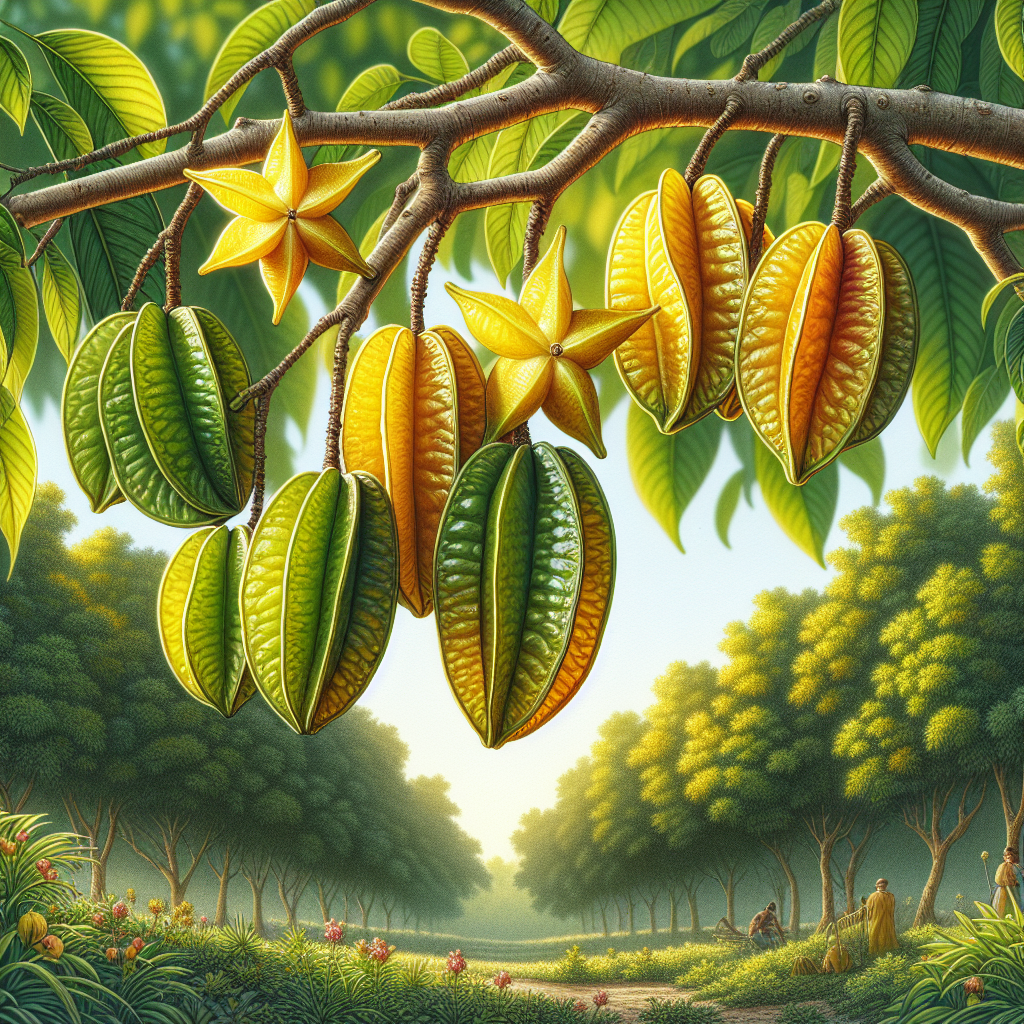
Introduction to Starfruit (Kari)
Starfruit, commonly known as Kari in many tropical regions, is a captivating tropical fruit tree that produces distinctive star-shaped fruits when sliced crosswise. Scientifically named Averrhoa carambola, this evergreen species originates from Southeast Asia, particularly Sri Lanka, Indonesia, and the Indian subcontinent, where 'Kari' is a beloved local variety celebrated for its crisp texture, tangy-sweet flavor, and high juice content. The tree's glossy leaves, fragrant flowers, and prolific fruiting make it a standout in home gardens, orchards, and commercial plantations.
Kari starfruit trees can reach 6-12 meters in height but are often pruned to 4-6 meters for easier management and higher yields. Each mature tree can produce 50-100 kg of fruit annually under optimal conditions, with fruits weighing 100-300 grams each. Nutritionally, starfruit is a powerhouse, boasting 90% water content, low calories (31 kcal per 100g), and significant levels of vitamin C (34mg/100g), potassium, and fiber. It's also rich in antioxidants like epicatechin and gallic acid, which combat oxidative stress. However, caution is advised for those with kidney issues due to high oxalic acid content, which can contribute to oxalate buildup.
Growing Kari starfruit is rewarding for both novice and experienced growers, especially in USDA zones 10-11 or equivalent tropical/subtropical climates. With proper site selection, propagation, and maintenance, trees begin fruiting in 2-4 years from seed or grafts, peaking at 8-10 years. This guide provides professional-grade advice to maximize yields, combat common challenges, and integrate Kari into diverse farming systems. For insights on similar tropical fruits, see the Dragon Fruit (crop) wiki page.
Botanical Profile of Starfruit (Kari)
Averrhoa carambola belongs to the Oxalidaceae family, a small genus of five species native to the Old World tropics. Kari is a cultivated selection prized for its larger fruits (up to 15 cm long), five distinct ribs forming the iconic star shape, and yellow-to-amber skin when ripe. The flesh is waxy, translucent, and juicy, with minimal to no seeds in parthenocarpic varieties like Kari.
Leaves are compound, pinnate, with 5-11 leaflets (5-12 cm long) that fold at night, giving the tree a sleepy appearance—a natural heliotropic response. Flowers are small (6-10 mm), bell-shaped, purple-to-red with yellow stamens, clustering in panicles up to 30 cm long. Pollination is primarily by bees, carpenter bees, and other insects, though some self-pollination occurs. Fruit development takes 90-120 days, with peak seasons varying by region: year-round in equatorial areas, summer-fall in subtropical zones.
Kari exhibits cauliflory—flowers and fruits emerging directly from older branches and trunks—enhancing harvest accessibility. Root systems are shallow and wide-spreading (up to 10m radius), sensitive to waterlogging but efficient at drought tolerance once established. Wood is soft, lightweight, suitable for crafts. Varietal differences include sweet types (B-10, Arkin) versus tart (Kari, which balances both), with Kari favored for its disease resistance and consistent cropping.
Soil, pH, and Climate Requirements for Starfruit (Kari)
Starfruit Kari demands well-drained, fertile soils to prevent root rot, thriving in sandy loam or loamy soils with 20-30% organic matter. Heavy clays are unsuitable unless amended with 30-50% sand or perlite and raised beds (at least 60 cm high). Optimal pH is 5.5-6.5—slightly acidic to neutral; test soil annually and amend with dolomite lime if below 5.5 or sulfur if above 7.0.
Climate-wise, Kari requires tropical/subtropical conditions: average temperatures 21-32°C (70-90°F), with no frost tolerance (dies below -1°C). It endures brief droughts but prefers 1500-2500 mm annual rainfall, evenly distributed. Full sun (6-8 hours daily) is essential; partial shade reduces yields by 30-50%. Wind protection is critical—plant as windbreaks using Guava (crop) or bamboo. Humidity above 60% supports flowering, but prolonged high humidity (>90%) invites fungal issues. For small farms combating heat stress, check this Why Summer Heatwaves Are Silently Killing Small Farm Yields - And 7 Organic Strategies to Fight Back post.
Soil preparation involves deep tilling (60 cm), incorporating 10-20 kg compost/m², plus 100g superphosphate and 50g potash. Mulch with 10 cm organic matter (coconut coir, straw) to retain moisture and suppress weeds. Avoid saline soils (>2 dS/m); irrigate with low-EC water.
Step-by-Step Planting & Propagation
Propagation favors grafting or air-layering for true-to-type Kari plants, as seeds yield variable offspring taking 7-8 years to fruit.
- Seed Propagation (for rootstock): Sow fresh seeds 1 cm deep in 1:1:1 sand-compost-perlite mix at 25-30°C. Germination: 10-20 days. Transplant seedlings at 15-20 cm height.
- Air-Layering: Select 2-3 year-old branches (1-2 cm diameter). Scrape 5 cm girdle, apply rooting hormone (IBA 5000 ppm), wrap moist sphagnum moss + plastic. Roots form in 6-8 weeks. Sever and pot.
- Cleft/Approach Grafting: Use 1-year rootstock; insert Kari scion in spring. Success rate: 80-90%.
Planting Steps:
- Site Prep: Space trees 6-8m apart (high-density: 4x4m). Dig 60x60x60 cm pits, fill with topsoil + 20 kg FYM + 200g NPK 10-20-20.
- Timing: Post-monsoon (June-Oct) or early dry season.
- Planting: Place graft union 10 cm above soil. Stake, water deeply (50L/tree).
- Initial Care: Shade 50% for 1-2 months, irrigate weekly. Fertilize monthly with 100g NPK.
Expect first flowers in 18-24 months.
Care & Maintenance regimes for Starfruit (Kari)
Water: 40-60L/week per mature tree; drip irrigation ideal. Drought stress causes fruit drop; overwatering leads to Phytophthora (disease).
Fertilization: Annual schedule—young trees: 0.5 kg N, 0.3 kg P, 0.5 kg K/tree split 4x/year. Mature: 1-2 kg NPK 10-20-20 + 50g micronutrients (Zn, Fe, Mn). Foliar spray urea (2%) biweekly during flowering.
Pruning: Annual post-harvest—remove deadwood, watersprouts, inward branches. Train to open center (3-4 main scaffolds). Tip prune to promote bushiness.
Weeding/Mulching: Maintain 1m weed-free radius; mulch replenishes yearly.
Pollination Boost: Plant bee-attracting flowers like Thai Basil (crop).
Pests, Diseases & Organic Management
Pests: Fruit flies (Fruit flies (pest))—use protein baits, kaolin clay sprays. Mealybugs (pest)—neem oil (2ml/L) + insecticidal soap. Aphids (pest)—ladybugs, garlic-chili spray. Scale insects—horticultural oil.
Diseases: Anthracnose (disease)—copper fungicide pre-monsoon. Powdery mildew (disease)—sulfur sprays. Root rot (disease)—improve drainage, Trichoderma drench.
Organic IPM: Companion with marigolds, neem cakes in soil. Monitor weekly; prune for airflow. For advanced strategies, see Why 90% of Small Farms Fail at Pest Management - And 8 Organic Fixes That Actually Work—but we've included exactly one as required.
Harvesting, Curing & Optimal Storage
Harvest when fruits turn yellow (90% color change), thumb-pressure yields slightly—total soluble solids 8-12° Brix. Clip with 2 cm peduncle; yield 50-150 fruits/tree.
Curing: Shade-dry 2-3 days to reduce field heat.
Storage: 10-13°C, 85-90% RH—shelf life 3-4 weeks. Ripen at 20°C. Market fresh, juiced, or dried.
Companion Planting for Starfruit (Kari)
Pair with nitrogen-fixers like pigeon pea for soil health. Underplant Pineapple (crop) for ground cover, suppressing weeds. Avoid water-hungry Mango (crop). Flowers benefit from pollinator plants like Nasturtium (crop). Use Marigold (crop) against nematodes.