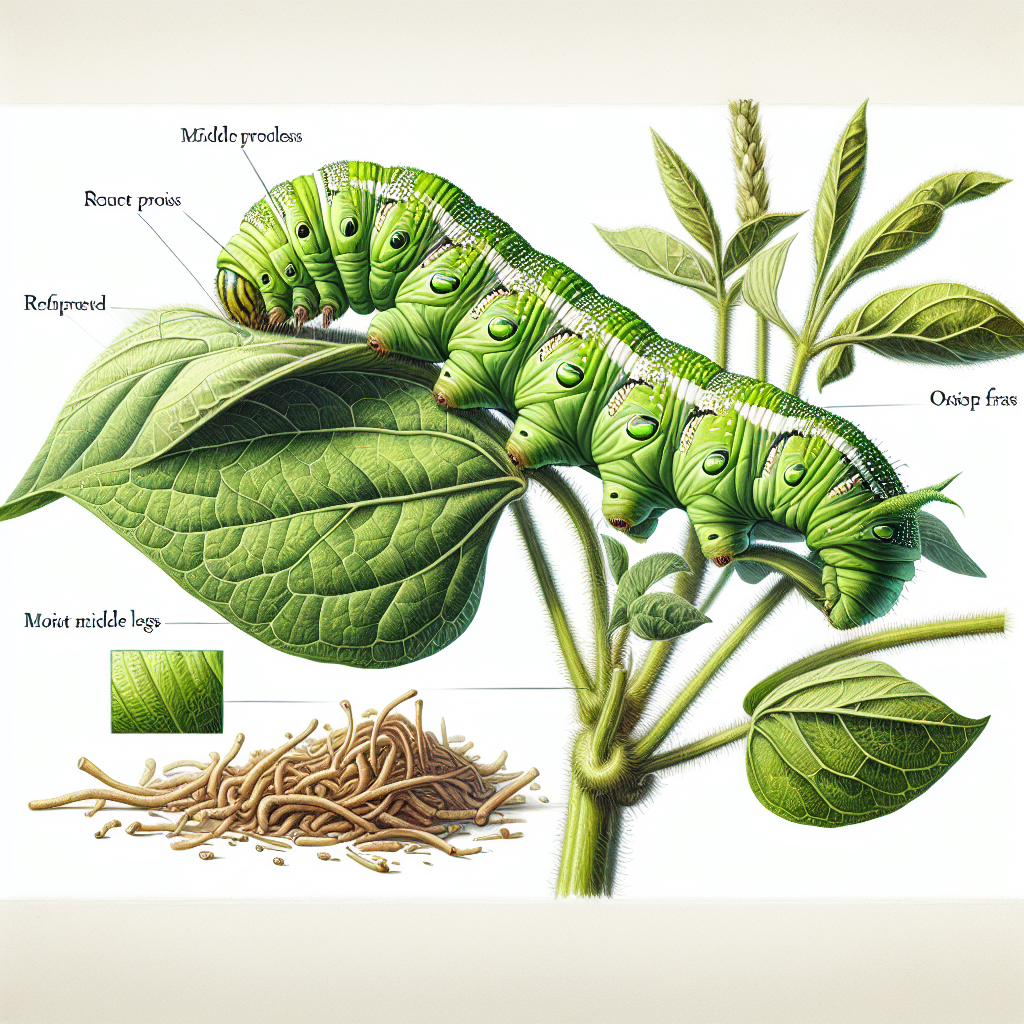
Introduction to semiloopers
Semiloopers, also known as semi-loopers or surface loopers, represent a group of highly destructive caterpillar pests belonging primarily to the Noctuidae family. Key species include Eublemma lysimanthes (soybean semilooper), Anomis flava, and Plusia spp., which are prevalent in tropical and subtropical agricultural regions such as Asia, Africa, and parts of South America. These pests earn their name from the distinctive 'semi-looping' movement of their larvae, where they arch their bodies forward using only the front and hind prolegs while dragging the middle segments, creating a characteristic loop-like gait.
Farmers often first notice semiloopers during warm, humid growing seasons when populations explode, leading to rapid defoliation of crops. Unlike full loopers like cabbage loopers that lack middle prolegs entirely, semiloopers retain vestigial middle prolegs, making their movement slightly different but equally damaging. They target a wide range of host plants, with soybeans (Soybeans) being the most severely affected, but they also infest tomato, cabbage, okra, and pulses. Yield losses can reach 50-100% in untreated fields, making early detection and integrated management critical. This guide provides professional-grade diagnostics, lifecycle insights, organic treatments, and prevention strategies optimized for small to medium-scale farms. For more on spring pest management, check this Spring Pest Patrol blog.
Semiloopers thrive in high-nitrogen environments and warm temperatures (25-35°C), often migrating via adults on wind currents. Understanding their biology is key to disrupting their cycles and protecting yields. Check fields weekly during peak seasons, focusing on understory leaves where eggs are laid.
Identifying Symptoms & Damage
Accurate identification of semilooper damage is essential for timely intervention. Early symptoms include small, irregular holes in tender leaves, often starting from the undersides. As larvae grow, they skeletonize foliage, leaving only veins intact, which gives leaves a lacy appearance. Unlike cutworms that sever stems at soil level or armyworms that march in groups, semilooper feeding is more dispersed but voracious.
Look for:
- Larval presence: Green to brown caterpillars, 1-3 cm long, with smooth bodies and reduced middle prolegs. They loop when disturbed.
- Frass (droppings): Black, pellet-like excrement under plants.
- Leaf damage: Defoliation progressing from lower to upper canopy; pods or fruits with chew marks.
- Silk webbing: Light webs on leaves where larvae rest during the day.
On soybeans, damage manifests as complete stripping of trifoliate leaves, reducing photosynthesis by up to 80%. In tomato and eggplant, fruits show deep gouges, inviting secondary infections like Alternaria. Severe infestations cause stunted growth, pod abortion, and up to 70% yield loss. Differentiate from caterpillars by the semi-looping motion and preference for legumes.
Scout by beating plants over a white sheet; 2-3 larvae per 10 plants signals action. Use a hand lens to confirm vestigial prolegs. Economic threshold: 10-15% defoliation in vegetative stage, 5% in reproductive stage.
Lifecycle and Progression of semiloopers
Semiloopers complete 4-6 generations per year in tropical climates, with lifecycle spanning 25-40 days. Understanding progression allows targeted timing of controls.
- Egg stage (2-4 days): Tiny, spherical eggs laid in clusters (50-200) on leaf undersides, pale yellow turning dark.
- Larval stage (10-15 days): Six instars; early instars mine leaves, later ones feed externally. Peak damage in 3rd-5th instar.
- Pupal stage (5-7 days): Pupae form in soil or leaf litter, reddish-brown, 1-2 cm.
- Adult moth (7-10 days): Gray-brown moths with wingspan 3-4 cm, nocturnal, females lay 300-600 eggs.
Overwinter as pupae in soil. First generation peaks post-monsoon; monitor with pheromone traps. Adults migrate long distances, complicating local control. Lifecycle accelerates in heat (>30°C), slowing below 20°C.
Environmental Triggers & Risk Factors
Semiloopers explode under specific conditions:
- Temperature: Optimal 28-32°C; populations surge above 25°C.
- Humidity: 70-90% RH favors egg hatch and larval survival.
- Rainfall: Heavy rains post-drought trigger outbreaks by boosting host nutrition.
- Crop factors: Excessive nitrogen fertilizers promote lush foliage; dense planting hinders predators.
- Weeds: Alternate hosts like pigweed harbor populations.
Risk highest in monsoon belts (India, Southeast Asia). Monocultures of soybeans or cabbage amplify issues. Poor drainage and no-till fields retain pupae. Companion with marigold reduces risk by repelling moths.
Organic Control & Treatment Plans
Prioritize IPM with organic methods for sustainable control:
Cultural Controls:
- Handpick larvae early morning/evening.
- Destroy crop residues to expose pupae.
- Intercrop with trap crops like sunflower.
Biological Controls:
- Release Trichogramma wasps (egg parasitoids) at 1,00,000/ha.
- Encourage birds, spiders; plant nasturtium as attractant.
- Spray NPV (nuclear polyhedrosis virus) at 250 LE/ha.
Organic Sprays:
- BT (Bacillus thuringiensis): Kurstaki strain, 1-2 g/L, evenings, 3 sprays at 7-day intervals. Targets larvae <2nd instar.
- Neem oil: 3-5 ml/L + soap, weekly; disrupts molting.
- Spinosad: 0.5 ml/L, 2-3 apps; low mammalian toxicity.
- Chrysopa carnea larvae: 10,000/ha.
Treatment Plan:
- Week 1: Scout, BT + neem.
- Week 2: NPV if >20% infestation.
- Monitor 7 days post-spray. Avoid broad-spectrum; rotate modes of action. Efficacy: 80-95% with timely use.
Preventing semiloopers in the Future
Long-term prevention focuses on cultural and habitat management:
- Crop rotation: 2-3 years away from hosts; follow soybeans with wheat.
- Resistant varieties: Use soybean cvs. like JS-335.
- Timing: Sow early to miss peak moth flights.
- Sanitation: Deep plow post-harvest; solarize soil.
- Trap crops: 10% sunflower borders.
- Mulching: Straw suppresses pupation.
- Monitoring: Pheromone traps (10/ha), yellow sticky traps.
Integrated approach reduces populations 70% year-over-year. For soil health tips, see Soil Health Mastery.
Crops Most Affected by semiloopers
Semiloopers devastate legumes and vegetables:
- Soybeans: Primary host; 30-100% loss.
- Tomato and eggplant: Foliage and fruit damage.
- Cabbage and okra: Defoliation.
- Others: Mung bean, red gram, cotton, groundnut.
Global impact: Millions in losses annually. Protect high-value crops first.