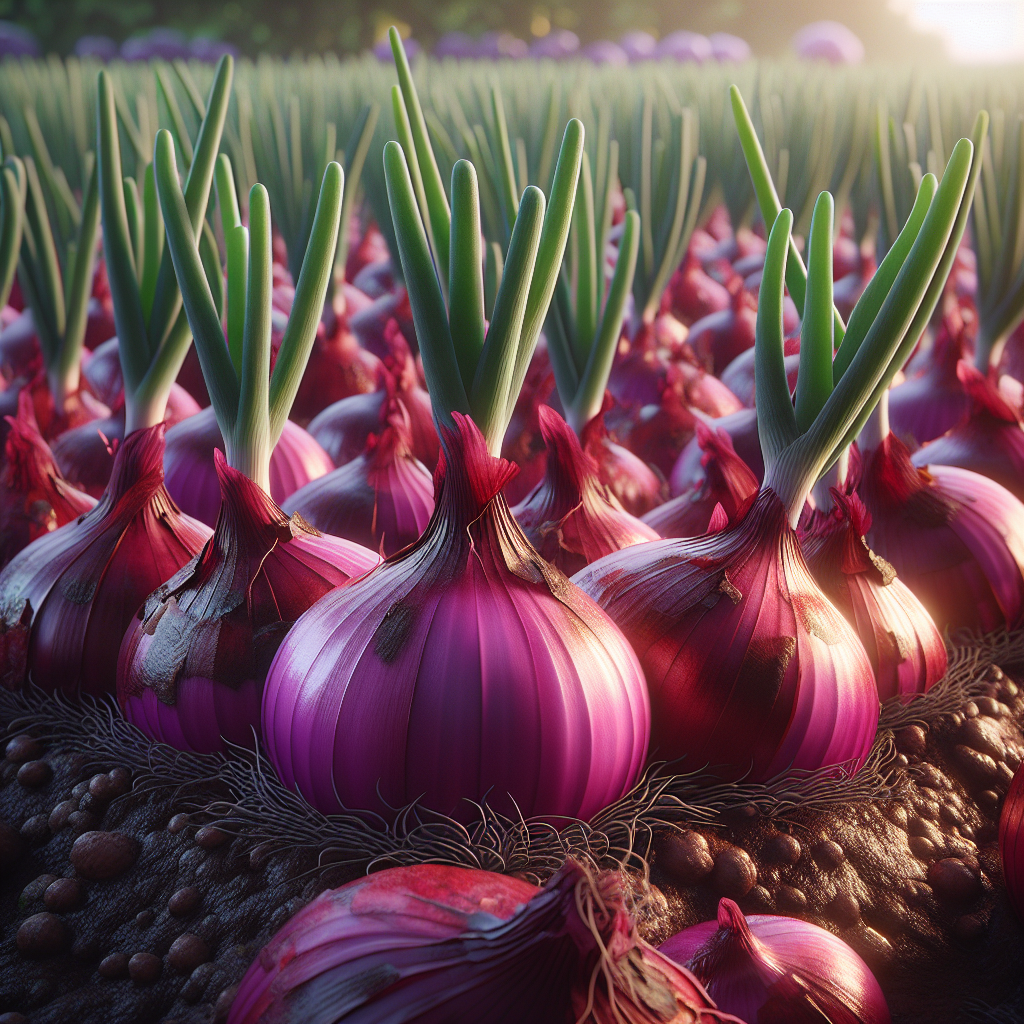
Introduction to Red Onion (Red Baron)
A classic red bulb onion for kitchen gardens, allotments, and small-scale market production, Red Baron is widely recognized for its glossy crimson-purple outer skin and striking internal rings. It is generally classed as a maincrop red onion, producing medium to large, round bulbs with a moderately pungent yet sweetening flavor after curing. Compared with many red onions, it combines visual appeal with good keeping quality, which is one reason it remains a favorite for both fresh use and storage.
This cultivar performs best where the growing season is cool to mild during vegetative development, followed by a relatively dry and bright ripening period. Like other bulbing onions, it is strongly influenced by daylength, and bulb initiation occurs as daylight hours increase. Growers who understand that onions first build leaves and then transform that leaf area into bulb size will manage Red Baron better: every healthy leaf roughly corresponds to one bulb ring, so early stress directly reduces final bulb potential. For broader background on bulb onions, see the general Onion guide.
Red Baron is especially useful where growers want a dual-purpose crop: it can be harvested young as a fresh red onion, or left to mature fully for long storage. Its color makes it highly marketable, and when grown well, bulbs cure to a uniform, neat finish. Historically, red onions have been selected in Europe and Asia for salads, pickling, and fresh slicing; Red Baron reflects that breeding direction by pairing color intensity with reasonably strong field performance.
Botanical Profile of Red Onion (Red Baron)
This crop belongs to the Amaryllidaceae family, genus Allium, and species Allium cepa. It is a biennial by life cycle but is cultivated as an annual for bulb production. In its first season, it produces hollow, waxy leaves emerging from a compressed basal plate; in its second season, if replanted and vernalized, it sends up a flower stalk and sets seed. For commercial bulb production, bolting is undesirable because energy shifts from bulb development to flowering.
Red Baron forms a true bulb made from swollen leaf bases rather than a root tuber. The root system is shallow and relatively sparse, with most active roots concentrated in the top 15-25 cm of soil. That shallow rooting explains why onions are sensitive to drought, surface crusting, nutrient competition, and waterlogging. Leaves are upright to arching, blue-green with a waxy bloom, and somewhat more delicate than many brassica or solanaceous crops.
Cultivar traits typically include:
- Deep red to purple skin with red-flushed internal rings.
- Globe to slightly flattened globe shape.
- Good uniformity when grown from seed or quality sets.
- Better storage than many sweet red onions, though usually not as long as the best storage yellow onions.
- Strong fresh flavor when immature, mellowing somewhat after curing.
Red coloration comes largely from anthocyanin pigments in the outer and inner scales. Color develops best under steady growth, adequate potassium, and full light. Excess nitrogen late in the season can produce lush tops but softer bulbs with poorer skin finish and weaker storage ability.
Soil, pH, and Climate Requirements for Red Onion (Red Baron)
Red Baron thrives in fertile, open, free-draining soil with fine tilth and good moisture retention. Ideal soil textures are sandy loam to silty loam. Heavy clay can produce misshapen bulbs, slow early growth, and raise the risk of Basal rot and Neck rot, especially in wet springs. Very light sand can work if irrigation and fertility are tightly managed, but bulb size will suffer if moisture fluctuates.
The preferred pH range is 6.2-6.8, with acceptable growth from roughly 6.0-7.0. Below pH 6.0, nutrient availability and root efficiency decline, and onions can become more vulnerable to stress. Acid soils also increase the chance of micronutrient imbalance. Where pH is below target, apply agricultural lime well before planting so it has time to react. Avoid over-liming above neutral unless a soil test clearly recommends it.
Because onions are salt-sensitive in early stages, avoid fresh manure or heavy applications of high-salt fertilizers before sowing. Well-rotted compost applied in the previous season is preferable to rich undecomposed organic matter immediately before planting. Soil should be stone-free, because hard obstructions distort bulbs and interfere with even swelling.
Climatically, Red Baron is best suited to temperate conditions with cool early growth and moderate summer warmth. Optimal vegetative growth occurs around 13-24°C. Seedlings tolerate light frosts once established, but repeated severe freezing can damage tissues or predispose plants to bolting. Bulbing and ripening are best when days are long, light is abundant, and rainfall declines. Prolonged temperatures above 30°C combined with drought can check leaf growth and prematurely force small bulbs.
Good airflow is essential. Damp, stagnant canopies encourage Downy mildew and neck infections. At the same time, exposed sites with strong drying winds can desiccate shallow-rooted plants unless irrigation is carefully managed.
A consistent moisture profile matters more than sheer water volume. The root zone should remain evenly moist but never saturated. A useful target is soil that feels cool and slightly damp 5-8 cm below the surface, not sticky or anaerobic. If squeezed soil forms a greasy, airless mass, it is too wet. If it is dusty or fails to hold shape at all in a loam bed, it is too dry. Overwatering signs include yellowing lower leaves unrelated to maturity, persistent surface algae, sour-smelling soil, soft necks, and slow bulb expansion despite lush top growth.
Step-by-Step Planting & Propagation
Red Baron can be grown from seed, transplants, or sets. Seed gives the best varietal fidelity and usually the best storage quality; sets offer convenience and earlier establishment but can increase bolting risk if poorly handled.
Choose the propagation method.
- From seed indoors: Best for long-season production and uniform bulbs.
- Direct sowing: Suitable in mild regions with a long season and well-prepared seedbeds.
- From sets: Fastest and simplest for home growers, though bulb size uniformity may be lower.
Prepare the bed thoroughly. Cultivate to a fine, firm tilth. Onions dislike fluffy ground because settling later can expose roots and distort bulbs. Work in mature compost sparingly if soil is low in organic matter, and base fertilizer rates on a soil test. Raised beds are especially helpful in regions with wet springs.
Start seed at the right time. Sow indoors 8-10 weeks before the last expected frost. Use modules or trays, sowing shallowly at about 0.5-1 cm depth. Maintain 15-18°C for germination. Once emerged, brighter light and cooler conditions, around 10-16°C, prevent weak, threadlike seedlings.
Harden off transplants. About 7-10 days before planting out, gradually expose seedlings to wind and outdoor temperature fluctuations. Avoid a sudden move from warm indoor conditions to cold open ground.
Plant spacing. For full-sized storage bulbs, space plants 10-12 cm apart in rows 25-30 cm apart. For smaller, more uniform bulbs, use 7-10 cm spacing. Crowding produces many undersized onions; overly wide spacing can produce oversized bulbs that sometimes store less evenly.
Plant depth correctly. Seedlings and sets should be planted shallowly. The tip of a set should sit just at or slightly above the soil surface. If buried too deeply, bulb swelling is restricted and necks stay thick. Transplants should be set with roots covered and the basal plate firmly in contact with soil, but not with several centimeters of stem buried.
Water in gently. After planting, irrigate enough to settle soil around roots without creating puddles. The aim is root-to-soil contact, not saturation.
Mulch carefully if needed. A very light mulch of clean straw or fine compost can reduce crusting and moisture swings, but keep the bulb shoulder exposed as swelling begins. Thick wet mulches around the neck increase disease risk.
If you want broader seasonal planning ideas for mixed vegetable beds, see fall companion planting tips.
Care & Maintenance regimes for Red Onion (Red Baron)
Early growth management determines final yield. Red Baron must build a strong canopy before bulbing starts, so the first half of the season is about uninterrupted leaf production.
Watering: Provide roughly 25 mm of water per week in cool conditions and up to 35 mm in warmer, drying weather, adjusted for soil type and rainfall. On sandy soils, smaller and more frequent irrigations are better than occasional heavy soakings. During active bulb swell, moisture stress causes bulbs to stop and start, producing split skins, strong pungency, and reduced size. Conversely, chronically wet soil deprives roots of oxygen and encourages rot. A practical check: if leaves look slightly dull or lose their normal turgid upright posture by midday and recover only slowly, the bed is probably getting too dry. If foliage becomes pale, growth stalls, and the neck remains watery, conditions may be too wet.
Feeding: Onions are moderate feeders but inefficient scavengers because of their shallow roots. They need accessible nutrients close to the root zone. Nitrogen is most useful early, supporting leaf number and area. Apply modest nitrogen early and, if needed, once again during strong vegetative growth. Reduce or stop nitrogen as bulbs begin to form; late nitrogen delays maturity and weakens skins. Potassium supports bulb firmness, color expression, and storage quality. Phosphorus helps root establishment, especially in cool soils. Sulfur contributes to characteristic onion flavor compounds.
Weed control: This is non-negotiable. Onions compete very poorly because they cast little shade and root shallowly. Even light weed pressure early in the season can reduce bulb size significantly. Keep beds clean by stale seedbedding, hand hoeing, or shallow mechanical cultivation. Never cultivate deeply near plants, as root pruning can set them back.
Mulching and soil surface management: Prevent crust formation after rain or irrigation. A hard surface limits oxygen diffusion and root extension. Shallow hoeing on a dry day can break crusts, but take care not to mound soil against bulbs.
Bolting prevention: Bolting is triggered by a combination of plant size and exposure to cold. Large sets are more likely to bolt than small, firm ones. Avoid planting too early into cold soils if using sets. Any bolted plant should be used fresh rather than stored, because flowering onions soften and deteriorate quickly.
Top management: Do not bend tops over to force ripening. This traditional practice can damage neck tissue and invite pathogens. Allow maturity to occur naturally as bulbs finish swelling.
Pests, Diseases & Organic Management
The main pest and disease issues in Red Baron are similar to other bulb onions, but red-skinned varieties grown for presentation quality require extra vigilance because cosmetic damage lowers market value.
Onion fly: Larvae tunnel into the base of seedlings and young bulbs, causing sudden collapse, yellowing, and a foul-smelling rot. Exclusion netting immediately after sowing or transplanting is one of the most effective organic defenses. Rotate crops and remove cull onions promptly.
Thrips: These tiny insects rasp leaf surfaces, leaving silvery streaking, patchy whitening, and reduced photosynthesis. Damage is worst in hot, dry weather. Strong plants under steady irrigation tolerate Thrips better. Organic management includes reflective mulches in some systems, encouraging predators, and targeted insecticidal soap or approved botanicals where permitted.
Downy mildew: Favored by cool, humid conditions and prolonged leaf wetness, it causes pale patches, leaf collapse, and gray-violet fungal growth. Space plants adequately, water early in the day, avoid overfertilizing with nitrogen, and rotate away from alliums for at least 3 years where disease is persistent.
Neck rot and Storage rots: Often linked to overly lush late growth, thick necks, delayed curing, bruising, or wet harvest conditions. This is why late nitrogen and irrigation must be reduced as maturity approaches. Harvest only when bulbs are mature and skins are beginning to set.
Basal rot and White rot: These are serious soilborne diseases. White rot is especially destructive and long-lived in soil. Infected plants yellow, wilt, and pull easily, often with white fungal growth and black resting bodies near the base. If present, avoid planting onions or related alliums in that ground for many years.
Organic prevention strategy:
- Rotate with non-allium crops for 3-4 years.
- Use certified clean seed or healthy sets.
- Maintain strict weed control, since weeds reduce airflow and compete for nutrients.
- Avoid waterlogging and unnecessary overhead irrigation.
- Remove infected plants and never compost badly diseased bulbs unless your composting system reliably reaches sanitizing temperatures.
- Sanitize tools and crates used during harvest and curing.
Harvesting, Curing & Optimal Storage
Red Baron can be harvested at several stages. For bunching or fresh kitchen use, lift young bulbs once they reach usable size. For full storage onions, wait until bulbs are mature and most tops have naturally yellowed and fallen over, typically when 50-80% of the stand has lodged.
Do not leave mature bulbs too long in wet soil, because skins loosen and rot risk increases. Lift in dry weather if possible, using a fork carefully to avoid puncturing bulbs. Handle gently; bruises that seem minor at harvest often become storage losses later.
Curing is essential. Lay bulbs in a single layer in a dry, airy, shaded place, or on mesh racks with strong ventilation. Ideal curing conditions are around 24-30°C with low to moderate humidity and excellent airflow for 10-21 days, depending on neck thickness and weather. The goal is fully dry outer skins and a tight, dry neck that does not feel fleshy when pinched.
Trim roots once dry. Tops can be cut to 2.5-5 cm above the bulb, or left longer for braiding if fully cured. Do not trim too close to the neck.
For storage, select only sound, firm bulbs with intact skins. Use any thick-necked, split, bolted, insect-damaged, or bruised onions first. Store at 0-4°C with relative humidity around 65-75%, or in a cool, very dry room with strong air movement if refrigeration is unavailable. The key is consistency: warm humid rooms trigger sprouting and mold, while condensation from fluctuating temperatures quickly ruins bulbs. Never store onions in sealed plastic bags.
Properly cured Red Baron usually stores for several months, though exact longevity depends on season, curing quality, and nutrition. Expect shorter storage than the very best dedicated storage onions, but significantly better keeping than many sweet salad onions.
Companion Planting for Red Onion (Red Baron)
Red Baron fits well into diversified vegetable systems because its upright growth occupies little lateral space and its sulfur-rich aroma may help confuse some pests around neighboring crops. Good companions are those that do not heavily shade onions and that benefit from the allium presence.
Carrot is one of the classic pairings. Onions may help disrupt carrot fly host-finding, while carrots make efficient use of deeper soil layers than the onion root zone. Keep rows distinct enough for weeding and harvest.
Lettuce is another excellent companion because it matures quickly, shades the soil lightly without overwhelming onions, and makes efficient use of bed space early in the season. Its shallow but fibrous rooting is generally compatible if spacing is sensible.
Beet also pairs well in mixed beds, especially where intensive planting is practiced. Beets are somewhat deeper rooted and can share fertility plans without excessive canopy competition.
Strawberry is sometimes interplanted in garden systems, where the onion scent may help mask strawberries from certain pests, though layout must allow enough sun and easy harvest access.
Avoid pairing Red Baron too closely with very vigorous, sprawling crops or heavy feeders that rapidly dominate the bed. Large brassicas, dense potato foliage, or aggressive vining cucurbits can shade onions and reduce bulb size. Keep companion schemes practical: onions still require unobstructed weeding, airflow, and harvest access more than they need dense interplanting.