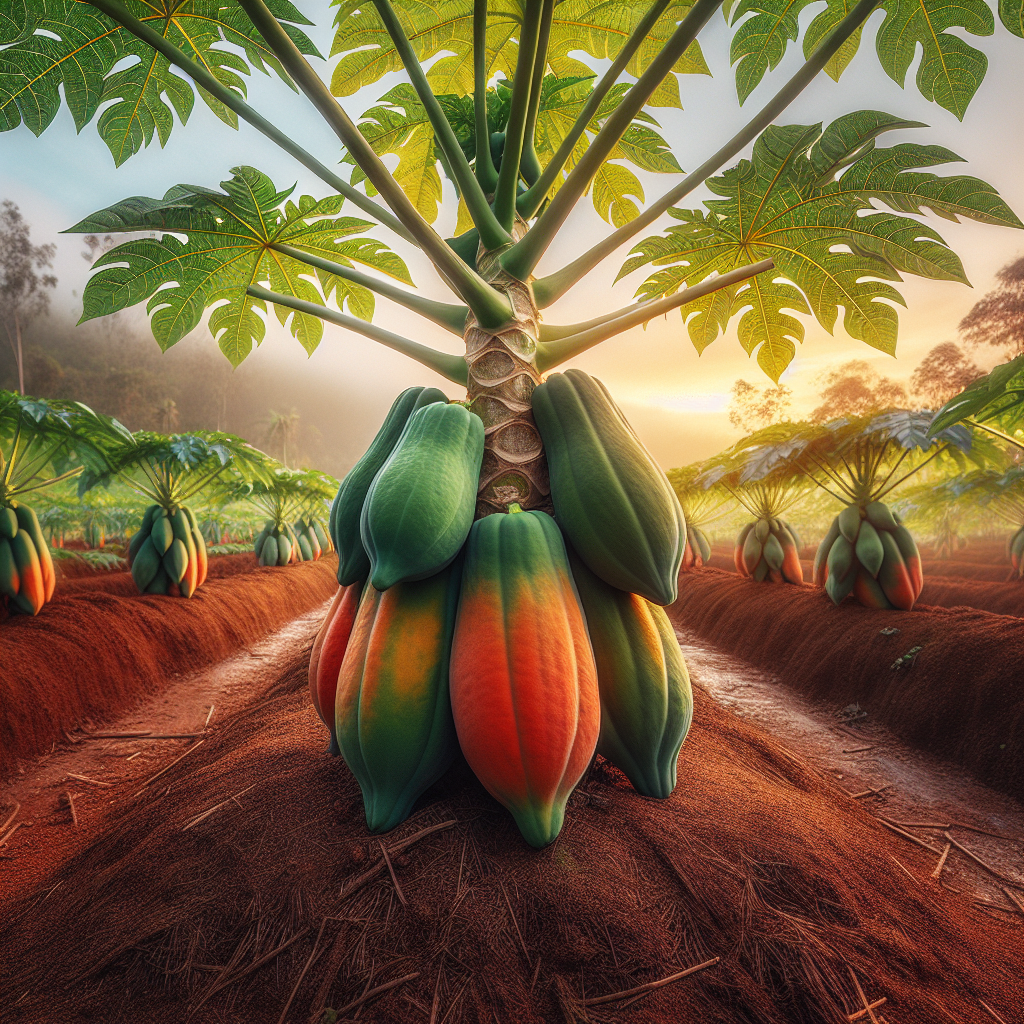
Introduction to Red Maradol Papaya
Originally associated with commercial papaya production in Mexico and widely grown across tropical and subtropical regions, this cultivar became popular because it combines impressive fruit size with attractive red-orange flesh and strong shipping quality. Fruits are typically much larger than the smaller Solo types, often elongated to pear-shaped, with green skin that turns yellow as it matures. The flesh is usually deep salmon to reddish orange, mildly musky, and sweeter when harvested at the correct maturity stage.
From a grower’s perspective, this is not a long-lived orchard tree in the way mango or citrus are. Papaya is a fast-growing, short-lived, giant herb with a hollow trunk and shallow, highly oxygen-demanding root system. That distinction matters because production success depends less on long-term structural pruning and more on getting the first 18 to 30 months right: rapid establishment, uninterrupted growth, balanced nutrition, and strict root-zone management. If growth stalls from cold, drought, waterlogging, or nutrient imbalance, the plant often never fully recovers its productive potential.
Red Maradol is favored in fresh markets because consumers recognize its large fruit and rich interior color. Compared with generic papaya types, it often needs more space and more thoughtful support from fertility and irrigation due to its vigorous canopy and heavier fruit load. For a broader species-level overview, see Papaya. As a production model, think of it as closer to a short-cycle tropical fruit crop than a permanent tree fruit planting.
Botanical Profile of Red Maradol Papaya
This cultivar belongs to the Caricaceae family. Like other papayas, it produces a single, soft-wooded, unbranched stem under normal conditions, topped by a crown of large, deeply lobed leaves held on long petioles. Under stress or after stem injury, branching can occur, but commercial growers usually prefer a clean single-stem plant because fruiting is more predictable and harvest is easier.
Plants can reach 2.5 to 4 meters in productive plantings, sometimes taller under humid tropical conditions with high nitrogen. The trunk is not true woody tissue; it is succulent and prone to mechanical injury, sunburn, and fungal invasion if damaged. Leaves are large and photosynthetically powerful, but also highly responsive to stress. Rapid yellowing of older leaves can indicate nitrogen shortage, magnesium shortage, root damage, or simple natural aging depending on pattern and plant stage.
A critical botanical nuance is sex expression. Papaya plants may be male, female, or hermaphrodite, and the sex ratio from seed is variable. Commercial Red Maradol plantings often prefer hermaphrodite plants because they produce elongated marketable fruit and can self-pollinate more reliably. Female plants can produce rounder fruit and require pollen from nearby male or hermaphrodite flowers. In some environments, temperature fluctuations and stress can influence floral expression, which is one reason growers often sow multiple seeds per station and rogue out unwanted plants once flowering begins.
Flowers arise in leaf axils on the trunk. Male flowers usually form on long pendulous panicles, while female and hermaphrodite flowers are borne closer to the stem. Fruit set occurs progressively upward as the plant grows, creating a vertical harvest column. This means anything that suppresses growth rate also suppresses the number of nodes capable of bearing fruit.
Red Maradol fruit commonly weigh 1.5 to 3.5 kg, though weights outside that range occur depending on fertility, spacing, sex type, and crop load. Flesh quality is best when the plant maintains steady carbohydrate production, which requires full sun, consistent moisture, and adequate potassium. High potassium is especially important for sweetness, flesh color development, and firmness.
Soil, pH, and Climate Requirements for Red Maradol Papaya
The single most important soil rule is drainage. Papaya roots demand constant oxygen and are unusually intolerant of standing water. A site that stays saturated for even 24 to 48 hours after heavy rain can cause feeder root death, predisposing plants to Phytophthora, Pythium, and general decline. The ideal soil is a well-drained sandy loam or loam with enough organic matter to hold moisture without becoming sticky or anaerobic.
Target soil pH is 5.5 to 6.8, with best nutrient availability usually around 6.0 to 6.5. Plants can survive slightly outside that range, but micronutrient disorders become more common in alkaline soils, especially iron, zinc, and manganese deficiencies. In soils above pH 7.2, chlorosis often appears on younger leaves as interveinal yellowing while veins remain green. In acidic soils below pH 5.2, root stress and nutrient imbalance may limit vigor unless calcium and magnesium are corrected.
Deep cultivation is less important than raised planting. On flat, heavy, or monsoon-prone ground, construct beds or mounds at least 30 to 45 cm high and 60 to 100 cm wide. This simple intervention often determines whether a planting thrives or collapses during wet weather. If you are improving depleted ground, general soil-building principles similar to those in soil health strategies are especially useful before establishing papaya.
Climate should be frost-free, warm, and bright. Optimal temperature is roughly 21 to 32°C. Growth slows below 16°C, pollen viability and fruit set can decline with cool nights, and chilling injury becomes likely below about 10 to 12°C. Frost usually kills foliage and often the whole plant. Excessive heat above 35°C is tolerated better than cold if soil moisture is adequate, but prolonged hot dry wind can scorch leaves, deform fruit, and reduce pollination.
Papaya performs best with 1500 to 2500 mm annual rainfall if drainage is excellent, or with irrigation in drier climates. Relative humidity that is moderate to high can support vigorous growth, but persistently wet foliage and poor air movement increase disease pressure. Wind protection is highly valuable because the leaf canopy acts like a sail, petioles snap easily, and leaning plants become unproductive or uproot under fruit load.
Full sun is mandatory for commercial-quality fruit. Shaded plants become taller, weaker, and less productive, with lower sugar accumulation.
Step-by-Step Planting & Propagation
Most Red Maradol plantings are established from seed. Because sex cannot be reliably known at sowing, growers typically place 3 to 4 seeds per container or planting station and thin later. Use fresh seed from healthy, fully mature fruit. Wash off the gelatinous sarcotesta thoroughly, then dry seed in shade for a day or two before sowing. Very old seed loses vigor quickly.
Use a sterile, fast-draining propagation mix such as 50% coco coir or peat substitute, 30% fine compost, and 20% perlite or coarse sand. Sow seeds 1 to 1.5 cm deep. Maintain media temperature around 25 to 30°C for rapid germination. Germination usually occurs in 2 to 5 weeks, faster in fresh warm conditions.
Transplant young seedlings when they have 4 to 6 true leaves and before roots circle excessively. Papaya dislikes root disturbance, so avoid bare-rooting. If possible, raise seedlings in biodegradable pots or tall nursery sleeves that let the root plug stay intact.
For field planting, dig holes only as deep as the root ball and about twice as wide. Do not bury the stem deeper than it was in the nursery container; papaya trunks rot readily when soil is banked around them. Incorporate well-finished compost into the backfill only if native soil drains well. In marginal drainage soils, it is better to plant on a mound with minimal amendment than to create a rich but water-holding pit.
Spacing depends on system and expected roguing. A common range is 2 to 3 m between plants and 3 to 4 m between rows. Closer spacing can increase early yield per hectare but raises disease pressure and complicates harvest. In home orchards, 3 m spacing gives better light and airflow.
After transplanting, water deeply enough to settle soil around the root ball, then let the upper few centimeters begin to dry before the next irrigation. The goal during establishment is uniformly moist but never swampy soil. As a practical standard, soil at 10 to 15 cm depth should feel cool and slightly damp, not sticky or sour-smelling. If squeezed soil forms a wet smear or free water appears, the root zone is too wet.
Once flowering begins, identify sex types. If fruit shape and self-fruitfulness are priorities, retain strong hermaphrodite plants and remove excess males. In mixed plantings, one male can service many female plants, but too many males waste space.
Care & Maintenance regimes for Red Maradol Papaya
Irrigation should be frequent and moderate rather than infrequent and excessive. Because roots are shallow, drought stress shows quickly as midday leaf droop, slowed leaf emergence, reduced petiole length, smaller new leaves, and fruit abortion. In sandy soil during hot weather, established plants may need water 2 to 4 times weekly; in loam, once or twice weekly may suffice. The target is a root zone that remains evenly moist in the top 30 to 45 cm while draining freely after each irrigation event.
Overwatering symptoms are distinct and often misread as nutrient deficiency. Watch for persistent wilting despite wet soil, yellowing lower leaves, a sour or stagnant smell near the planting mound, trunk softening at the base, and slow recovery in morning hours. If fruit begin showing surface fungal spotting during wet periods and the plant looks weak, assume root stress is contributing.
Fertilization should support constant vegetative growth without creating lush, brittle tissue. In the first 3 months after transplanting, use small, frequent feedings with a balanced fertilizer that includes micronutrients. As plants approach flowering, increase potassium relative to nitrogen. A practical schedule is to feed every 2 to 4 weeks with a complete fertilizer plus supplemental calcium and magnesium where soils are deficient. Mature bearing plants are heavy feeders and often respond well to split applications totaling substantial nitrogen and even greater potassium over the year.
Common nutrient signals include: nitrogen deficiency as uniform paling of older leaves and reduced canopy size; potassium deficiency as marginal scorch or yellowing on older leaves and less sweet fruit; magnesium deficiency as interveinal yellowing on older leaves; boron deficiency as misshapen fruit and distorted new growth; calcium deficiency as weak tissue and poor root resilience. Foliar feeding can correct micronutrient shortages quickly, but root-zone correction is the durable solution.
Mulch is highly beneficial if kept 15 to 20 cm away from the trunk. Apply 5 to 10 cm of coarse organic mulch to buffer moisture, reduce weed competition, and moderate soil temperature. Never pile mulch against the stem.
Pruning is minimal. Remove only dead, diseased, or badly damaged leaves, and sanitize tools. Excessive leaf removal reduces sugar production and fruit fill. If plants become too tall for convenient harvest, replacement is usually more sensible than topping, because topped papayas often branch irregularly and lose commercial form.
Staking may be needed in windy sites or on plants carrying heavy fruit. Use soft ties and avoid trunk abrasion. Windbreaks using non-competitive species or temporary barriers can dramatically improve survival and fruit quality.
In protected subtropical sites, production may continue for 2 or even 3 years, but highest quality and easiest management are often in the first major fruiting cycle. Commercial blocks are frequently replanted on a relatively short rotation.
Pests, Diseases & Organic Management
The most serious threats are usually root and fruit diseases rather than chewing insects. Waterlogged conditions invite Damping-off in seedlings and Root rots in older plants. Phytophthora can cause Collar rot, leaf collapse, fruit lesions, and rapid decline. Prevention is far more effective than cure: raised beds, clean irrigation water, adequate spacing, and no standing water.
Papaya ringspot virus is one of the most destructive diseases in many growing regions. Symptoms include mosaic, leaf distortion, oily streaking on petioles and stems, and ring-like markings on fruit. Infected plants become stunted and unproductive. There is no curative treatment. Rogue infected plants early, control aphid vectors as best as possible, and start with clean seed and a clean field edge.
Anthracnose commonly affects ripening fruit, especially during humid weather. Small dark lesions expand and may become sunken after harvest. Good airflow, removal of diseased debris, careful handling, and harvesting at the correct maturity stage reduce losses.
Powdery mildew can appear in drier conditions with humid nights, coating leaves and reducing vigor. Sulfur-based organic sprays can help if applied early, but avoid phytotoxicity during high heat.
Common insect pests include Aphids, Whiteflies, Spider mites, Mealybugs, Scales, and Fruit flies. Aphids and Whiteflies are especially important as virus vectors. Spider mites become worse under hot, dusty, water-stressed conditions. Mealybugs cluster in protected areas near fruit stalks and leaf bases.
Organic management works best as an integrated program:
- Start with sanitation: remove fallen fruit, diseased leaves, and volunteer papaya seedlings.
- Maintain weed control, especially around the trunk, because weeds shelter insect vectors.
- Encourage beneficial insects with flowering borders such as Thai Basil and Yarrow.
- Use reflective mulches or light-colored groundcovers in high virus-pressure zones to discourage aphid landing.
- Apply insecticidal soap or neem-based products against soft-bodied pests, targeting early infestations and spraying undersides of leaves.
- Use baited traps or bagging strategies where fruit fly pressure is severe.
- Avoid overhead irrigation late in the day, which prolongs leaf wetness and spreads disease.
Any organic spray program should be rotation-based and applied preventively or at first sign of trouble rather than after severe establishment of pests or pathogens.
Harvesting, Curing & Optimal Storage
Harvest timing strongly influences flavor. Fruit can be picked at mature-green to quarter-yellow stage for shipping, or later for local sales. A reliable sign is the first visible color break from green to yellow at the blossom end, accompanied by full fruit size and a slight reduction in latex pressure. Immature fruit exude abundant milky latex when scratched and often fail to sweeten properly.
For best eating quality, many growers harvest when 10 to 30% of the skin has turned yellow. Fruit then continue ripening off the plant over several days. Handle with gloves if needed, because latex can irritate skin and stain surfaces.
Use clippers or a clean knife to avoid tearing the fruit stem. Never drop harvested fruit; even minor bruising predisposes papaya to postharvest decay. Set fruit stem-end down briefly to let latex drain, but do not leave in direct sun. Some growers lightly wash and sanitize fruit after harvest, then air-dry before packing.
Papaya does not require curing in the same sense as onion or sweet potato, but a short postharvest conditioning period in shade helps surface moisture dissipate and reduces packing injury. Store at about 10 to 13°C with high relative humidity around 85 to 95%. Below roughly 7 to 8°C, chilling injury may develop as skin pitting, uneven ripening, dull flavor, and water-soaked flesh. At room temperature, ripe fruit is perishable and usually best used within a few days.
Do not stack deeply. Large Red Maradol fruit are heavy and bruise easily under compression. For market presentation, sort by size, color stage, and skin cleanliness. Fruit with small superficial blemishes may still be excellent for local sale or processing into puree, juice, or fresh-cut product.
Companion Planting for Red Maradol Papaya
The best companions are shallowly competitive, biologically useful plants that do not create dense shade or hold excessive humidity around the trunk. In tropical mixed plantings, companion species should either attract beneficial insects, suppress weeds, or improve the immediate soil surface without aggressively invading the papaya root zone.
Thai Basil is valuable near papaya rows because its flowers attract pollinators and predatory insects, and its compact habit does not compete heavily for light. Yarrow is another excellent support plant for insectary function and biodiversity, especially at row edges rather than directly against trunks. Nasturtium can function as a trap crop for Aphids in some gardens while also covering bare soil, though it should be monitored so it does not become a pest reservoir. Clover can serve as a managed living mulch in drier systems, helping reduce erosion and moderate soil temperature, but it must be kept low and away from the trunk to prevent excess humidity and nutrient competition.
Avoid planting papaya with large, dense, or highly thirsty neighbors that cast shade or force heavy root competition. Also avoid crowded mixed canopies that reduce air movement, because fruit disease pressure rises quickly when foliage remains damp. The best companion strategy is functional spacing: insectary plants at row shoulders, low living mulches between rows, and a clean, dry zone immediately around each papaya stem.