Introduction to Raspberry cane borer
The raspberry cane borer (Oberea perspicillata), a member of the longhorned beetle family Cerambycidae, poses a significant threat to bramble fruit production across North America. This pest targets the new growth of raspberry and blackberry plants, boring into canes and disrupting nutrient flow, which leads to weakened plants and reduced fruit yields. Adult beetles emerge in midsummer, laying eggs at the base of new primocanes, and their larvae overwinter inside the canes, causing progressive damage over time.
Farmers and home gardeners often overlook early signs, mistaking wilting tips for drought stress or powdery mildew. However, prompt diagnosis and intervention can prevent up to 80% of crop loss. This guide provides comprehensive strategies for identification, lifecycle understanding, organic management, and prevention, drawing from entomological research and practical field experience. For small farms, integrating these methods with tools like those in Spring Pest Patrol: Organic AI Strategies to Shield Your Crops from Common Invaders can optimize control efforts.
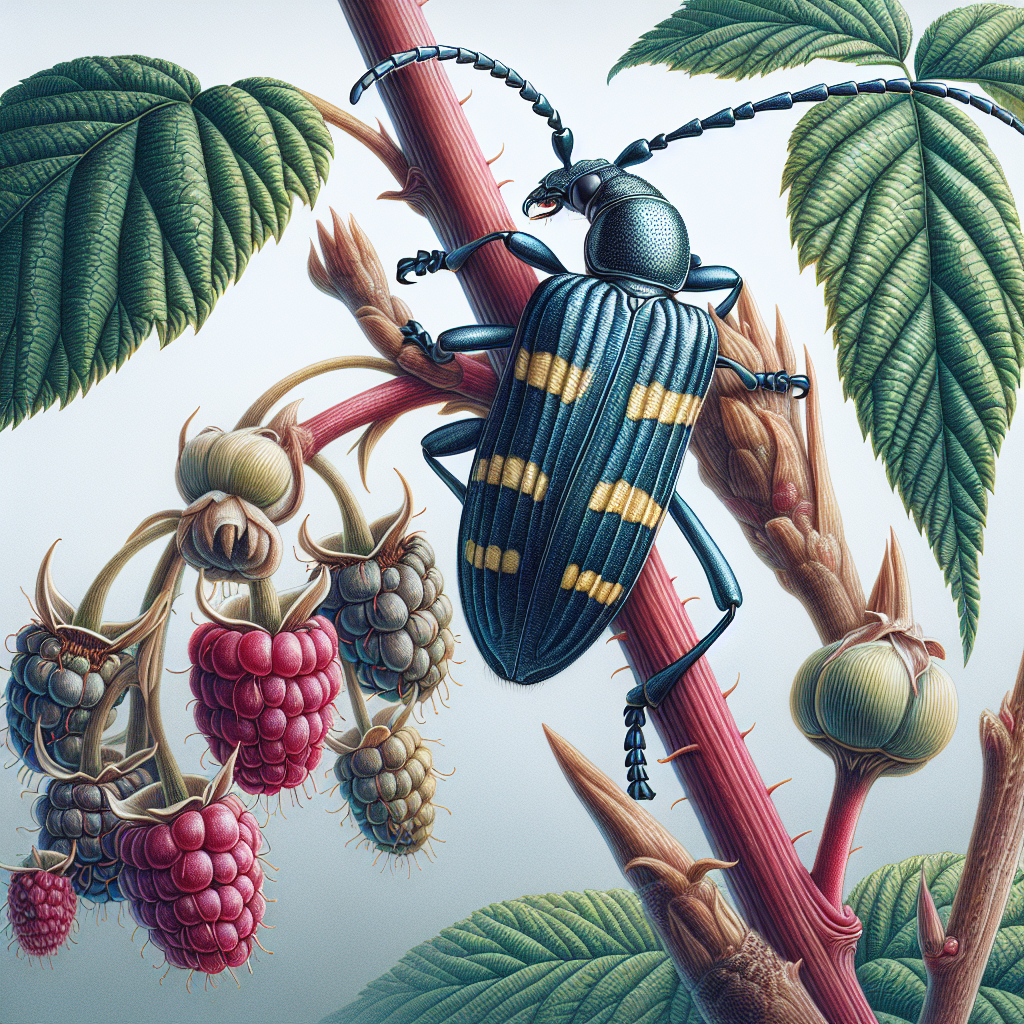
Understanding the raspberry cane borer's biology is key to breaking its lifecycle. Adults are slender, 1/2-inch long beetles with long antennae, metallic blue-black bodies, and yellow bands across the wings. They feed minimally on foliage but are notorious for precise egg-laying that dooms canes. Larvae, creamy-white and legless, tunnel upward, girdling vascular tissues and creating telltale double slits. In commercial settings, infestations can reduce yields by 50% or more if unchecked, emphasizing the need for vigilant scouting.
Identifying Symptoms & Damage
Accurate identification begins with scouting new primocanes in late summer. The hallmark symptom is two characteristic slits about 1/4-inch apart near the base of the cane, made by the female beetle to create an egg-laying scar. These slits appear as neat, V-shaped notches, often with a small egg visible inside. Within weeks, the cane tip wilts, turning black and drooping—a 'flag' symptom signaling larval entry.
As larvae feed and tunnel upward, canes show longitudinal ridges, swelling, or galls at damage sites. Severely infested canes die back from the tip, with brittle, hollow interiors visible upon splitting. Entry holes are small (1/16-inch), while larger exit holes (1/4-inch) appear the following summer when adults emerge. Differentiate from cane borers, which may cause similar girdling but lack the precise double slits; raspberry cane borer damage is uniquely paired.
Secondary signs include reduced vigor, fewer lateral branches, and sparse fruit set on affected canes. In heavy infestations, entire hills collapse, mimicking root rot or Verticillium wilt. Use a knife to split suspect canes: live larvae or frass (sawdust-like excrement) confirm infestation. Damage peaks in floricane-bearing fields, where primocane loss affects next year's fruiting wood. Early detection via weekly inspections from July onward prevents spread.
Lifecycle and Progression of Raspberry cane borer
The raspberry cane borer completes one generation per year, tightly synced with bramble phenology. Adults emerge from overwintered pupae in late June to August, peaking in July. Females chew two slits encircling the cane base, insert one egg per scar, and cover with chewed tissue. Eggs hatch in 7-10 days into tiny larvae that bore into the pith.
Larvae overwinter in tunnels 4-12 inches up the cane, resuming feeding in spring. By June, mature larvae (1/2-inch long) pupate near the exit hole. New adults chew out, leaving frass-packed holes. This progression means primocane damage appears in year one, with floricane effects the next season. In warmer climates, a partial second generation may occur.
Lifecycle timing varies by region: northern areas see peak egg-laying in mid-July, southern in June. Overwintering survival exceeds 90% in protected canes. Monitoring with yellow sticky traps captures adults for timing sprays. Understanding this cycle allows targeted interventions, such as removing infested tips before larval establishment.
Environmental Triggers & Risk Factors
Raspberry cane borers thrive in warm, humid summers with temperatures above 70°F during adult flight. Stressed plants from drought, poor drainage, or nutrient deficiency are prime targets, as vigorous canes resist boring. Overly vigorous growth from excess nitrogen paradoxically attracts egg-laying.
Risk spikes in weedy fields, where alternate hosts like sumac or apple provide reservoirs. New plantings from infested nurseries introduce pests. Monocultures of susceptible varieties like Heritage Raspberry amplify outbreaks. Poor pruning leaves stubs ideal for egg scars. Climate change extends flight periods, increasing overlap with primocane emergence.
Soil types matter: heavy clays retain moisture, favoring larval survival, while sandy soils dry out tunnels. Proximity to wild brambles within 1 mile ensures reinfestation. Companion pests like aphids weaken plants further. Mitigate by selecting resistant varieties and maintaining orchard sanitation.
Organic Control & Treatment Plans
Organic management emphasizes cultural, biological, and minimal chemical tactics. Sanitation first: Cut infested canes 12 inches below the lowest egg scar or larva tunnel before July 15, removing all debris to disrupt overwintering. Flame-killing tips halts larval progression.
Insecticidal soaps and oils: Apply pyrethrin or spinosad (OMRI-listed) at peak adult flight, targeting eggs and young larvae. Neem oil disrupts feeding. Rotate materials to prevent resistance. Biological controls: Release parasitic wasps like Bracon cephi or predatory beetles; encourage native predators with flowering borders.
Row covers: Exclude adults from primocanes during July-August. Trap crops: Plant perimeter blackberry rows to concentrate damage. For severe cases, insecticidal dusts like diatomaceous earth around bases deter females. Integrated plans reduce populations 70-90% over 2-3 years. Scout weekly, acting on first slits.
Preventing Raspberry cane borer in the Future
Prevention hinges on cultural practices and monitoring. Plant certified, pest-free stock of resistant varieties like Meeker or Killarney. Space rows 8-10 feet for airflow, prune annually to remove old canes. Mulch suppresses weeds and moderates soil moisture.
Install 4-foot fencing to block wild host migration. Use pheromone traps for early detection. Rotate fields every 4 years, interplanting with non-hosts like strawberry. Fall tillage buries pupae. Long-term, select primocane-fruiting types that allow total top removal annually, eliminating overwintering sites.
Monitor with branch beat sheets or sticky traps from June. Educate workers on slit identification. Combine with broad IPM for Japanese beetles and other borers. Consistent prevention sustains yields without reliance on sprays.
Crops Most Affected by Raspberry cane borer
Primarily raspberries (Rubus idaeus) and blackberries (Rubus fruticosus), especially black raspberries. Wild brambles serve as reservoirs. Minor hosts include loganberry, boysenberry, and dewberry. No significant impact on other crops like strawberry or blueberry, confining economic damage to bramble production. Susceptible cultivars include Heritage, Heritage, Boysen, and wild types.