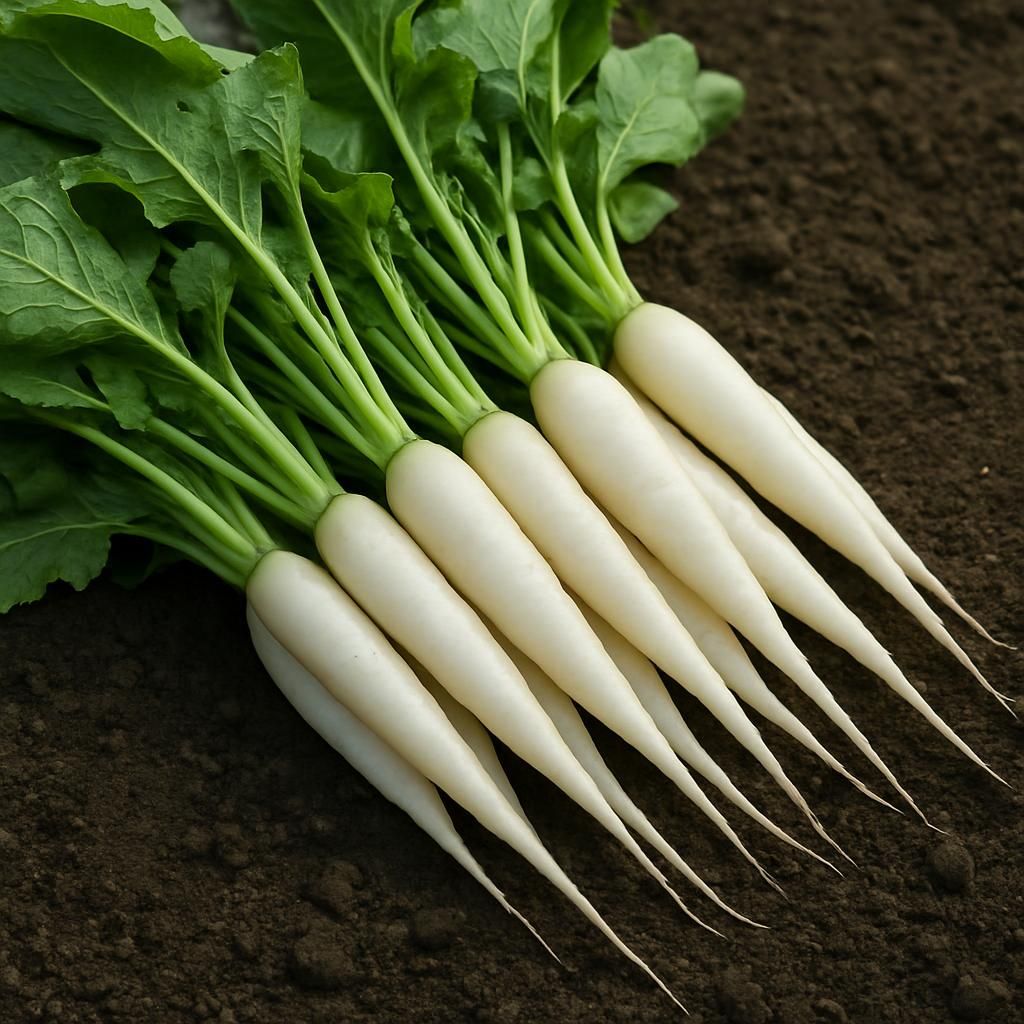
Introduction to Radish (White Icicle)
White Icicle radish is an elongated, pure-white heirloom variety of Radish that matures in 25–30 days. Gardeners value it for its crisp texture, mild heat, and versatility in salads, pickling, and fresh eating. Its rapid growth cycle makes it an excellent choice for succession planting and for filling gaps in cool-season rotations.
Botanical Profile of Radish (White Icicle)
White Icicle belongs to the Brassicaceae family. Plants produce deeply lobed, bright-green leaves arranged in a rosette that reaches 8–12 inches tall. The edible taproot grows 4–6 inches long and 1 inch in diameter at maturity, tapering to a fine point. The skin remains smooth and ivory-white while the interior stays crisp and white with a subtle peppery flavor. Flowers are small, four-petaled, and white to pale lavender when allowed to bolt.
Soil, pH, and Climate Requirements for Radish (White Icicle) (MUST INCLUDE A MARKDOWN TABLE OF IDEAL CONDITIONS)
White Icicle radish thrives in loose, well-drained soil with high organic matter. Heavy clay or compacted soils cause forking and poor root shape. Maintain consistent moisture to prevent pithiness and cracking.
| Parameter | Ideal Range | Notes |
|---|---|---|
| Soil Type | Sandy loam to loam | Avoid heavy clay; amend with compost |
| Soil pH | 6.0–7.0 | Slightly acidic to neutral |
| Soil Temperature | 45–65 °F (7–18 °C) | Germination optimum 55–65 °F |
| Air Temperature | 50–70 °F (10–21 °C) | Bolting occurs above 80 °F |
| Spacing | 1–2 in (2.5–5 cm) between plants; 8–12 in (20–30 cm) between rows | Thin seedlings early |
| Sun Exposure | Full sun (6+ hours) | Tolerates light afternoon shade in heat |
Step-by-Step Planting & Propagation
- Prepare seedbed by loosening soil to 8–10 inches and incorporating 2–3 inches of well-rotted compost.
- Sow seeds directly ½ inch deep and 1 inch apart in rows 8–12 inches apart.
- Keep soil evenly moist until germination (3–7 days).
- Thin seedlings to 2 inches apart once true leaves appear to allow root expansion.
- For continuous harvest, sow every 7–10 days until daytime temperatures exceed 75 °F.
Care & Maintenance regimes for Radish (White Icicle) (MUST INCLUDE A MARKDOWN TABLE OF WATER, FERTILIZER, AND PRUNING SCHEDULES)
Consistent moisture and balanced fertility are critical. Over-fertilization with nitrogen produces excessive foliage at the expense of roots.
| Growth Stage | Watering Schedule | Fertilizer Schedule | Pruning / Thinning Schedule |
|---|---|---|---|
| Pre-emergence | Light daily mist to keep surface moist | None | None |
| Seedling (1–2 weeks) | ½–1 inch per week; maintain even moisture | Side-dress with low-nitrogen organic fertilizer at week 2 | Thin to 2 inches when plants have 2 true leaves |
| Vegetative (weeks 3–4) | 1 inch per week; avoid water stress | Light compost tea every 10–14 days | Remove any yellowing lower leaves |
| Root Development | Consistent 1 inch weekly; mulch to retain moisture | Stop nitrogen; apply phosphorus-rich amendment if soil test indicates deficiency | No further pruning needed |
Pests, Diseases & Organic Management
Common pests include flea beetles, cutworms, and aphids. Row covers deployed at planting prevent flea beetle damage. Handpick cutworms at dusk or use collars around seedlings. Encourage beneficial insects such as lady beetles and lacewings for aphid control.
Diseases are infrequent in well-drained soil but may include Alternaria leaf spot and downy mildew. Practice 2–3 year crop rotation away from other brassicas. Remove and destroy infected foliage. Copper-based organic fungicides provide preventive protection during prolonged wet periods.
Harvesting, Curing & Optimal Storage
Harvest when roots reach 4–6 inches long and shoulders are still smooth. Pull gently to avoid breakage. Brush off soil; do not wash until ready to use. Store unwashed roots in perforated plastic bags in the refrigerator for up to two weeks. For longer storage, pack in damp sand at 32–40 °F with 90–95 % humidity.
Companion Planting for Radish (White Icicle)
Pair White Icicle radish with Lettuce, Spinach, and Peas to maximize space and deter pests. Radish acts as a trap crop for flea beetles, protecting nearby brassicas. Avoid planting near Potato to reduce shared disease pressure. Nasturtium planted at row ends repels aphids and adds edible flowers to the harvest.