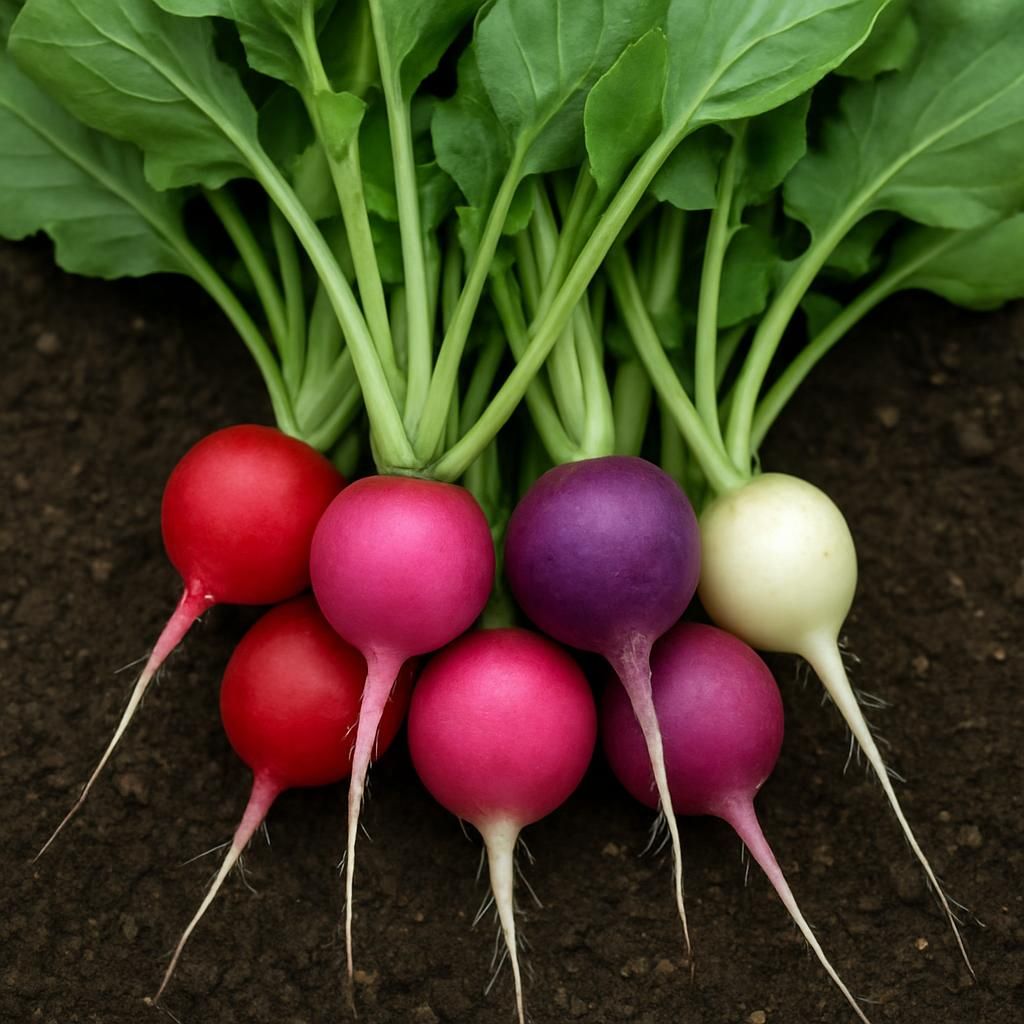
Introduction to Radish (Easter Egg)
Easter Egg radish (Raphanus sativus) is a popular heirloom-type variety known for its multicolored roots that range from bright red to pink, purple, and white. These small, globe-shaped roots are crisp, mild, and slightly sweet, making them excellent for fresh eating, salads, and garnishes. Because it matures rapidly, usually within 25–30 days, it is an excellent choice for beginner gardeners and commercial growers seeking quick turnover in cool-season production systems. The variety is also valued for its edible greens, which can be harvested young and used in salads or sautés.
Botanical Profile of Radish (Easter Egg)
Easter Egg radish belongs to the Brassicaceae family and is botanically classified as Raphanus sativus. It develops a swollen hypocotyl that forms the edible root, while the above-ground portion consists of a rosette of lobed, green leaves. The roots are typically 2–4 cm in diameter at maturity and display a spectrum of colors due to anthocyanin pigments. Flowers are small, four-petaled, and white to pale lavender, appearing if plants are allowed to bolt. The plant is an annual that completes its life cycle in 25–45 days depending on temperature and day length.
Soil, pH, and Climate Requirements for Radish (Easter Egg)
Easter Egg radish performs best in loose, well-drained sandy loam soils with high organic matter content. Consistent moisture is essential to prevent cracking or pithiness in the roots. The crop thrives in cool temperatures between 10–20 °C and bolts quickly in heat or long day lengths.
| Parameter | Ideal Range | Notes |
|---|---|---|
| Soil Type | Sandy loam to loam | Avoid heavy clay; ensure good drainage |
| Soil pH | 6.0 – 7.0 | Slightly acidic to neutral |
| Temperature (Day) | 15 – 20 °C | Optimal root development |
| Temperature (Night) | 7 – 12 °C | Prevents bolting |
| Spacing (In-row) | 2.5 – 5 cm | Thin seedlings to proper distance |
| Row Spacing | 15 – 20 cm | Allows airflow and easy harvest |
| Soil Organic Matter | 3 – 5 % | Improves moisture retention |
Step-by-Step Planting & Propagation
- Prepare the bed by loosening soil to 15–20 cm depth and incorporating well-rotted compost.
- Sow seeds directly 1 cm deep and 2.5 cm apart in rows spaced 15–20 cm.
- Maintain soil moisture at field capacity until germination (usually 3–7 days).
- Thin seedlings to 5 cm spacing when they reach 5 cm height.
- For continuous harvest, sow new rows every 7–10 days.
- Avoid transplanting; direct seeding prevents root disturbance.
Care & Maintenance regimes for Radish (Easter Egg)
Consistent moisture and light fertility are key to crisp, mild roots. Over-fertilization with nitrogen produces excessive foliage at the expense of root quality.
| Task | Schedule | Rate / Method |
|---|---|---|
| Watering | Every 2–3 days or when top 2 cm dry | 2.5 cm water per week; drip irrigation preferred |
| Fertilizer (N-P-K) | At planting and 10 days later | 5-10-10 at 200 kg/ha; side-dress lightly |
| Mulching | Immediately after thinning | 5 cm organic mulch to retain moisture |
| Weeding | Weekly until canopy closes | Hand pull or shallow cultivation |
| Pruning / Thinning | Once at 5 cm height | Remove weak seedlings; no further pruning needed |
Pests, Diseases & Organic Management
Common pests include flea beetles, cutworms, and aphids. Diseases such as clubroot and Alternaria leaf spot can occur in poorly managed soils. Use floating row covers to exclude flea beetles and practice crop rotation with non-brassica crops. Apply neem oil or insecticidal soap for aphids. Maintain soil pH above 6.2 and improve drainage to reduce clubroot risk.
Harvesting, Curing & Optimal Storage
Harvest Easter Egg radishes when roots reach 2–4 cm diameter, typically 25–30 days after sowing. Pull gently and remove tops, leaving 1–2 cm of stem. Rinse soil from roots and store unwashed in perforated plastic bags at 0–4 °C with 95 % humidity for up to two weeks. Greens can be stored separately for 3–5 days. For longer storage, pickle or ferment the roots.
Companion Planting for Radish (Easter Egg)
Easter Egg radish grows well with Lettuce, Spinach, Peas, and Carrot. It benefits from the shade provided by taller companions and helps loosen soil for root crops. Avoid planting near Potato to reduce shared pest pressure. Interplant with Nasturtium to deter aphids and flea beetles.