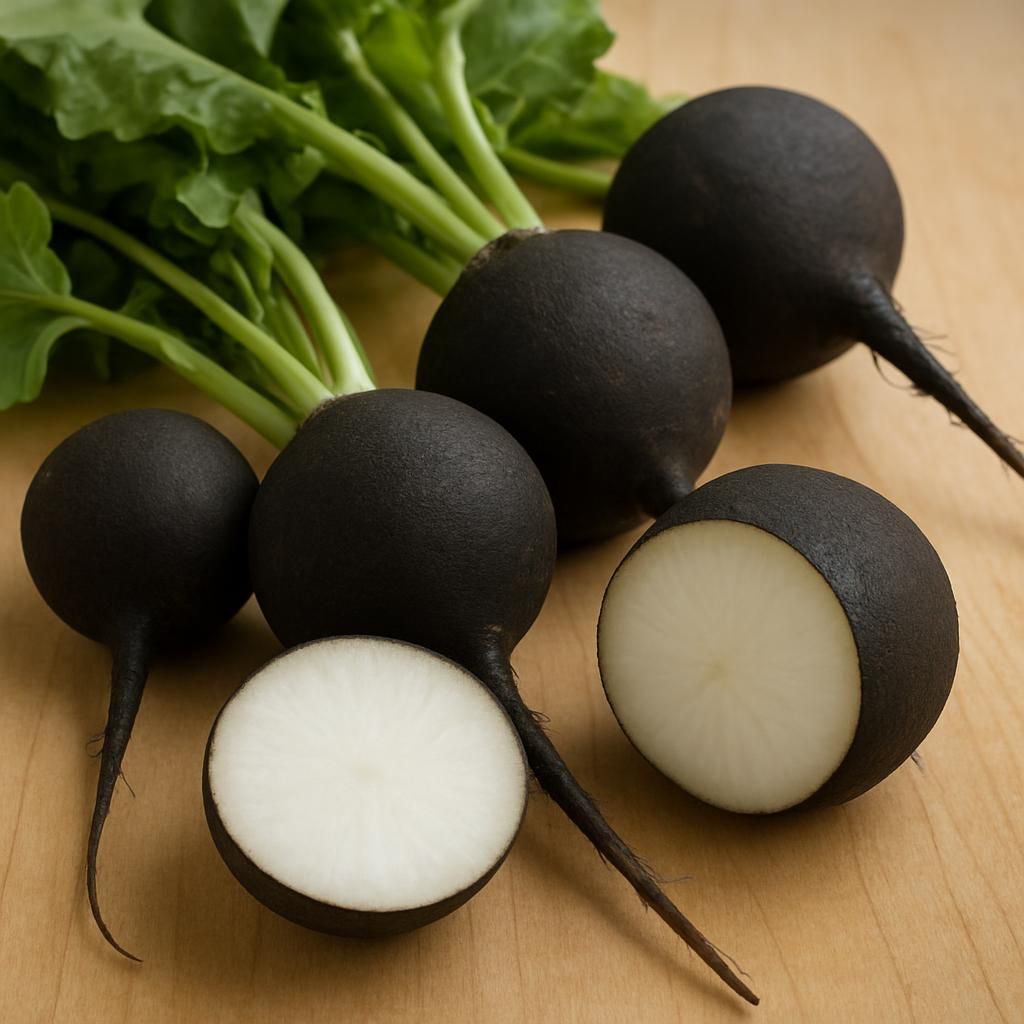
Introduction to Radish (Black Spanish Round)
Black Spanish Round radish is a cold-hardy, large-rooted winter variety that has been cultivated for centuries in Europe and North America. Its distinctive black skin protects the dense, white, mildly pungent flesh that remains crisp for months when stored correctly. Growers value this cultivar for its ability to mature in late fall or early winter, providing fresh roots when other vegetables are scarce.
The variety tolerates light frosts and can be left in the ground for extended periods, making it an excellent choice for season extension. With proper spacing and soil management, roots can reach 3–4 inches in diameter and weigh up to one pound. Its long storage life and resistance to many common radish pests make it a favorite among market gardeners seeking winter revenue.
Botanical Profile of Radish (Black Spanish Round)
Black Spanish Round belongs to the Brassicaceae family and is botanically classified as Raphanus sativus var. niger. It produces a swollen taproot that develops a thick, coal-black periderm over a crisp white interior. The foliage forms a rosette of deeply lobed, dark-green leaves that can reach 12–18 inches in height.
The plant is a biennial but is grown as an annual for root harvest. Flowering occurs in the second year unless plants are subjected to prolonged vernalization, producing typical four-petaled white or pale lavender flowers. Seeds are contained in siliques that shatter readily when mature.
Soil, pH, and Climate Requirements for Radish (Black Spanish Round)
Black Spanish Round radish performs best in cool weather with consistent moisture and fertile, well-drained soil. The crop prefers loamy or sandy loam textures that allow rapid root expansion without forking.
| Parameter | Ideal Range | Notes |
|---|---|---|
| Soil Type | Sandy loam to loam | Avoid heavy clay; improve drainage with organic matter |
| Soil pH | 6.0–7.0 | Slightly acidic to neutral; test and lime if below 5.8 |
| Temperature (Day) | 50–65 °F (10–18 °C) | Cool conditions promote sweetness and crisp texture |
| Temperature (Night) | 40–50 °F (4–10 °C) | Frost tolerant to 25 °F (-4 °C) |
| Soil Temperature | 45–55 °F (7–13 °C) | Minimum germination temperature 40 °F |
| Spacing | 4–6 in (10–15 cm) between plants | Rows 12–18 in (30–45 cm) apart |
| Depth | ½–¾ in (1.3–1.9 cm) | Direct sow; firm soil after seeding |
Step-by-Step Planting & Propagation
- Select a site with full sun and good air circulation. Remove crop residues from previous brassicas to reduce disease carryover.
- Incorporate 2–3 inches of well-rotted compost or aged manure two weeks before planting. Conduct a soil test and adjust fertility according to results.
- Sow seeds directly ½ inch deep in moist soil. Space seeds 1 inch apart initially, then thin to 4–6 inches once seedlings reach the first true leaf stage.
- For succession harvests, sow every 10–14 days from late summer through early fall in zones 5–8. In colder regions, use row covers or high tunnels for late plantings.
- Keep the seedbed consistently moist until germination, which occurs in 4–7 days at optimal temperatures.
Care & Maintenance regimes for Radish (Black Spanish Round)
Consistent moisture is critical; fluctuations cause cracking and pithiness. Side-dress with a balanced organic fertilizer once at the four-leaf stage if soil tests indicate low nitrogen.
| Task | Frequency / Rate | Timing | Method |
|---|---|---|---|
| Irrigation | 1–1.5 in (2.5–3.8 cm) per week | Throughout growth | Drip or soaker hose; avoid overhead wetting |
| Fertilizer | ½ lb N per 100 ft² (balanced 5-5-5) | At thinning (2–3 weeks) | Side-dress 2–3 inches from row |
| Mulch | 2–3 inches organic mulch | After thinning | Straw or shredded leaves to retain moisture |
| Weeding | Weekly until canopy closes | First 4–5 weeks | Shallow cultivation or hand pulling |
| Pruning | Remove yellowing outer leaves | As needed | Improves airflow and reduces disease |
Pests, Diseases & Organic Management
Common pests include flea beetles, cutworms, and root-knot nematodes. Row covers deployed at planting effectively exclude flea beetles. Handpick cutworms at dusk or use collars around seedlings.
Diseases such as Alternaria leaf spot and clubroot can affect the crop. Practice a 3–4 year rotation away from brassicas and maintain soil pH above 6.8 to suppress clubroot. Remove and destroy infected foliage promptly. Beneficial nematodes and compost tea drenches help manage soil-borne pathogens.
Harvesting, Curing & Optimal Storage
Harvest when roots reach 3–4 inches in diameter, typically 55–70 days after sowing. Gently loosen soil with a fork and pull roots by the tops. Trim leaves to 1 inch and brush off excess soil; do not wash unless immediately marketing.
Cure harvested roots for 1–2 days in a cool, shaded area with good airflow. Store at 32–40 °F (0–4 °C) and 90–95 % relative humidity. Properly cured Black Spanish Round roots maintain quality for 2–4 months in perforated plastic bags or crates.
Companion Planting for Radish (Black Spanish Round)
Black Spanish Round pairs well with Lettuce, Spinach, and Peas. These shallow-rooted companions utilize different soil layers and provide light shade that moderates temperature. Aromatic herbs such as Thyme and Rosemary deter flea beetles. Avoid planting near other brassicas to limit shared pest and disease pressure. Nasturtium serves as a trap crop for aphids and provides edible flowers.
For additional season-extension and soil-health strategies, see The Truth About Fall Garden Transitions for Small Farm Resilience.