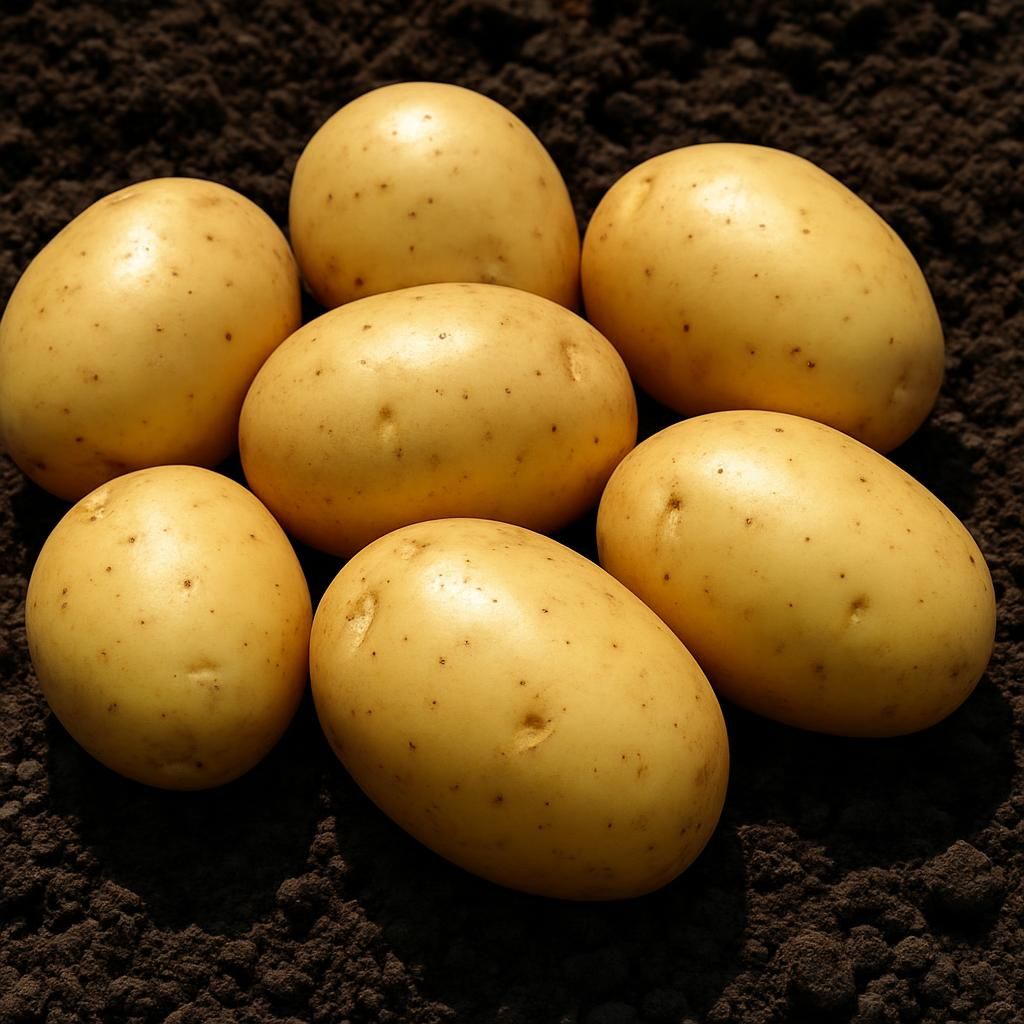
Introduction to Potato (Ratina)
Potato (Ratina) stands out among modern cultivars for its balanced agronomic traits and culinary versatility. Developed for consistent tuber quality and resistance to common field stresses, it delivers uniform oval tubers with shallow eyes and bright yellow flesh that holds shape during boiling and roasting. Commercial growers value its moderate dormancy and strong skin set, which reduce bruising during mechanical harvest. Home gardeners appreciate the variety’s reliable yields even on smaller plots when basic soil and spacing requirements are met.
Globally, potatoes remain a dietary staple, and Ratina fills an important niche where markets demand attractive, waxy tubers rather than the floury russet types. Its moderate maturity window (approximately 90–110 days from planting) allows flexible rotation with both cool-season and warm-season crops. Because the variety stores well for up to six months under proper conditions, it supports extended market windows and household food security.
Botanical Profile of Potato (Ratina)
Potato (Ratina) belongs to the nightshade family, Solanaceae, and shares the same growth habit as other Potato (crop) cultivars. Plants produce compound leaves with leaflets arranged along a central rachis and bear clusters of white to pale-lilac flowers typical of the species. Underground, stolons extend from the base of the stem and swell at their tips to form tubers. The Ratina cultivar is distinguished by its smooth, thin yellow skin and dense, firm flesh that resists disintegration when cooked.
The plant’s root system is relatively shallow, with most feeder roots concentrated in the upper 30 cm of soil. This architecture makes the crop sensitive to both drought and waterlogging, requiring careful irrigation management. Flowering occurs 6–8 weeks after emergence, but fruit (true seed berries) rarely set under field conditions and are not used for propagation.
Soil, pH, and Climate Requirements for Potato (Ratina)
Successful cultivation begins with matching site conditions to the crop’s physiological needs. The following table summarizes optimal parameters for Ratina production.
| Parameter | Ideal Range | Notes |
|---|---|---|
| Soil Type | Sandy loam to loam | Good drainage prevents tuber rot |
| Soil pH | 5.5–6.5 | Avoid liming immediately before planting |
| Temperature (Day) | 18–24 °C | Optimal photosynthesis and tuberization |
| Temperature (Night) | 10–15 °C | Cooler nights favor starch accumulation |
| Frost Tolerance | Sensitive below −2 °C | Protect emerging shoots with row cover |
| Growing Degree Days | 1,200–1,600 GDD (base 7 °C) | Maturity reached in 90–110 days |
Ratina performs best in regions with cool, moist springs and moderate summers. Excessive heat above 28 °C during tuber bulking can induce physiological disorders such as hollow heart. In warmer climates, planting is timed for late winter or early spring so that tuber development occurs before peak summer temperatures.
Step-by-Step Planting & Propagation
- Source certified seed tubers free of viruses and bacterial diseases. Avoid saving tubers from previous crops unless rigorous rogueling and testing have been performed.
- Pre-sprout (“chit”) seed pieces 4–6 weeks before planting by placing tubers in a cool (10–15 °C), bright location. Each seed piece should weigh 40–60 g and contain at least one strong sprout.
- Prepare the field or bed by incorporating well-rotted compost at 20–30 t/ha. Form ridges or raised beds 75–90 cm apart to improve drainage and ease hilling.
- Plant seed pieces 5–8 cm deep with 25–30 cm between plants in the row. Shallower planting risks greening; deeper placement delays emergence.
- Immediately after planting, apply a light irrigation to settle soil around the seed pieces and initiate uniform sprouting.
Care & Maintenance regimes for Potato (Ratina)
Consistent cultural practices maximize both yield and quality. The table below outlines key inputs throughout the season.
| Growth Stage | Irrigation (mm/week) | Fertilizer (N-P-K kg/ha) | Pruning / Hilling |
|---|---|---|---|
| Pre-emergence | 15–20 | 40-60-80 basal | None |
| Vegetative (4–6 wk) | 25–30 | 30-0-40 side-dress at 30 cm height | First hilling when plants 15 cm tall |
| Tuber Initiation | 30–35 | 20-0-60 at flowering | Second hilling 3 weeks later |
| Bulking | 25–30 | Optional foliar K at 60 DAP | Maintain 10–12 cm soil cover on tubers |
| Maturity | Reduce to 10 | None | Cease hilling; allow natural senescence |
Mulch with 5–8 cm of straw or plastic immediately after the second hilling to conserve moisture and suppress weeds. Scout weekly for nutrient deficiencies; interveinal chlorosis often signals magnesium shortage, correctable with 2 % Epsom salt foliar sprays.
Pests, Diseases & Organic Management
Ratina is moderately resistant to common scab but remains susceptible to Colorado potato beetle, aphids, and late blight. Implement an integrated approach:
- Hand-pick or use Bacillus thuringiensis sprays for early larval stages of Colorado potato beetle.
- Deploy yellow sticky traps and reflective mulch to reduce aphid colonization and virus transmission.
- Apply copper-based fungicides or approved biologicals (e.g., Bacillus subtilis) at 7–10 day intervals during humid periods to manage late blight.
- Practice strict 3–4 year rotations with non-host crops such as Corn (crop) or small grains to break soil-borne pathogen cycles.
- Encourage beneficial insects by planting Nasturtium (crop) strips around field borders.
Harvesting, Curing & Optimal Storage
Begin harvest when vines have senesced naturally or after a light frost kills foliage. Use a fork or mechanical lifter to avoid bruising. Cure tubers at 12–15 °C and 90–95 % RH for 10–14 days to heal harvest wounds. Store at 4–7 °C with 85–90 % humidity and good ventilation; avoid temperatures below 4 °C to prevent reducing-sugar accumulation and subsequent browning during frying. Under these conditions, Ratina maintains culinary quality for 5–6 months.
Companion Planting for Potato (Ratina)
Strategic neighbors improve pest suppression and nutrient dynamics. Plant Garlic (crop) or Onion (crop) in alternating rows to deter aphids and beetles through volatile compounds. Clover (crop) sown between beds fixes nitrogen and provides habitat for predatory ground beetles. Avoid planting near Tomato (crop) or other Solanaceous crops to limit shared disease pressure. Aromatic herbs such as Thyme (crop) and Rosemary (crop) further mask potato volatiles, reducing insect host-finding success.
For additional organic soil-building techniques, see the practical guidance in The Forgotten Art of Fall Soil Revival: 8 Organic Strategies for Small Farm Resilience.