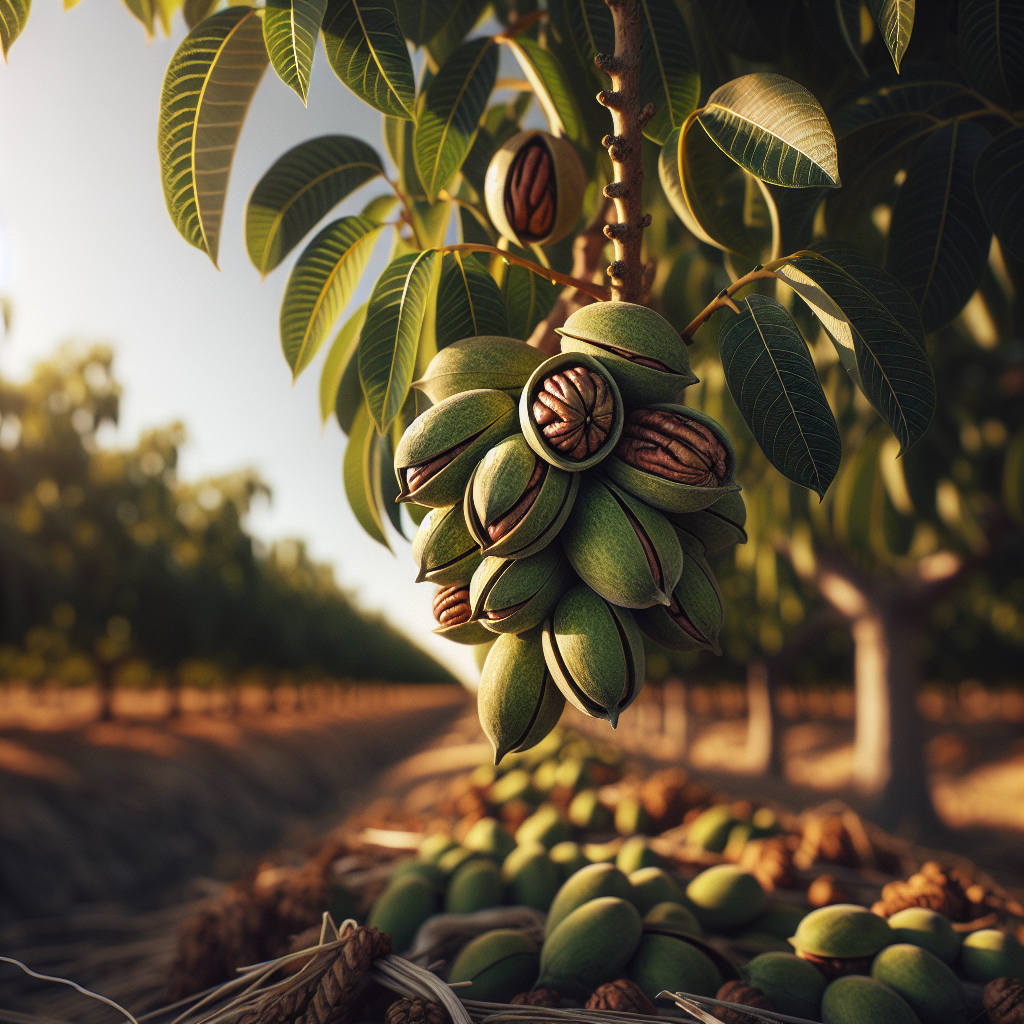
Introduction to Pecan (Western Schley)
Developed and widely planted in the American Southwest, this cultivar became especially important in New Mexico, West Texas, and comparable dryland-irrigated pecan districts where intense summer heat and low humidity can favor high kernel quality. It is often referred to simply as "Western" in commercial trade, though the full name Western Schley distinguishes it from the older Schley lineage. Its reputation rests on thin shells, bright kernels, and strong market acceptance for in-shell and shelled sales.
Among pecan cultivars, Western Schley is admired for producing nuts with a high kernel percentage and a relatively easy-to-crack shell. That same thin-shell trait, however, means orchard management must be precise: moisture stress during kernel filling, nutrient imbalance, poor pollination, and heavy crop load can all reduce nut size and kernel plumpness quickly. In well-managed orchards, it can be a profitable choice, but it is not a neglect-tolerant tree.
Western Schley is best understood as a cultivar for growers who can provide deep soil, full sun, regular irrigation, and a pollinizer plan. In many western orchards it is paired with complementary pollen-shedding cultivars to stabilize set because pecans are dichogamous and rarely pollinate themselves reliably. If you are new to the crop, a general Pecan guide can help provide broader species context before focusing on this cultivar.
Its long juvenile period is another defining feature. Grafted trees generally begin bearing in 4 to 7 years under good management, but true commercial production comes later as canopy and root systems mature. Once established, the tree becomes large, long-lived, and highly productive, though alternate bearing can become pronounced if crop load is not moderated by nutrition, irrigation consistency, and orchard balance.
Botanical Profile of Pecan (Western Schley)
This is a deciduous tree in the walnut family, Juglandaceae, native at the species level to North America. Like other pecans, it forms a tall central trunk when young and later develops a broad, rounded canopy with strong scaffold limbs. Mature height can reach 70 to 100 feet in unrestricted plantings, though orchard-trained trees are managed more for spacing and harvest access than maximal height.
Leaves are alternate, pinnately compound, and typically 12 to 20 inches long with multiple lance-shaped leaflets. The foliage emerges in spring after adequate heat accumulation and drops in autumn following nut maturation and leaf senescence. The root system is vigorous, with a strong taproot tendency in seedlings and extensive lateral roots in established orchard trees. Because of this, shallow, compacted, or hardpan soils are a serious limitation.
Pecan flowers are unisexual but borne on the same tree. Male flowers occur as pendulous catkins on previous season wood, while female flowers appear near the ends of current-season shoots. Western Schley is generally classified as a protandrous, or Type I, cultivar, meaning pollen is shed before the female flowers on the same tree are fully receptive. This is why an overlapping Type II pollinizer is strongly recommended nearby.
The nuts are oblong to somewhat elliptical, with a thin shell and excellent cracking quality. Kernel color is typically bright and attractive when harvest timing, drying, and storage are handled properly. Shell thickness is lighter than many traditional cultivars, contributing to the desirable "paper-shell" reputation but also requiring gentler handling to reduce shell breakage for premium in-shell sales.
A notable horticultural trait of Western Schley is its suitability to low-humidity production areas. In humid southeastern climates it can be more vulnerable to disease pressure, especially scab, and therefore is often outperformed there by more disease-tolerant cultivars. In arid western orchards, its strengths are more fully expressed: quality kernels, premium shelling traits, and good adaptation to heat when irrigation is sufficient.
Soil, pH, and Climate Requirements for Pecan (Western Schley)
Deep, well-drained alluvial or loamy soils are ideal. Productive commercial sites usually provide at least 5 to 6 feet of penetrable soil depth, and 8 feet or more is even better. Pecans are unforgiving of shallow rooting zones. Avoid soils with a hardpan, perched water table, cemented caliche near the surface, or prolonged saturation after irrigation.
The preferred texture is sandy loam, loam, or silty loam with high water-holding capacity yet good drainage. Heavy clay can work only if internal drainage is excellent and irrigation is carefully controlled. Constantly wet root zones predispose trees to oxygen stress, reduced fine-root growth, nutrient uptake problems, and root disease. Signs of chronic overwatering include pale foliage, weak shoot extension, delayed leaf hardening, leaf scorch despite wet soil, algae or moss near emitters, sour-smelling soil, and reduced nut fill.
Optimal pH is slightly acidic to neutral, roughly 6.0 to 7.5. The species can survive above this range, but Western Schley in alkaline western soils commonly develops micronutrient issues, especially zinc deficiency and sometimes iron chlorosis. In calcareous soils above pH 7.8, expect to manage nutrition intensively through foliar feeding and organic matter improvement. Soil salinity is another concern in irrigated desert valleys. Aim for low electrical conductivity and good leaching practices where irrigation water quality is marginal.
Climate should provide a long frost-free growing season, abundant summer heat, and enough winter chilling to support normal dormancy release. Western Schley excels in hot summer climates with low atmospheric humidity. Daytime summer temperatures in the 90-105°F range are generally tolerated well if root-zone moisture remains stable. Young trees can be damaged by extreme heat combined with dry wind, especially in reflective sandy soils, so trunk protection and mulch are valuable.
Late spring frost is a major risk because budbreak and flowering can be injured by subfreezing events. Autumn freezes before full nut maturity can reduce kernel development and darken quality. Choose sites with good air drainage and avoid low frost pockets. Wind exposure matters too: strong winds can break young scaffolds, reduce pollination efficiency, and increase evapotranspiration stress.
For irrigation scheduling, the critical principle is deep, even moisture rather than frequent shallow wetting. During active growth and especially from nut sizing through kernel fill, maintain soil moisture in the main root zone at approximately 60-80% of field capacity. In practical terms, soil from 8-18 inches deep should feel cool and moist and form a weak ball when squeezed, not crumble to dust and not ooze water. Tensiometer targets often fall near 20-40 centibars in loam during key production periods, adjusted by soil type. Severe drying during late summer can cause shriveled kernels, poor shell separation, and increased fruit drop.
Step-by-Step Planting & Propagation
Use grafted nursery trees rather than seedlings if the goal is true-to-type production. Seedling trees vary greatly in nut quality, bearing age, and growth habit, while grafted Western Schley trees reproduce the cultivar's known shelling and kernel characteristics. Select healthy, certified nursery stock with a straight trunk, well-healed graft union, and no circling roots.
Choose the site carefully. Provide full sun all day and enough space for future canopy expansion. Traditional orchard spacing may range from 35 x 35 feet to 40 x 40 feet depending on soil vigor, irrigation system, and long-term thinning plans. Backyard growers often underestimate final tree size; do not plant close to foundations, septic systems, or overhead wires.
Test soil before planting. Sample for pH, salinity, organic matter, phosphorus, potassium, calcium, magnesium, and micronutrients. If infiltration is poor, correct drainage first rather than trying to compensate later with reduced irrigation.
Prepare the planting area. Rip compacted ground deeply if appropriate before planting. Remove perennial weeds in a wide strip. Incorporate compost only if it is mature and salt-free; avoid creating a small amended pocket in otherwise poor soil because roots may stall at the interface.
Plant during dormancy. Late winter to early spring is ideal in most pecan regions, after the worst freezes but before bud swell. Container trees can be planted over a broader window if heat stress is avoided, but dormant bare-root trees often establish very well when planted promptly.
Dig a broad planting hole. Make it only as deep as the root system and at least 2-3 times as wide. The graft union should remain above the final soil line. Spread roots naturally; do not bend the taproot sharply upward.
Backfill with native soil. Firm lightly to remove large air pockets. Water immediately and thoroughly to settle soil around roots.
Head and train if needed. If the nursery tree is tall and unbranched, light heading may help scaffold development, but avoid excessive top removal that slows establishment. Stake only where wind is severe, and remove ties before girdling occurs.
Protect the trunk. Use a white tree guard or diluted interior white latex paint on the southwest side to prevent sunscald in hot western sites.
Install irrigation from day one. Young trees should never be allowed to dry severely between irrigations. Wet the root zone deeply, then allow slight surface drying before the next cycle. The first year is about root expansion, not forcing top growth with excessive nitrogen.
Propagation by grafting is standard. Budding or grafting onto seedling rootstocks is usually done by nurseries or experienced orchardists. Patch budding and whip or bark grafting can work depending on stock size and season. For small growers, purchasing a finished grafted tree is far more reliable than trying to propagate at home.
Because pollination is essential, plant at least one compatible pollinizer within effective pollen distance. Many growers pair Western Schley with protogynous, Type II cultivars such as Stuart Pecan, depending on regional bloom timing. Final pollinizer choice should always match local flowering calendars, not just generic compatibility charts.
Care & Maintenance regimes for Pecan (Western Schley)
Irrigation is the most important management lever in western production. Young trees need consistent moisture to establish deep roots, while mature trees need large volumes of water timed to phenology. Water demand rises sharply from late spring through summer canopy expansion and becomes especially critical from shell hardening through kernel fill. A mature, fully leafed tree in arid heat may use several inches of water per week across its root zone, depending on canopy size, soil type, humidity, and wind.
Drip, microsprinkler, and flood systems can all work if managed correctly. Drip is efficient but must wet a sufficiently broad soil volume as trees mature; too few emitters create a narrow wet column and restricted root distribution. Microsprinklers are often preferred because they spread water more widely under the canopy. Whatever system you use, check moisture at multiple depths. If the top 4 inches are wet but the 12-24 inch zone is dry, the tree is under-irrigated despite frequent watering.
Fertilization should be guided by annual leaf analysis, usually midsummer, and periodic soil tests. Nitrogen demand rises with tree age and crop load, but overapplication produces excessive vegetative growth, weakens wood, and can worsen alternate bearing. Split applications are better than one heavy dose. Zinc is the signature nutrient issue in pecans, especially under alkaline conditions. Deficiency appears as small, narrow, chlorotic leaves in rosettes, shortened internodes, and poor shoot elongation. Foliar zinc sprays are often necessary several times from early leaf expansion onward.
Phosphorus and potassium should be corrected based on test results, not guesswork. Potassium becomes increasingly important under heavy crop load because nut filling removes substantial reserves. Calcium and magnesium balance matter in sodic or calcareous soils, and organic matter helps buffer nutrient availability.
Training in youth should focus on a strong central leader with well-spaced scaffolds. Remove narrow crotches and crossing branches early. Mature pruning is lighter than in many fruit trees; pecans need a large productive canopy. The main goals are maintaining access, removing dead or storm-damaged wood, improving light penetration where canopies overcrowd, and preventing low limbs from interfering with irrigation or harvest equipment.
Weed management is especially important for young trees because turf and weeds compete aggressively for shallow moisture and nitrogen. Maintain a weed-free ring at least 3-4 feet wide around newly planted trees, expanding it as the tree grows. Organic mulch can be used, but keep it several inches away from the trunk to prevent rot and rodent issues.
Bearing management is partly about consistency. Western Schley can show alternate bearing tendencies, especially after a heavy crop that depletes carbohydrate reserves. Reduce stress in on-years by keeping irrigation even, preventing nutrient shortages, and controlling pests that weaken foliage. Healthy late-season leaves are crucial because they manufacture reserves for the following year's flowering and shoot growth.
For orchard floor and soil-building strategies, many growers integrate managed cover species in row middles or non-wetted zones; practical ideas overlap with broader perennial orchard systems discussed in soil health strategies.
Pests, Diseases & Organic Management
In arid western conditions, disease pressure is often lower than in humid pecan regions, but it is not absent. The major concern to evaluate regionally is Pecan scab, caused by Venturia effusa. Western Schley is not considered highly scab-resistant, so in humid climates it can be difficult to grow organically without substantial crop loss. Symptoms include dark, velvety lesions on leaves, shoots, and shucks, leading to poor nut development and premature drop. The best organic management is site selection in dry climates, open canopies, sanitation, and avoiding overhead irrigation that prolongs leaf wetness.
Aphids are among the most common pecan pests. Black pecan aphids are especially damaging because they inject toxins that create angular yellow lesions between veins, followed by premature defoliation. Yellow pecan aphids and Blackmargined aphids also reduce tree vigor by sucking sap. Organic management includes conserving lacewings, lady beetles, hoverflies, and parasitoids, avoiding broad-spectrum sprays that kill beneficials, and using insecticidal soap or horticultural oil only when coverage and temperature conditions are appropriate.
Pecan nut casebearer can cause severe early nut loss. Larvae feed directly in developing nuts shortly after pollination. Monitoring adult flight with pheromone traps and scouting egg lay on nut clusters are essential for timing any intervention. Bacillus thuringiensis products may provide suppression when applied at the correct larval stage, but timing is everything.
Hickory shuckworm can injure kernels later in the season by entering shucks and nuts, causing poor fill, staining, and delayed shuck split. Sanitation, timely harvest, and habitat management help reduce carryover.
Mites, scale insects, stink bugs, and leaf-feeding caterpillars can also appear depending on region. Birds and squirrels may become serious pre-harvest competitors in small plantings.
For diseases beyond scab, watch for Powdery mildew, Crown gall, and root disorders in wet soils. Crown gall causes tumor-like swellings, often near the crown or roots, and is best prevented by using clean nursery stock and avoiding trunk or root injury. Root decline often traces back to poor drainage more than an infectious agent.
Organic management works best as a system:
- maintain tree vigor with balanced fertility and irrigation
- improve airflow and sun penetration
- remove mummified nuts and diseased debris where practical
- monitor weekly during critical windows
- support predator habitat with flowering understory species away from direct trunk competition
- use targeted, low-residual interventions only when thresholds justify them
Harvesting, Curing & Optimal Storage
Western Schley is harvested when shucks split naturally and nuts separate cleanly from the husk. Do not rely only on calendar date; maturity varies with climate, crop load, and irrigation regime. Well-filled mature nuts have developed full kernel color and texture, and the shell interior should not be watery. Premature harvest reduces kernel flavor, fill, and storage life.
In commercial orchards, trees are often shaken once most nuts are ready, then swept and collected quickly. For small growers, hand gathering from tarps or frequent ground collection is workable. Speed matters because nuts left on damp soil absorb moisture, stain, and become vulnerable to molds, insects, and wildlife.
After harvest, remove remaining shuck material and trash. Dry the nuts promptly in a well-ventilated area out of direct rain and intense sun. Aim to reduce kernel moisture to about 4.5-5% for long-term storage, though in-shell nuts may initially be held slightly higher before final conditioning. Practical drying conditions include thin layers, strong airflow, and moderate warmth rather than high heat. Overheating can darken kernels and damage flavor oils.
You can judge adequate drying by cracking a sample: the kernel should be crisp, not rubbery, and the packing tissue between kernel halves should be dry rather than leathery. Another sign is a sharper rattling sound of the kernel inside the shell compared with freshly harvested nuts.
Storage quality depends on temperature, oxygen, and light. Pecans are rich in oils and can turn rancid if stored warm. In-shell nuts keep longer than shelled nuts because the shell protects the kernel from oxidation. For short-term storage, keep them cool, dry, and rodent-proof. For long-term quality, refrigerate or freeze. Shelled kernels stored in airtight packaging at freezer temperatures can maintain quality for many months.
Before marketing, sort out poorly filled, insect-damaged, stained, or sprouted nuts. Western Schley's commercial advantage is its attractive kernel, so careful postharvest handling is part of realizing its premium value.
Companion Planting for Pecan (Western Schley)
Under mature pecan trees, companion planting should be approached as orchard-floor management rather than close trunk planting. The tree casts deep shade as it ages, uses large amounts of water, and may release juglone-related compounds that suppress some sensitive species, though pecan is generally less notorious for this effect than black walnut. The best companions are low-competition, soil-improving, insect-supporting plants placed outside the immediate trunk zone and managed so they do not rob young trees of water.
Clover is one of the most useful choices for row middles or orchard alleys. It suppresses weeds, supports pollinators and beneficial insects, and contributes biologically fixed nitrogen to the system when managed as a living cover. Keep it mowed or terminated as needed so it does not compete aggressively with young trees in dry weather.
Yarrow is valuable for attracting predatory insects and parasitoids that help regulate aphids and other orchard pests. Its deep-rooting habit can also help improve soil structure in non-irrigated alley zones.
Thyme works well in hot, sunny margins and can serve as a low-growing aromatic insectary plant. It is better suited to the orchard edge, berm shoulders, or drier borders than directly inside the main wetted root zone of a newly planted tree.
Nasturtium can be useful in smaller diversified orchards as a seasonal trap and nectar plant, though it is less common in large commercial systems. It fits best where irrigation is available and where growers want added support for beneficial insect populations.
Avoid heavy-feeding annual vegetables directly under the canopy of young pecans, and avoid deep tillage around established trees because feeder roots are easily damaged. In arid sites, the right companion plants are those that improve biodiversity and soil cover without increasing irrigation stress.