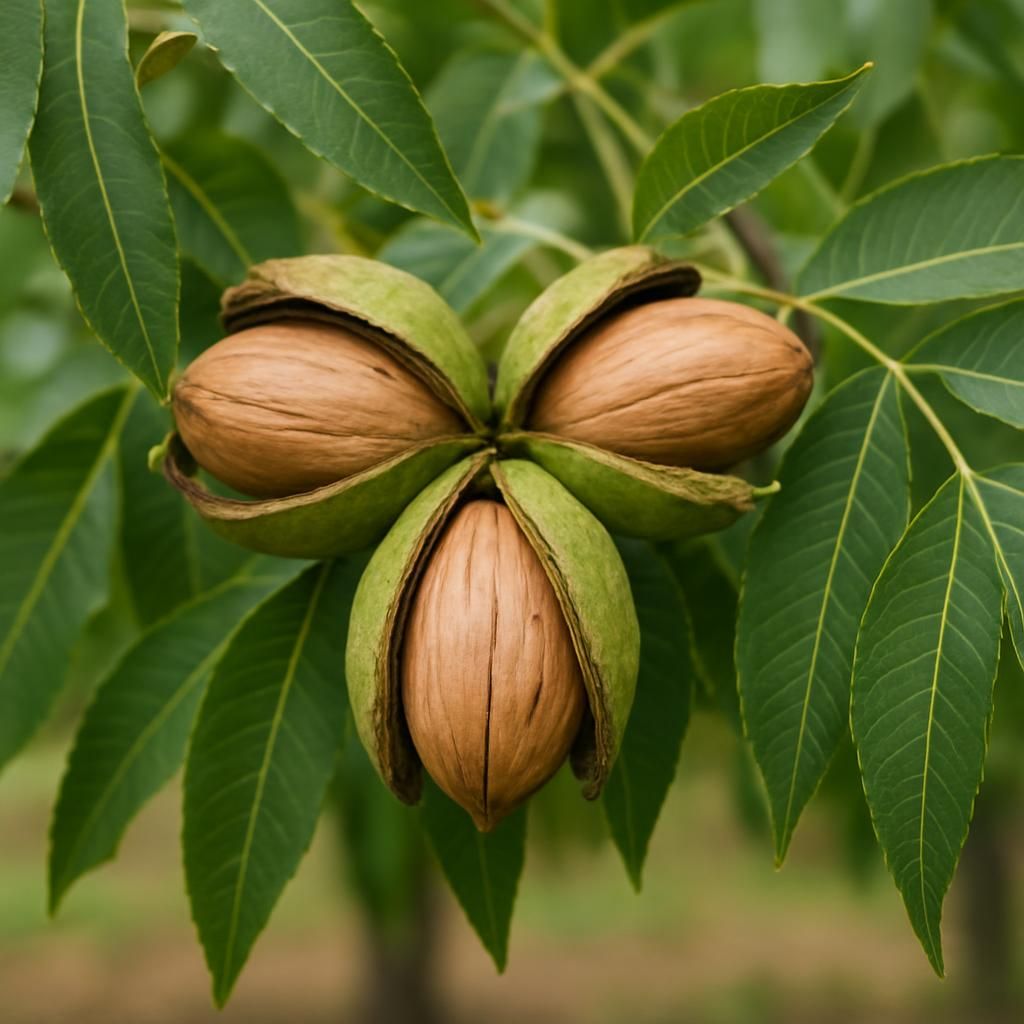
Introduction to Pecan (Kiowa)
Kiowa pecans deliver consistent heavy crops of large, high-quality kernels that command premium prices in both fresh and processed markets. Developed by the USDA, the cultivar combines the large nut size of Mahan with the scab resistance of Odom, making it a top choice for commercial orchards in the southeastern United States and similar warm climates. Its moderately early harvest window (mid-to-late October) allows growers to avoid late-season weather risks while still capturing strong market demand.
Botanical Profile of Pecan (Kiowa)
Kiowa is a deciduous tree in the Juglandaceae family that reaches 70–100 feet at maturity with a broad, spreading canopy. The compound leaves consist of 9–17 lanceolate leaflets and turn golden-yellow in autumn. Trees are monoecious, producing separate male catkins and female flowers on the same plant; pollination is wind-driven and requires a compatible cultivar such as Stuart Pecan or Desirable Pecan planted within 300 feet. The nuts are large (60–70 count per pound), oblong, and thin-shelled with kernels that average 55–60% of nut weight.
Soil, pH, and Climate Requirements for Pecan (Kiowa) (MUST INCLUDE A MARKDOWN TABLE OF IDEAL CONDITIONS)
Kiowa performs best on deep, well-drained sandy loam to loam soils with high organic matter. The cultivar tolerates brief flooding but suffers from prolonged waterlogging that leads to root rot. Adequate chill hours (400–600) and long, hot summers are essential for proper kernel fill.
| Parameter | Ideal Range | Notes |
|---|---|---|
| Soil Type | Sandy loam to loam | Deep profiles (>4 ft) preferred |
| Soil pH | 6.0–7.0 | Adjust with lime or sulfur as needed |
| Drainage | Excellent | Avoid low-lying frost pockets |
| Annual Rainfall | 30–45 inches | Supplemental irrigation required in drier zones |
| Temperature Range | 0–100 °F | Young trees need winter protection below 10 °F |
| Chill Hours | 400–600 | Below 45 °F; insufficient chill reduces yield |
| Growing Season Length | 180–220 frost-free days | Critical for nut maturation |
Step-by-Step Planting & Propagation
- Site Selection: Choose full-sun locations with at least 40 ft spacing between trees and 50 ft between rows for mature canopy development.
- Soil Testing: Submit samples to a certified lab; amend to reach pH 6.3–6.8 and incorporate 20–30 tons/acre of well-rotted compost.
- Tree Acquisition: Purchase 4–6 ft bare-root or container-grown trees from reputable nurseries; ensure rootstock is Stuart Pecan or similar for vigor.
- Planting Window: Late winter to early spring (February–March) when soils are workable but before bud break.
- Hole Preparation: Dig 3 ft wide × 3 ft deep holes; backfill with native soil mixed 1:1 with compost.
- Planting Depth: Set graft union 2–3 inches above grade; water thoroughly and apply 3–4 inches of organic mulch, keeping mulch 6 inches from trunk.
- Initial Irrigation: Provide 10–15 gallons per tree weekly for the first two seasons.
Care & Maintenance regimes for Pecan (Kiowa) (MUST INCLUDE A MARKDOWN TABLE OF WATER, FERTILIZER, AND PRUNING SCHEDULES)
Kiowa requires consistent moisture, balanced nutrition, and annual pruning to maintain light penetration and air flow. Young trees need training to a central leader; mature trees benefit from selective thinning of crowded limbs.
| Season | Water Schedule | Fertilizer (per tree, mature) | Pruning Action |
|---|---|---|---|
| Spring (Mar–May) | 1–1.5 inches/week via drip or micro-sprinklers | 2 lb 10-10-10 + 0.5 lb zinc sulfate | Remove dead/diseased wood; tip-prune new growth |
| Summer (Jun–Aug) | Increase to 2 inches/week during nut fill | 1.5 lb 10-10-10 split applications; foliar zinc | Light thinning for light penetration |
| Fall (Sep–Nov) | Reduce to 0.75 inch/week post-harvest | Apply 0.5 lb potassium sulfate | Structural pruning after leaf drop |
| Winter (Dec–Feb) | Dormant irrigation only if dry | Soil test every 3 years; adjust lime/sulfur | Major limb removal if needed |
Pests, Diseases & Organic Management
Kiowa shows good resistance to pecan scab but remains susceptible to pecan nut casebearer, hickory shuckworm, black pecan aphids, and yellow pecan aphids. Implement integrated pest management combining monitoring, beneficial insects, and targeted organic sprays.
- Monitor with pheromone traps starting in April for casebearer flights.
- Release Trichogramma wasps and lacewings for biological control.
- Apply horticultural oil or neem during dormant and delayed-dormant stages.
- Use kaolin clay particle film during peak aphid pressure.
- Maintain orchard floor sanitation to reduce overwintering shuckworm pupae.
Harvesting, Curing & Optimal Storage
Harvest begins when shucks split and nuts fall freely, typically mid-to-late October. Shake trees or use mechanical harvesters; collect nuts daily to prevent ground mold. Air-dry nuts to 8–10% moisture using forced-air dryers at 90–100 °F for 24–48 hours. Store in-shell at 32–40 °F and 65–70% relative humidity for up to 12 months; shelled kernels remain fresh for 6 months refrigerated or 12 months frozen.
Companion Planting for Pecan (Kiowa)
Understory legumes such as clover and hairy vetch fix nitrogen and suppress weeds. Tall companions like sunflower attract beneficial insects without competing for light once trees are mature. Avoid planting tomato or potato within 30 feet, as they can harbor shared fungal pathogens. Diverse insectary strips of marigold and thyme enhance biological control of aphids and mites.