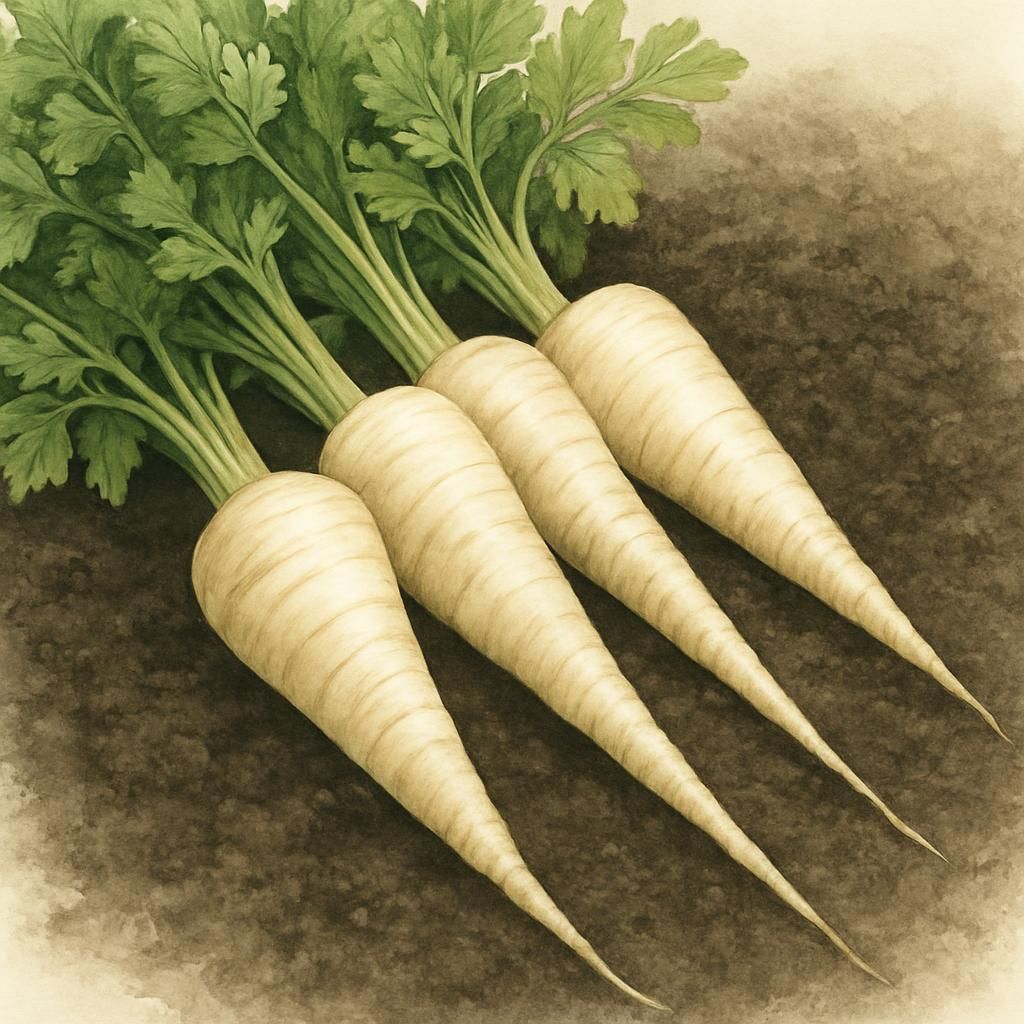
Introduction to Parsnip (Hollow Crown)
Hollow Crown parsnip has been a staple root crop in temperate gardens for generations. Its tapered, creamy-white roots develop exceptional sweetness when exposed to several weeks of cold weather, converting starches into sugars. Commercial growers and home gardeners alike value this variety for its reliable germination, uniform shape, and resistance to forking when grown in properly prepared soil. Unlike modern hybrids, Hollow Crown offers true-to-type seed saving potential and performs consistently across a range of climates.
Botanical Profile of Parsnip (Hollow Crown)
Pastinaca sativa 'Hollow Crown' belongs to the Apiaceae family, sharing lineage with Carrot and Parsley. The plant produces a deep taproot that can reach 12–18 inches in loose soil, topped by a rosette of deeply lobed, dark-green leaves. Hollow Crown is a biennial that flowers in its second year, producing flat umbels of tiny yellow flowers attractive to beneficial insects. The variety is named for the slight depression or “crown” at the root shoulder, a trait that distinguishes it from shorter, stump-rooted types.
Soil, pH, and Climate Requirements for Parsnip (Hollow Crown)
Parsnips demand deep, stone-free loam that allows straight root development. Heavy clay or compacted soils cause forking and stunting.
| Parameter | Ideal Range | Notes |
|---|---|---|
| Soil Type | Sandy loam to loam | Avoid rocks and hardpans |
| Soil pH | 6.0–7.0 | Slightly acidic to neutral |
| Soil Temperature | 50–70 °F (10–21 °C) | Germination slows below 45 °F |
| Air Temperature | 55–75 °F (13–24 °C) day; 40–50 °F night | Cool-season crop; tolerates light frost |
| Organic Matter | 3–5 % | Well-rotted compost or aged manure |
| Drainage | Excellent | Raised beds recommended on clay soils |
Step-by-Step Planting & Propagation
- Site Selection & Preparation: Choose a sunny location that received no fresh manure the previous season. Loosen soil to 18 inches and remove stones.
- Timing: Sow seed 2–3 weeks before the last spring frost when soil reaches 50 °F. In mild climates, fall sowing 60–90 days before first frost is viable.
- Seed Treatment: Parsnip seed loses viability quickly; use fresh seed each year. Soak 4–6 hours to improve germination.
- Sowing Depth & Spacing: Plant ½ inch deep, 2–3 seeds per inch in rows 18–24 inches apart. Thin to 3–4 inches between plants once seedlings reach 2 inches tall.
- Succession & Interplanting: Follow early lettuce or radish with parsnip for efficient bed use.
Care & Maintenance regimes for Parsnip (Hollow Crown)
Consistent moisture and weed control are critical during the first six weeks. Mulch with 2–3 inches of clean straw once seedlings are established to suppress weeds and retain moisture.
| Task | Frequency | Rate / Method | Notes |
|---|---|---|---|
| Watering | Weekly during establishment | 1 inch (25 mm) per week | Increase in sandy soils |
| Fertilizer | At sowing & 4 weeks later | 5-10-10 NPK at 2 lb/100 ft² | Avoid high-nitrogen after root bulking |
| Side-dress | Mid-season (8–10 weeks) | Compost tea or ½ rate balanced fertilizer | Supports steady root expansion |
| Weeding | As needed until canopy closes | Shallow cultivation or hand-pull | Avoid root disturbance |
| Pruning | None required | — | Remove flower stalks in year-two seed crop |
Pests, Diseases & Organic Management
Common threats include carrot rust fly larvae, wireworms, and aphids. Floating row covers installed at sowing exclude adult flies. Practice strict three-year rotation away from other Apiaceae crops. For fungal leaf spots, improve airflow and apply copper-based sprays only when disease pressure is high. Beneficial nematodes (Heterorhabditis bacteriophora) suppress wireworm populations in the root zone.
Harvesting, Curing & Optimal Storage
Begin harvest after 100–120 frost-free days or once roots reach 1 inch diameter at the shoulder. A light frost sweetens flavor. Lift carefully with a garden fork to avoid breakage. Cure by leaving roots in the ground under mulch through early winter or store in moist sand at 32–38 °F with 90–95 % humidity. Properly stored Hollow Crown roots remain crisp for 4–6 months.
Companion Planting for Parsnip (Hollow Crown)
Parsnips pair well with Onion, Garlic, and Lettuce to deter pests and maximize space. Avoid planting near Potato because shared pests and diseases can increase. Marigold and Nasturtium provide additional insectary benefits when sown at bed edges.