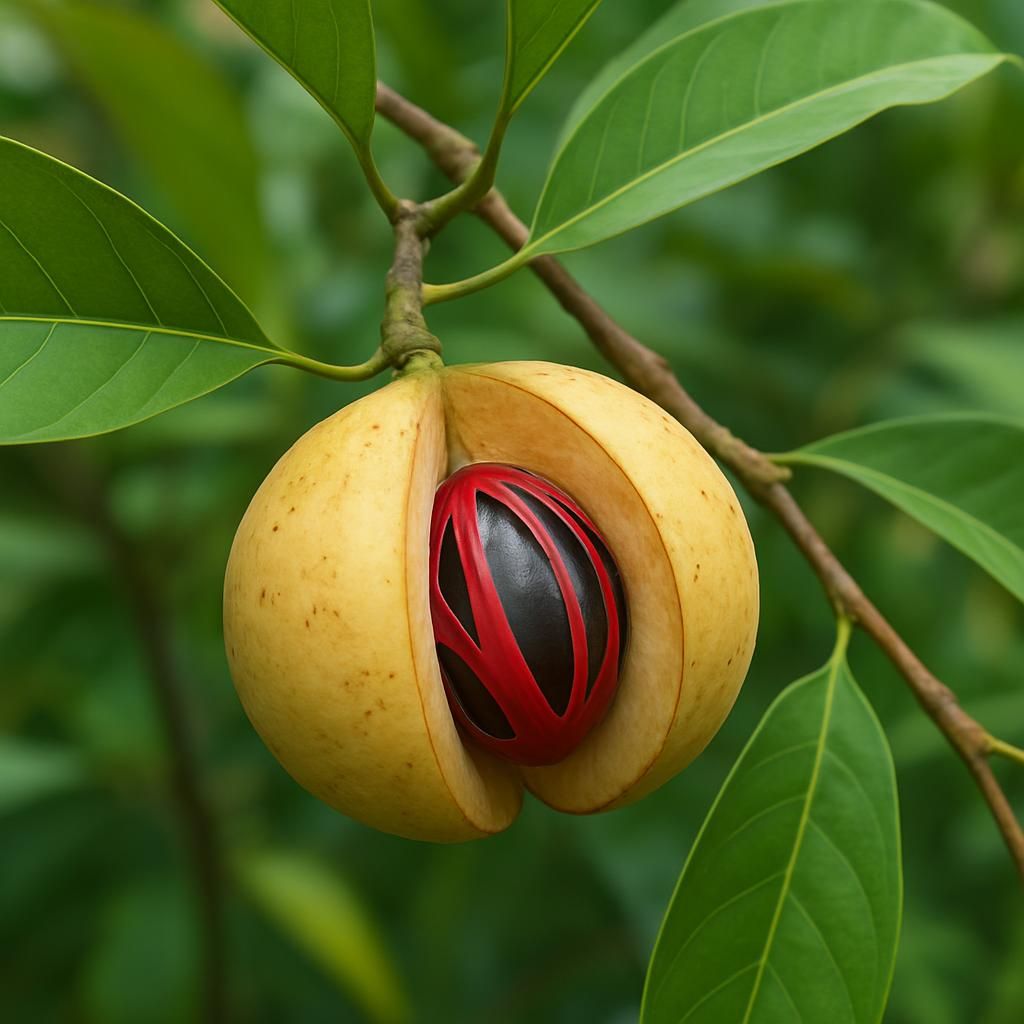
Introduction to Nutmeg (Myristica fragrans)
Nutmeg (Myristica fragrans) is a dioecious evergreen tree native to the Moluccas Islands of Indonesia and is now grown throughout the humid tropics for its highly valued seed and crimson aril known as mace. The spice has been traded for centuries and remains a cornerstone of global culinary, pharmaceutical, and cosmetic industries. Commercial plantations typically begin producing usable yields between years 8–12, with peak production occurring after 20–25 years and continuing for 60–80 years under optimal management. Successful cultivation demands consistent high humidity, deep fertile soils, and protection from strong winds.
Botanical Profile of Nutmeg (Myristica fragrans)
The tree grows 10–20 m tall with a dense, pyramidal crown and greyish-brown bark. Leaves are alternate, oblong-lanceolate, dark green, and aromatic when crushed. Male and female flowers are small, pale yellow, and borne on separate trees, requiring a ratio of one male per 10–12 females for adequate pollination. The fruit is a fleshy drupe that splits at maturity to reveal the dark brown seed surrounded by the bright red aril. The seed contains 7–15 % essential oil rich in myristicin, while the aril yields the milder, more delicate mace spice.
Soil, pH, and Climate Requirements for Nutmeg (Myristica fragrans)
Nutmeg thrives in deep, well-drained loamy or sandy loam soils rich in organic matter. Waterlogging quickly leads to root rot and should be avoided through raised beds or contour drains on slopes. The following table summarizes the ideal growing conditions:
| Parameter | Ideal Range | Notes |
|---|---|---|
| Soil Type | Deep sandy loam to clay loam | High organic matter; avoid heavy clays |
| Soil pH | 5.5–7.0 | Slightly acidic to neutral |
| Annual Rainfall | 2000–3500 mm | Evenly distributed; supplemental irrigation in dry spells |
| Temperature | 22–32 °C | Sensitive to frost below 10 °C |
| Relative Humidity | 70–90 % | Critical for pollination and fruit set |
| Elevation | 0–800 m a.s.l. | Best below 600 m for commercial yields |
| Spacing | 6 m × 6 m or 7 m × 7 m | 200–280 trees/ha with windbreaks |
Step-by-Step Planting & Propagation
- Site Selection & Preparation: Choose a sheltered location with deep, fertile soil and install windbreaks using fast-growing species such as Gliricidia. Clear vegetation, incorporate 20–30 kg well-rotted manure per planting hole, and construct 30 cm raised mounds.
- Seed Collection & Treatment: Harvest fully ripe fruits from high-yielding female trees. Remove the aril, wash seeds, and soak in clean water for 24 hours. Sow immediately because viability drops rapidly after three weeks.
- Nursery Phase: Plant seeds 2–3 cm deep in polybags filled with a 2:1:1 mixture of topsoil, sand, and compost. Maintain 70–80 % shade and daily watering. Germination occurs in 30–60 days.
- Sex Identification & Grafting: After 12–18 months, seedlings can be field-planted. Because only females produce fruit, commercial orchards graft female scions onto seedling rootstocks or use marcotting to propagate known female clones. Grafted plants begin bearing 4–6 years earlier than seedlings.
- Field Planting: Transplant at the start of the rainy season. Dig 60 cm³ holes, backfill with topsoil plus 5 kg compost and 200 g rock phosphate. Stake plants and provide temporary shade for the first 6–12 months.
Care & Maintenance regimes for Nutmeg (Myristica fragrans)
Consistent moisture, balanced nutrition, and timely pruning are essential for sustained high yields. The table below outlines recommended schedules:
| Operation | Frequency | Details |
|---|---|---|
| Irrigation | Weekly in dry season | 20–30 L per tree; drip irrigation preferred to maintain 70 % field capacity |
| Fertilizer | Year 1–3: 4×/year; Year 4+: 2×/year | Apply 500 g NPK 15-15-15 + 5 kg compost per tree in split doses; increase to 2–3 kg NPK at maturity |
| Mulching | Twice yearly | 10–15 cm layer of coconut husk or leaf litter to conserve moisture and suppress weeds |
| Pruning | Annual after harvest | Remove dead wood, water sprouts, and low branches; maintain 3–4 main scaffold limbs |
| Weeding | 3–4×/year | Manual or mechanical; avoid deep cultivation near shallow feeder roots |
Pests, Diseases & Organic Management
Major pests include scale insects, mealybugs, and fruit flies. Regular monitoring and release of predatory beetles and lacewings provide effective biological control. Root-knot nematodes can be managed through crop rotation with marigold and solarization of nursery beds. The primary disease threats are Phytophthora collar rot and thread blight. Improve drainage, apply 1 % Bordeaux mixture during monsoon onset, and prune for better air circulation. Organic growers may use neem oil (0.5 %) and Trichoderma viride soil drenches to suppress fungal pathogens.
Harvesting, Curing & Optimal Storage
Fruits are harvested when the pericarp splits naturally, usually 9–10 months after flowering. Pick by hand or with long-handled poles fitted with nets to avoid bruising. Separate the aril (mace) immediately and sun-dry for 3–5 days until it turns amber. The remaining seeds are dried for 4–8 weeks until the kernel rattles inside the shell, then cracked and graded. Store nutmeg kernels and mace separately in airtight containers at 10–15 °C and <60 % RH. Properly cured nutmeg retains flavor and essential oil content for 2–3 years.
Companion Planting for Nutmeg (Myristica fragrans)
Nutmeg benefits from understory companions that improve soil fertility and deter pests. Coconut provides light shade and wind protection in the early years. Leguminous cover crops such as pigeon pea and clover fix nitrogen and reduce erosion on slopes. Aromatic herbs including thyme and rosemary repel aphids and whiteflies. Interplanting rows of black pepper on living standards of gliricidia creates an additional income stream while maintaining the humid microclimate preferred by nutmeg.