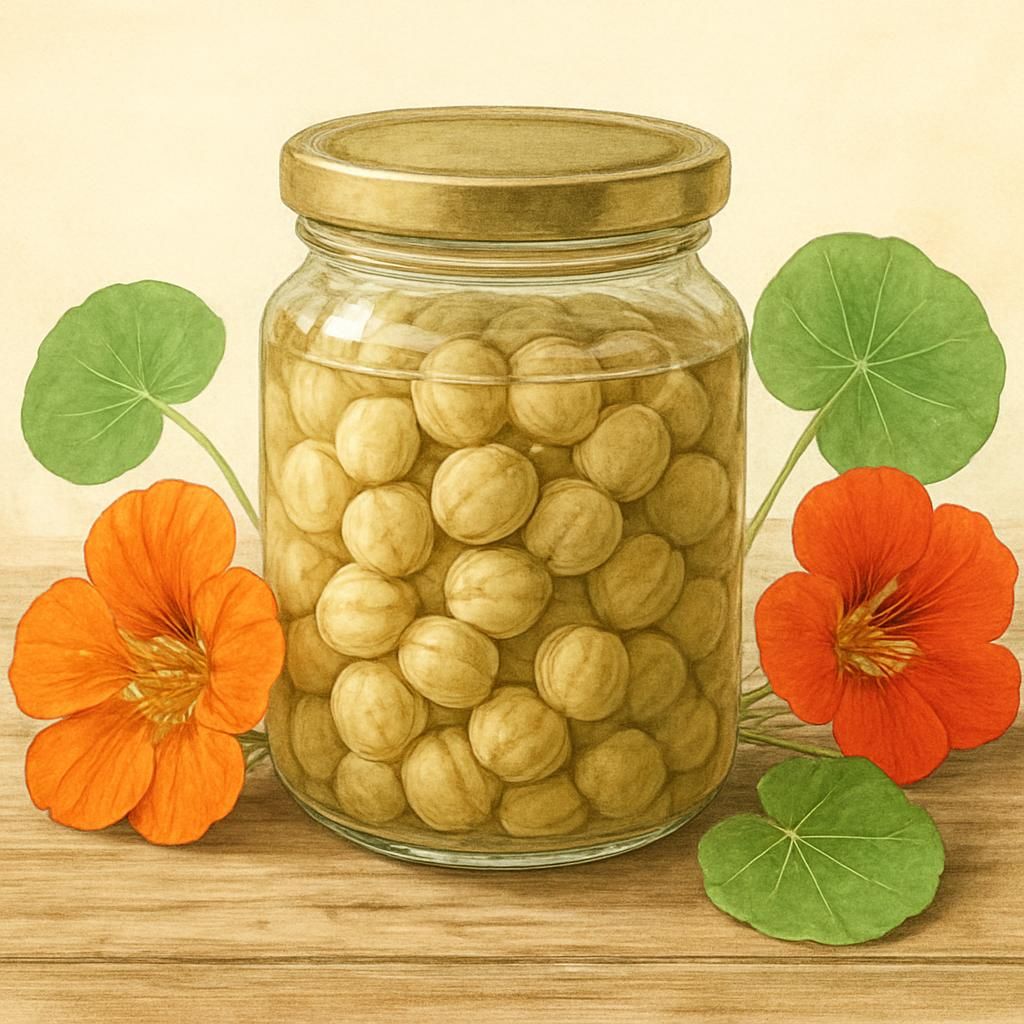
Introduction to Nasturtium Seed (Pickled)
Nasturtium Seed (Pickled) is produced from the annual herbaceous plant Tropaeolum majus, whose large, peppery seeds are harvested at full maturity and preserved in vinegar brine. The resulting product offers a spicy, mustard-like flavor that serves as an economical alternative to true capers. Commercial and small-farm growers value nasturtium for its rapid growth cycle, edible flowers and leaves, and the additional revenue stream from pickled seeds sold to specialty food markets.
The plant thrives in temperate climates and requires minimal inputs once established, making it suitable for both home gardeners and market gardeners seeking low-maintenance, high-value crops. Seed production begins approximately 90–110 days after sowing, with peak harvest occurring when pods turn from green to light tan. Proper post-harvest handling ensures the seeds retain their characteristic pungency and firm texture after brining.
This definitive growing guide provides detailed, professional-grade instructions on soil preparation, planting schedules, irrigation regimes, integrated pest management, and seed processing specifically optimized for pickled-seed production. Emphasis is placed on organic practices that maintain soil health while maximizing seed yield and quality.
Botanical Profile of Nasturtium Seed (Pickled)
Tropaeolum majus belongs to the family Tropaeolaceae and is native to the Andes of South America. The species is a fast-growing, sprawling or climbing annual that reaches 1–3 meters in length depending on cultivar and support. Leaves are peltate, orbicular to reniform, and 3–15 cm across with prominent palmate venation. Bright yellow to orange-red flowers are zygomorphic with a long nectar spur, attracting pollinators throughout the growing season.
Mature fruits are schizocarps that split into three single-seeded segments. Each seed is 5–8 mm in diameter, wrinkled, and greenish-brown when fresh, turning pale tan upon drying. The seeds contain glucosinolates that hydrolyze into isothiocyanates, imparting the characteristic spicy flavor prized in pickling. Unlike many legumes, nasturtium seeds do not require scarification for germination but benefit from consistent moisture during the first 7–10 days after sowing.
Soil, pH, and Climate Requirements for Nasturtium Seed (Pickled)
Nasturtium performs best in moderately fertile, well-drained soils. Excessive nitrogen promotes lush foliage at the expense of flowering and seed set. The crop tolerates a wide pH range but achieves optimal nutrient uptake and seed quality between pH 6.0 and 7.0. In heavier clay soils, incorporation of coarse organic matter improves drainage and reduces the risk of root rot.
| Parameter | Ideal Range | Notes |
|---|---|---|
| Soil Type | Sandy loam to loam | Avoid heavy clay without amendment |
| Soil pH | 6.0 – 7.0 | Maintain with agricultural lime if needed |
| Temperature (day) | 18–26 °C | Optimal flowering and seed fill |
| Temperature (night) | 10–15 °C | Tolerates light frost once established |
| USDA Hardiness | Zones 9–11 (annual elsewhere) | Direct sow after last frost |
| Light Requirement | Full sun (6+ hours) | Partial shade reduces seed yield |
| Drainage | Excellent | Raised beds recommended in wet climates |
Step-by-Step Planting & Propagation
Site Selection: Choose a location receiving at least six hours of direct sunlight with protection from strong winds. South- or west-facing slopes warm earlier in spring and accelerate early growth.
Soil Preparation: Conduct a soil test four weeks before planting. Incorporate 2–3 cm of well-rotted compost or aged manure. Avoid fresh manure, which can cause excessive vegetative growth. Rake the surface smooth and remove large stones.
Sowing Timing: Direct sow seeds outdoors when soil temperature reaches a minimum of 12 °C, typically 1–2 weeks after the last expected frost. In cooler regions, start seeds indoors in biodegradable pots 3–4 weeks before transplanting.
Seeding Depth and Spacing: Plant seeds 1.5–2 cm deep. Space plants 20–30 cm apart in rows 45–60 cm wide for seed production; closer spacing (15 cm) is acceptable when growing primarily for flowers.
Support Structures: Install 1.5–2 m trellises or pea netting for climbing cultivars to improve air circulation and facilitate harvest. Bush types require no support but benefit from 5 cm of mulch to suppress weeds.
Germination: Expect 70–90 % germination within 7–14 days under optimal moisture and temperature. Thin seedlings to one vigorous plant per station when they reach the two-true-leaf stage.
Care & Maintenance regimes for Nasturtium Seed (Pickled)
Consistent but moderate irrigation promotes steady seed development without promoting fungal issues. Mulch with 5–7 cm of straw or shredded leaves to conserve moisture and moderate soil temperature. Side-dress with a low-nitrogen, phosphorus-rich organic fertilizer at flowering to support seed fill.
| Growth Stage | Watering Frequency | Fertilizer Application | Pruning / Training |
|---|---|---|---|
| Seedling (0–4 weeks) | Keep evenly moist | None | None |
| Vegetative (4–8 weeks) | 25 mm/week | Compost tea (1:10) at week 6 | Pinch tips at 30 cm to encourage branching |
| Flowering (8–12 weeks) | 20 mm/week | Low-N bloom booster (2-5-8) at first bloom | Remove spent flowers to prolong bloom |
| Seed Fill (12–16 weeks) | 15–20 mm/week | Light potassium sulfate if deficiency noted | Cut back 20 % of foliage for air flow |
| Pre-Harvest | Reduce to 10 mm/week | None | Remove lower leaves to ease harvest |
Pests, Diseases & Organic Management
Nasturtium is relatively pest-resistant due to its natural production of benzyl isothiocyanate, but aphids, cabbage loopers, and slugs and snails may occasionally appear. Monitor weekly and apply insecticidal soap or neem oil at the first sign of infestation. Powdery mildew can develop in humid conditions; improve spacing and apply a weekly spray of 1 % potassium bicarbonate solution.
Root-knot nematodes are rare but can be managed through crop rotation with marigold or garlic and solarization of beds between seasons. Maintain good sanitation by removing crop debris at season end to reduce overwintering inoculum of Botrytis.
Harvesting, Curing & Optimal Storage
Harvest seeds when pods turn pale tan and begin to split naturally, typically 100–120 days after sowing. Collect pods in the early morning while dew is still present to reduce shattering. Dry seeds on screens in a shaded, well-ventilated area at 25–30 °C for 5–7 days until moisture content reaches 10–12 %.
For pickling, place fully dry seeds in sterilized jars and cover with a hot brine of 5 % vinegar, 2 % non-iodized salt, and optional spices (mustard seed, peppercorns, bay leaf). Process in a boiling-water canner for 10 minutes for long-term storage. Properly sealed jars retain quality for 12–18 months at cool room temperature.
Companion Planting for Nasturtium Seed (Pickled)
Nasturtium serves as an excellent trap crop for aphids when planted near tomato or cucumber. Its flowers attract beneficial insects such as hoverflies and parasitic wasps that help control aphids and thrips across the garden. Pair nasturtium with basil and marigold to enhance biodiversity and reduce pest pressure organically.
Avoid planting near brassicas if seed production is the primary goal, as shared pests may increase. Interplanting with low-growing lettuce or radish provides living mulch and maximizes bed space during the early season.