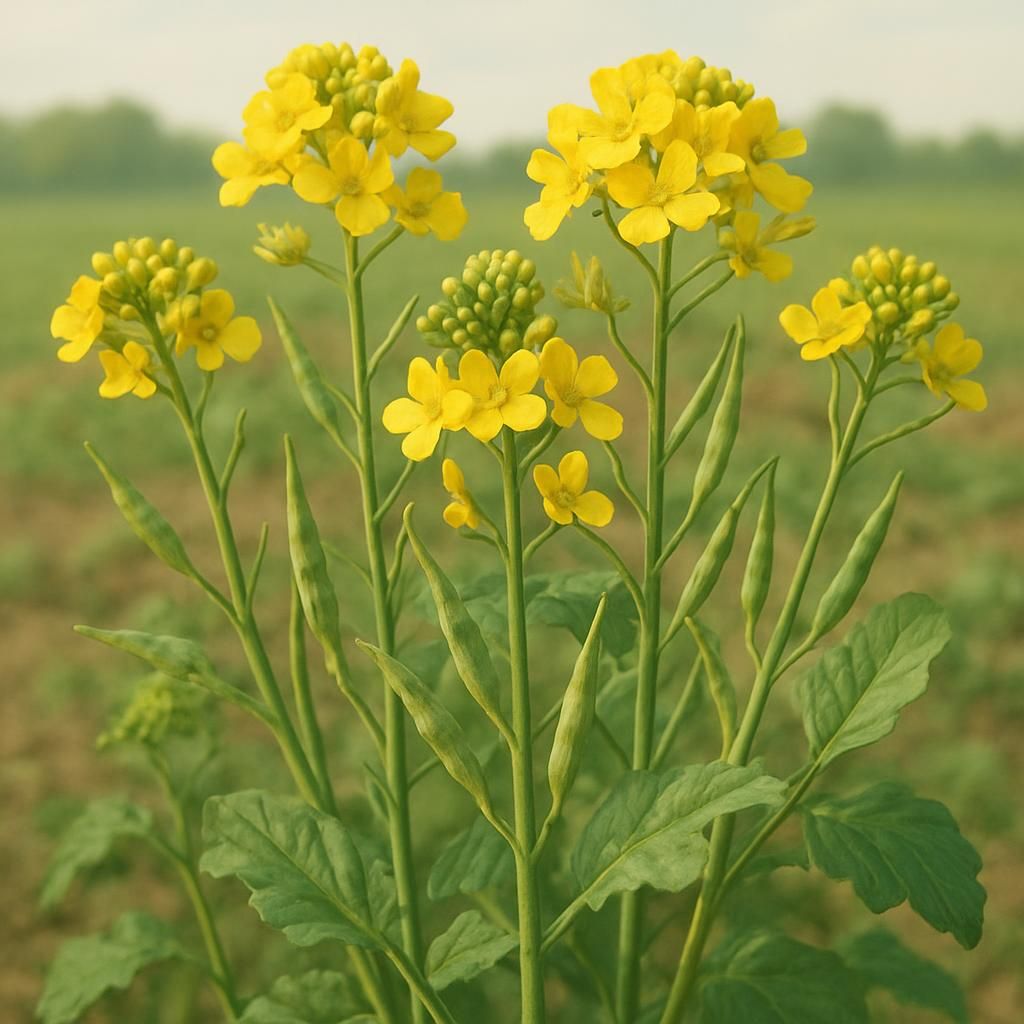
Introduction to Mustard Seed (Yellow - Sinapis alba)
Yellow mustard (Sinapis alba) is one of the oldest cultivated crops, grown for both its oil-rich seeds and as a green manure. The plant produces bright yellow flowers and spherical seeds that are ground into the familiar table mustard condiment or pressed for culinary oil. Because it matures in 80–95 days and fixes nitrogen while suppressing weeds and nematodes, it is a popular break crop in cereal rotations. Commercial production occurs across the Canadian prairies, northern Europe, and parts of India and Australia.
Botanical Profile of Mustard Seed (Yellow - Sinapis alba)
Sinapis alba belongs to the Brassicaceae family and is closely related to Rapeseed. The plant grows 60–120 cm tall with deeply lobed leaves and terminal racemes of four-petaled yellow flowers. Each silique contains 4–6 spherical seeds 1.5–2.5 mm in diameter. Seeds contain 25–35 % oil and 30–35 % protein. The species is predominantly self-pollinating but benefits from insect visitation. Unlike brown or black mustard (Brassica juncea and Brassica nigra), yellow mustard has a milder flavor and higher mucilage content, making it preferred for European-style mustards.
Soil, pH, and Climate Requirements for Mustard Seed (Yellow - Sinapis alba)
Yellow mustard performs best on well-drained loams and sandy loams with moderate fertility. It tolerates slightly saline conditions better than most brassicas but is sensitive to waterlogging. The crop prefers cool temperatures during vegetative growth and warm, dry conditions during seed fill.
| Parameter | Ideal Range | Notes |
|---|---|---|
| Soil Type | Loam to sandy loam | Avoid heavy clays and compacted soils |
| Soil pH | 6.0–7.5 | Tolerates up to 8.5; liming recommended below 5.8 |
| Temperature (day) | 15–25 °C | Optimal flowering at 18–22 °C |
| Temperature (night) | 5–12 °C | Frost tolerant to –4 °C at seedling stage |
| Annual Rainfall | 400–750 mm | Supplemental irrigation if <350 mm |
| Growing Degree Days | 1,200–1,600 GDD (base 5 °C) | Maturity reached in 80–95 days |
Step-by-Step Planting & Propagation
- Seedbed Preparation: Till or use no-till drills to create a firm, fine seedbed free of large clods.
- Sowing Window: Plant when soil temperature reaches 7–10 °C; early spring in northern latitudes or autumn in mild-winter regions.
- Seeding Rate: 6–10 kg/ha for grain production; 12–15 kg/ha for green manure.
- Depth and Spacing: Drill 1–2 cm deep in 15–20 cm rows. For broadcast stands, harrow lightly after seeding.
- Inoculation: Not required, but seed can be treated with rhizobial inoculants if following non-legume crops.
- Germination: Expect 85–95 % emergence within 5–8 days under adequate moisture.
Care & Maintenance regimes for Mustard Seed (Yellow - Sinapis alba)
Adequate moisture during flowering and early pod fill is critical. Excess nitrogen promotes lodging; balanced fertility is preferred.
| Growth Stage | Irrigation Schedule | Fertilizer Application | Pruning / Other Operations |
|---|---|---|---|
| Pre-plant | Ensure top 10 cm moist | 30–40 kg N/ha, 20–30 kg P₂O₅/ha, 15–25 kg K₂O/ha | Incorporate residue from previous crop |
| Emergence–Rosette | 15–20 mm if rainfall <10 mm/week | Side-dress 20 kg N/ha if deficiency appears | Scout for flea beetles |
| Stem Elongation | Maintain 50 % field capacity | Avoid excess N to prevent lodging | None required |
| Flowering–Pod Fill | Critical period; 25 mm/week | Foliar boron 0.3 % if soil test <1 ppm | None required |
| Maturity | Withhold irrigation 10–14 days prior | None | Swath or direct combine |
Pests, Diseases & Organic Management
Common pests include flea beetles, aphids, and cutworms. Early planting and trap cropping with radish reduce flea-beetle pressure. Diseases such as Alternaria leaf spot, white mold, and clubroot can be managed by 3–4 year rotations and resistant varieties. Organic controls include neem-based sprays for aphids, Bacillus thuringiensis for caterpillars, and soil solarization for clubroot. Beneficial insects such as lady beetles and parasitic wasps should be conserved by avoiding broad-spectrum insecticides during flowering.
Harvesting, Curing & Optimal Storage
Harvest when 60–70 % of pods turn straw-colored and seed moisture reaches 12–15 %. Swathing followed by 5–10 days of field drying is standard in dry climates. Direct combining is possible with desiccation when seed moisture is below 12 %. Clean and dry seed to 8–9 % moisture for long-term storage. Store in cool (<15 °C), dry (<65 % RH) conditions in sealed bins or bags. Viability remains above 85 % for 3–5 years under proper conditions.
Companion Planting for Mustard Seed (Yellow - Sinapis alba)
Yellow mustard is an excellent companion for cereals such as Wheat and Barley because it breaks disease cycles and improves soil structure. It pairs well with legumes like Peas and Lentils in mixed stands for nitrogen fixation synergy. Avoid planting near other brassicas to reduce shared pest and disease pressure. When used as a biofumigant green manure, mustard residues suppress soil-borne pathogens for subsequent crops such as Potato and Tomato.