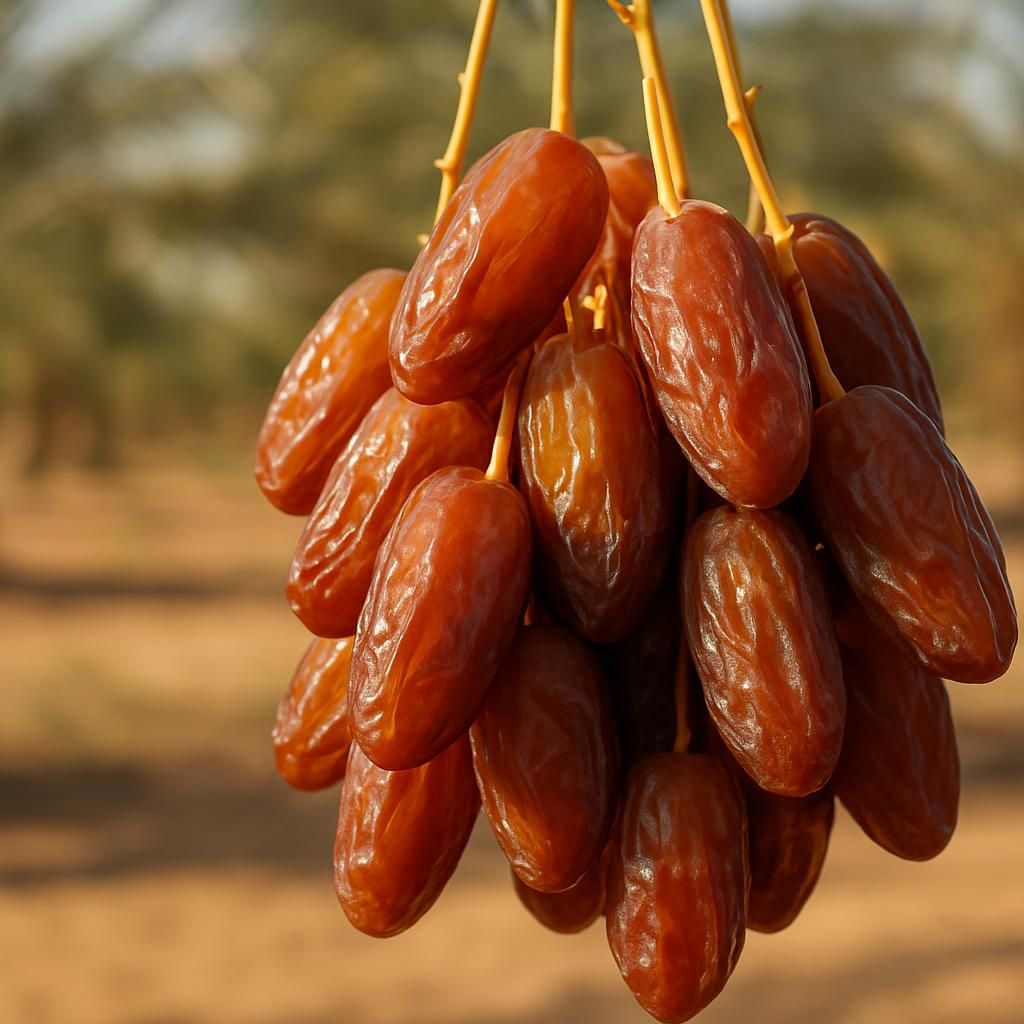
Introduction to Medjool
Medjool dates represent the pinnacle of date palm cultivation, offering growers exceptional market value and consumers a luxurious, nutrient-dense fruit. Originally cultivated in Morocco's Tafilalet region, the cultivar has become the world's most recognized soft date thanks to its large fruit size, rich caramel flavor, and versatile culinary applications. Successful production requires arid or semi-arid climates, precise irrigation management, and long-term commitment since palms reach full productivity only after 7–10 years.
Botanical Profile of Medjool
Medjool belongs to the Arecaceae family and grows as a tall, single-trunked dioecious palm reaching 15–25 meters at maturity. The trunk is covered in persistent leaf bases that provide structural support and protection. Each palm produces 10–20 pinnate fronds annually, each 3–5 meters long. Female inflorescences emerge from axillary buds and develop into heavy bunches weighing 10–20 kg when mature. The fruit is an oblong drupe 3.5–5 cm long with thick, amber-to-mahogany skin and a single elongated seed. Medjool palms exhibit moderate salt tolerance and can survive brief frosts to -5 °C but require sustained heat units above 3,000 growing degree days for proper ripening.
Soil, pH, and Climate Requirements for Medjool
Medjool palms demand well-drained sandy loam or loamy sand soils with high permeability to prevent root rot. They tolerate moderate salinity (EC up to 6–8 dS/m) but perform best in low-sodium conditions. Soil pH should remain slightly alkaline.
| Parameter | Ideal Range | Notes |
|---|---|---|
| Soil Type | Sandy loam to loamy sand | Excellent drainage essential |
| Soil pH | 7.5–8.5 | Tolerates 7.0–9.0; avoid acidic soils |
| Soil Salinity (EC) | 0–4 dS/m | Up to 8 dS/m acceptable for mature palms |
| Temperature Range | 20–45 °C daytime | Requires >3,000 GDD for fruit ripening |
| Annual Rainfall | <250 mm | Supplemental irrigation mandatory |
| Relative Humidity | <50 % during ripening | High humidity increases disease pressure |
| Frost Tolerance | Brief exposure to -5 °C | Young palms more sensitive |
| Elevation | 0–800 m | Higher elevations delay maturity |
Step-by-Step Planting & Propagation
- Site Selection: Choose full-sun locations with deep water tables and protection from strong winds.
- Soil Preparation: Deep-rip to 1.2 m, incorporate 20–30 t/ha well-rotted manure, and level for flood or drip irrigation.
- Propagation: Use offshoots (pups) 1–2 years old weighing 15–25 kg. Remove carefully with a sharp chisel, treat cut surfaces with copper fungicide, and plant immediately.
- Planting Depth & Spacing: Plant pups so the root ball sits 5 cm below grade. Commercial spacing is 8–10 m between rows and 8 m within rows (125 palms/ha). Home gardens can use 7 m triangular spacing.
- Irrigation at Planting: Apply 40–50 L per palm immediately after planting and maintain consistent moisture for the first 90 days.
- Wind Protection: Install temporary shade cloth or windbreaks for the first two seasons.
Care & Maintenance regimes for Medjool
Young palms require frequent irrigation and balanced nutrition to establish strong root systems. Mature palms transition to deficit irrigation strategies that concentrate sugars while preventing stress-induced fruit drop.
| Growth Stage | Water Schedule | Fertilizer Schedule | Pruning Schedule |
|---|---|---|---|
| Establishment (Yr 1–3) | 40–60 L/palm, 3–4× weekly drip | 200 g N, 100 g P₂O₅, 300 g K₂O per palm every 6 weeks | Remove only dead or damaged fronds |
| Juvenile (Yr 4–6) | 80–120 L/palm, 2× weekly | 500 g N, 250 g P₂O₅, 750 g K₂O split into 4 applications | Thin to 80–90 green fronds; remove suckers |
| Mature Production | 150–200 L/palm weekly, reduce 30 % at fruit set | 1.5 kg N, 0.75 kg P₂O₅, 2.5 kg K₂O + 200 g Mg + micronutrients annually | Maintain 70–80 fronds; remove 1–2 oldest fronds per month |
| Pre-Harvest (Aug–Sep) | Reduce to 100 L weekly to concentrate sugars | Stop N applications; maintain K only | No pruning 60 days before harvest |
Pests, Diseases & Organic Management
Major threats include the Red palm weevil, Rhinoceros beetle, and Spider mites. Fungal issues such as Graphiola leaf spot and Bayoud disease can devastate orchards. Implement integrated management:
- Sanitation: Remove and destroy infested fronds and offshoots.
- Biological control: Release predatory mites against spider mites and use entomopathogenic nematodes for weevil larvae.
- Organic sprays: Neem oil (0.5 %) + horticultural oil every 14 days during flush growth.
- Pheromone traps: Deploy 4–6 traps per hectare for red palm weevil monitoring.
- Resistant rootstocks: Use Bayoud-tolerant cultivars such as 'Deglet Noor' or 'Barhee' as interstocks where possible.
Harvesting, Curing & Optimal Storage
Medjool dates reach the Khalal (color break), Rutab (softening), and Tamar (fully ripe) stages. Commercial harvest occurs at early Tamar when fruit moisture is 20–24 % and skin shows deep amber color. Cut entire bunches with a curved knife, lower gently with ropes, and sort on padded tables. Curing involves 3–5 days at 35–40 °C and 70–75 % RH to equalize moisture and develop flavor. Cool to 0–4 °C within 24 hours post-curing. Store at 0 °C and 85–90 % RH for up to 12 months or freeze at -18 °C for 24+ months. Maintain 18–22 % moisture for premium soft texture.
Companion Planting for Medjool
Interplanting with nitrogen-fixing legumes improves soil fertility and provides wind protection. Recommended companions include Clover, Pigeon pea, and Sesame sown in alleyways. Low-growing aromatic herbs such as Rosemary and Thyme deter spider mites and improve pollinator habitat. Avoid tall competitive crops like Corn or Sunflower within 3 m of palm trunks. In young orchards, intercropping with Watermelon or Cantaloupe during the first three years maximizes land use without competing for water or nutrients.