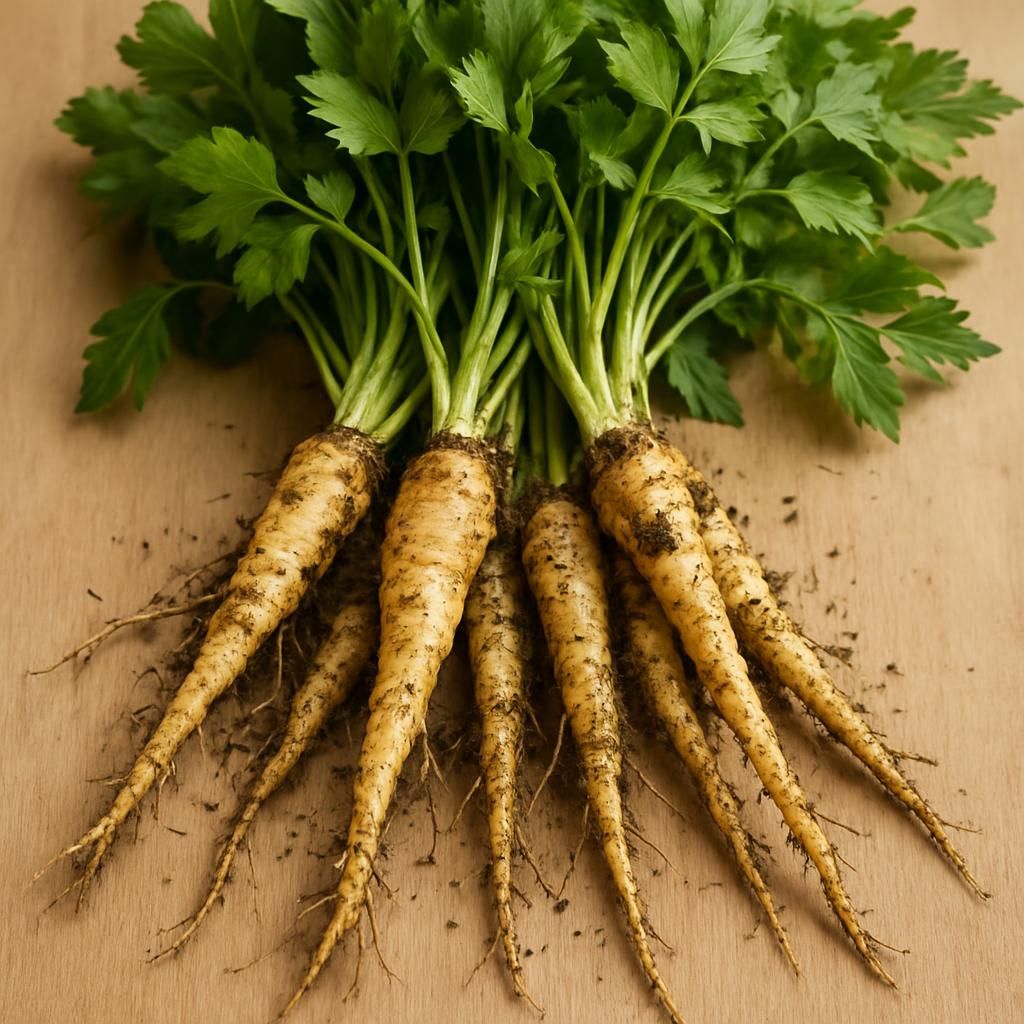
Introduction to Lovage Root
Lovage (Levisticum officinale) is a vigorous, celery-scented perennial in the Apiaceae family that has been cultivated since ancient times for its aromatic roots, leaves, and seeds. The plant reaches 1.5–2.5 m in height with deeply divided, glossy green foliage and umbels of yellow-green flowers that attract beneficial insects. Its thick taproots develop a rich, savory flavor reminiscent of celery and parsley, making them prized in soups, stews, and herbal liqueurs.
Home gardeners and small-scale growers appreciate lovage for its low maintenance once established and its ability to produce for 5–10 years from a single planting. The roots contain essential oils, coumarins, and phthalides that contribute to traditional uses as a digestive tonic and diuretic. Because the plant is both ornamental and productive, it fits well into edible landscapes and perennial herb borders.
Botanical Profile of Lovage Root
Lovage forms a basal rosette of compound leaves in its first year before sending up tall, hollow flowering stems in subsequent seasons. The roots are fleshy, pale yellow to tan, and can reach 30–60 cm in length with a diameter of 3–8 cm on mature plants. Flowers appear in compound umbels from early to mid-summer, followed by ribbed, aromatic seeds that readily self-sow if not harvested.
The plant is fully hardy to USDA zone 4 and tolerates light frost. It prefers full sun to partial shade and performs best with consistent moisture and fertile, well-drained soil. Unlike true celery, lovage develops a deep taproot that stores carbohydrates, allowing it to regrow vigorously each spring.
Soil, pH, and Climate Requirements for Lovage Root
Lovage performs optimally in deep, loamy soils with high organic matter. The following table summarizes ideal growing conditions:
| Parameter | Ideal Range/Value | Notes |
|---|---|---|
| Soil Type | Deep loam or sandy loam | Avoid compacted or heavy clay |
| Soil pH | 6.0–7.0 | Slightly acidic to neutral |
| Temperature Range | 15–24 °C (59–75 °F) | Cool-season perennial; tolerates light frost |
| USDA Hardiness Zones | 4–8 | Dies back in winter; regrows from crown |
| Sun Exposure | Full sun to partial shade | At least 6 hours direct light preferred |
| Spacing | 45–60 cm between plants | Rows 75–90 cm apart |
| Soil Depth | Minimum 45 cm workable depth | Accommodates long taproot |
Step-by-Step Planting & Propagation
- Site Preparation: Choose a permanent location with deep, fertile soil. Remove weeds and incorporate 5–8 cm of well-rotted compost or aged manure.
- Seed Starting: Sow seeds indoors 8–10 weeks before the last frost at 18–21 °C. Germination takes 14–21 days. Transplant seedlings when they have 4–6 true leaves.
- Direct Sowing: In early spring or fall, sow seeds 1 cm deep in prepared beds. Thin seedlings to 45–60 cm spacing once they reach 10 cm tall.
- Division: Established clumps can be divided in early spring or autumn. Each division should include at least one growing point and a portion of the taproot.
- Root Cuttings: Take 8–10 cm root sections in late winter, plant vertically with the top just below soil level, and keep moist until shoots emerge.
Care & Maintenance regimes for Lovage Root
Consistent moisture and moderate fertility keep plants productive. The table below outlines recommended schedules:
| Task | Frequency | Details |
|---|---|---|
| Watering | 2–3 times per week during growth | Maintain even moisture; 2.5–4 cm per week |
| Fertilizer | Early spring and mid-summer | Apply balanced organic fertilizer (NPK 5-5-5) or compost tea |
| Pruning | Remove flower stalks after bloom | Cut back to base to encourage leaf production; divide every 4–5 years |
| Mulching | Apply 5–8 cm organic mulch | Retains moisture and suppresses weeds |
| Winter Protection | Late autumn | Cut foliage to 10 cm and mulch crowns in zones 4–5 |
Pests, Diseases & Organic Management
Lovage is relatively pest-resistant but can be affected by Aphids, Spider Mites, and Slugs. Monitor undersides of leaves and use strong water sprays or insecticidal soap for aphids. Slugs are best controlled with beer traps or diatomaceous earth barriers.
Fungal issues such as Powdery Mildew may appear in humid conditions. Improve air circulation by proper spacing and remove affected foliage. Root Rot can occur in poorly drained soils; ensure beds are raised or amended with coarse sand. Rotate plantings every 5–7 years to reduce soil-borne pathogen buildup.
Harvesting, Curing & Optimal Storage
Leaves can be harvested continuously from the second year onward. Cut outer stalks at the base to encourage new growth. Roots are best dug in autumn of the second or third year when they reach 3–5 cm diameter. Wash thoroughly, slice into 1 cm pieces, and dry at 35–40 °C until brittle. Store dried roots in airtight glass jars away from light for up to two years. Fresh roots may be refrigerated in damp sand for several weeks.
Seeds are collected when umbels turn brown. Cut entire stalks, hang upside down in paper bags, and allow to finish drying indoors. Store seeds in cool, dark conditions for culinary or planting use.
Companion Planting for Lovage Root
Lovage pairs well with Tomato, Carrot, and Onion because its aromatic foliage repels pests while attracting pollinators. Avoid planting near Parsley or other Apiaceae members to reduce cross-pollination and disease transmission. Its tall stature provides light shade for low-growing crops such as Lettuce during summer heat.
For more ideas on strategic pairings, see Summer Companion Planting: 10 Organic Pairings to Boost Small Farm Resilience.