Introduction to Loose Smut
Loose smut stands as one of the most insidious fungal diseases plaguing cereal agriculture worldwide, capable of devastating yields by transforming healthy grain heads into powdery masses of spores. Caused primarily by species of the Ustilago genus—such as Ustilago nuda in barley, Ustilago tritici in wheat, and U. avenae in oats—this pathogen infiltrates the plant during its most vulnerable seedling stage. Unlike covered smuts where spore masses remain enclosed in membranes, loose smut's teliospores are exposed and readily dispersed by wind, earning its name from the loose, dusty appearance of infected heads.
First identified in the 19th century, loose smut has evolved alongside cereal cultivation, with historical records noting epidemics in Europe and North America that wiped out entire harvests. Today, it poses a persistent threat to small farms and large-scale operations alike, particularly in temperate regions. Yield losses can exceed 70% in untreated fields, as infected plants produce no viable grain, only serving as spore factories for future infections. Early detection and proactive management are crucial, as chemical seed treatments offer reliable control, but organic growers must turn to resistant cultivars and cultural practices. This guide provides definitive diagnostic criteria, lifecycle insights, and proven strategies to safeguard your cereal crops from loose smut's grip. For more on related fungal threats, see our overview of covered smut.
Understanding loose smut's biology is key to prevention. The fungus overwinters in seeds, germinating systemically within the embryo without external symptoms until heading. This stealthy invasion differentiates it from foliar diseases like rusts or powdery mildew, demanding seed-focused interventions. Global incidence varies, but in high-risk areas like the U.S. Great Plains and India's wheat belts, it affects up to 20% of untreated crops annually.
Identifying Symptoms & Damage
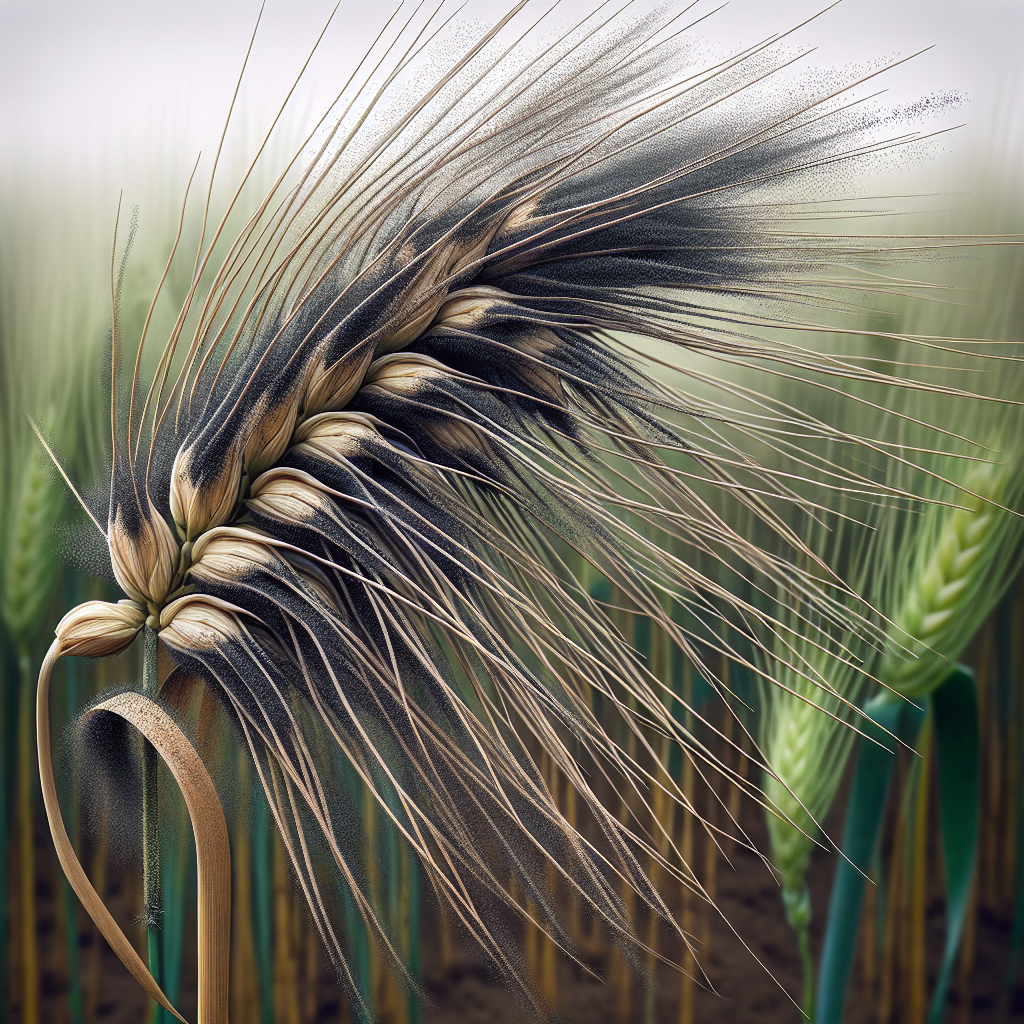
Diagnosing loose smut requires keen observation during the crop's reproductive phase, typically at heading or anthesis. The hallmark symptom is the complete replacement of the grain head with a dusty mass of olive-black teliospores, which emerge from the boot leaf as the awns or glumes begin to split. Unlike healthy heads brimming with plump kernels, infected ones appear elongated and fragile, with spores sifting out easily upon the slightest breeze or touch—hence the 'loose' moniker.
Early signs are subtle: infected plants may tiller normally and show no foliar chlorosis or stunting until boot stage. At full head emergence, the spore mass mimics a miniature dust cloud, often 1-2 inches long, contrasting sharply with neighboring healthy panicles. Damage is total per plant; no grains form, leading to 100% loss for that tiller. Field-wide, infection rates below 5% may go unnoticed, but hotspots exceeding 20% signal severe epidemics. Differentiate from common bunt (covered spore sacs) or Fusarium head blight (pinkish mycelium and mycotoxins).
Secondary symptoms include slight plant vigor reduction due to energy diversion to spore production. In advanced cases, spores cover leaves and soil, staining equipment black. Yield impact scales linearly with infection: 10% infection halves potential harvest. Scout fields weekly from boot stage, shaking heads over white paper to check for spore fallout. Lab confirmation via microscopy reveals teliospores (7-10 μm, globose, spiny-walled). Economic thresholds: rogue plants if >5% incidence pre-harvest to curb spore spread.
Lifecycle and Progression of Loose Smut
Loose smut's lifecycle is a masterclass in systemic parasitism, synchronizing perfectly with host development. Infection begins with teliospores on the seed surface or soil, germinating in cool, moist conditions (10-20°C, high humidity) to produce basidiospores (promycelia) that penetrate the seedling embryo within 24-48 hours of planting. Crucially, this occurs before the coleoptile emerges, allowing mycelium to grow intercellularly through meristems without triggering defenses.
The fungus remains dormant yet proliferative, colonizing shoot and flower primordia over winter. No external symptoms manifest until meiosis at heading: diploid teliospores form in floret spaces, rupturing glumes to expose 10^6-10^7 spores per head. Dispersal follows via wind (up to 1 km), rain splash, or machinery, with viability persisting 2-5 years in dry soil. Unlike foliar pathogens, loose smut is strictly seedborne or soilborne, not airborne during vegetation.
Progression hinges on temperature: optimal infection at 15°C soil temps during imbibition. In wheat, systemic spread completes by tillering; in barley, by jointing. Sporulation peaks at anthesis, with spores maturing over 7-10 days. Over-summering occurs in plant debris or seed lots, resistant to desiccation. This closed lifecycle underscores seed certification's primacy—contaminated lots perpetuate cycles indefinitely.
Environmental Triggers & Risk Factors
Cool, wet springs prime loose smut epidemics, with soil temps of 12-18°C and >80% relative humidity during germination favoring basidial penetration. Prolonged leaf wetness (12+ hours) at boot stage accelerates spore release. Regions like the Pacific Northwest or Punjab exemplify hotspots due to maritime climates. Poor drainage, compacted soils, and high residue retention exacerbate survival.
Key risk factors include volunteer cereals harboring spores, continuous monoculture (e.g., wheat-on-wheat), and untreated farm-saved seed (infection rates >30%). Susceptible varieties like older spring barleys amplify damage; late planting dodges cool windows but risks drought. Compounding pests like aphids or Hessian fly stress plants, indirectly boosting susceptibility. Climate change may shift risks northward with milder winters. For farms in variable climates, check our blog on Why 80% of Small Farms Battle Weather Disasters - And How Hyper-Local AI Forecasts Can Save Your Harvest.
Organic Control & Treatment Plans
Organic management pivots on cultural tactics and host resistance, as fungicides like triadimenol are off-limits. Prioritize certified smut-free seed (infection <0.5%), sourced from hot-water treated or resistant stock. Hot water treatment (52°C for 11 min barley, 43°C 5hr wheat) kills 99% embryos without chemicals—scald seeds post-harvest, dry immediately.
Deploy resistant varieties: 'AC Metcalfe' barley or 'AC Andrew' wheat show <1% infection vs. 20% susceptibles. Crop rotation (3+ years non-hosts like peas or clover) starves soil inoculum. Deep plowing buries spores beyond germination depth. Roguing: hand-remove infected heads pre-sporulation, burning off-field (>95% reduction). Biocontrol with Pseudomonas fluorescens seed dips suppresses 40-60% in trials. Monitor via seed assays; solarization in high-risk fields kills surface spores.
Integrated plan: Year 1—resistant seed + rotation; Year 2—volunteer control + deep tillage. Expect 90% control vs. 100% chemical efficacy. Combine with soil health practices from Soil Health Mastery: 5 Proven Strategies for Small Farms.
Preventing Loose Smut in the Future
Long-term prevention builds resilient systems: annual seed testing (blotter method) ensures clean stocks. Breed for polygenic resistance via marker-assisted selection. Diversify with intercrops like mustard to disrupt lifecycles. Farm hygiene—clean equipment, border fallows—cuts spread 70%. Climate-smart planting: early sowing evades cool windows. Record-keeping tracks incidence; threshold for action: 1% in seed lots.
Community efforts: seed exchanges of certified stock, regional forecasting. Future tech like CRISPR-edited resistance looms promising. Sustainable rotation (cereals:legumes:grasses 1:1:1) minimizes buildup. Vigilance pays: farms averaging <0.1% incidence sustain yields 15% above peers.
Crops Most Affected by Loose Smut
Loose smut predominantly targets cool-season cereals. Wheat (U. tritici) suffers globally, with spring types most vulnerable. Barley (U. nuda) sees 50%+ losses in untreated fields; six-row varieties hit hardest. Oats (U. avenae) experience milder epidemics but chronic in northern Europe. Sorghum and triticale report rare cases. Avoid confusion with corn smut in corn. Grasses like rye (U. occulta) host minor strains. Focus vigilance on these staples for ROI protection.