Introduction to Leptosphaeria maculans
Leptosphaeria maculans, the causal agent of blackleg disease, ranks among the most devastating fungal pathogens affecting Brassicaceae crops globally. Also known as phoma stem canker, this ascomycete fungus targets oilseed rape (Brassica napus), canola (Rapeseed (crop)), mustard, and related species, causing stem cankers, root rots, and seedling blights that can slash yields by 20-100% in severe epidemics. First identified in the early 20th century, L. maculans thrives in temperate regions with cool, moist conditions, making it a perennial threat in major production areas like Canada, Australia, Europe, and China.
The pathogen's insidious nature lies in its long-term survival as pseudothecia in crop debris, enabling it to persist in fields for up to 10 years. Unlike its less aggressive sibling Leptosphaeria biglobosa, L. maculans produces aggressive isolates that penetrate deep into stem tissues, leading to girdling and lodging. Economic losses exceed billions annually, prompting rigorous breeding for resistance and cultural controls. This definitive guide equips growers with diagnostic tools, lifecycle insights, and organic management protocols to combat blackleg effectively. Understanding its biology is crucial for timely interventions that preserve crop health and profitability.
Identifying Symptoms & Damage
Accurate diagnosis hinges on recognizing distinct symptom phases across plant growth stages. Seedling infection manifests as dark brown to black lesions on cotyledons and hypocotyls, often with concentric rings resembling 'target spots.' These lesions expand rapidly under wet conditions, leading to wirestem—a wiry, constricted stem base prone to snapping. Affected seedlings exhibit stunting, chlorosis, and high mortality rates, sometimes wiping out 50% of stands.
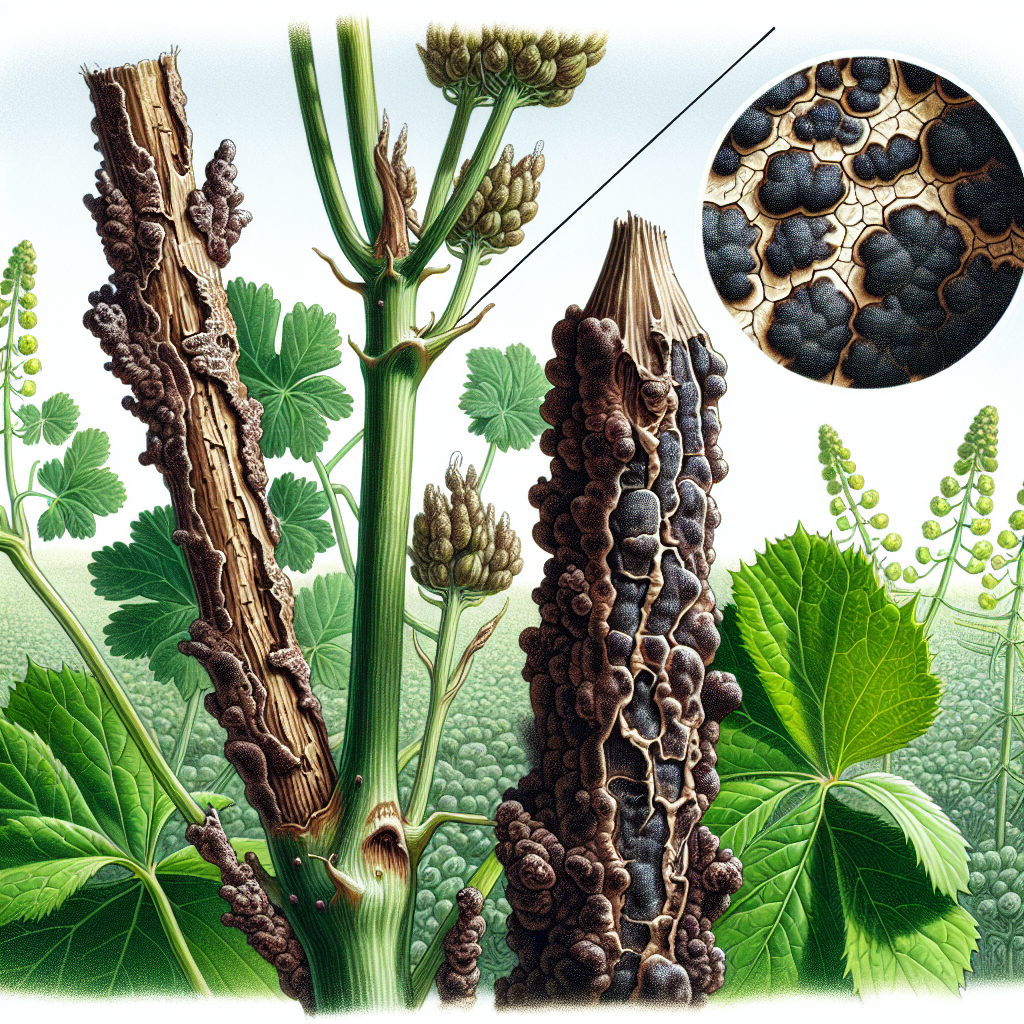
In adult plants, foliar symptoms appear as small, gray-green spots on leaves with pycnidial dots (black fruiting bodies) at the center, maturing to beige centers with dark margins—classic phoma leaf spots. These rarely kill plants but serve as entry points for stem invasion via petioles. The hallmark damage occurs at stem bases: dark brown cankers with longitudinal cracks, often extending internally up to 20 cm. Mature cankers girdle stems, causing white, brittle breaks, lodging, and whiteheads (bleached seed pods with few seeds).
Root damage includes black rot extending into the taproot, impairing water uptake and nutrient transport. Yield impacts vary: minor leaf spots reduce photosynthesis minimally, but stem cankers cut seed yield by 10-30% per 1 cm of canker length. Differentiate from Alternaria (disease) (larger, zonate lesions without pycnidia) or Phytophthora (disease) (water-soaked rots). Lab confirmation via PCR or culturing on V8 agar reveals L. maculans' characteristic multilocular pseudothecia. Scout fields post-rainfall, using a 10x hand lens to spot pycnidia oozing cirri—key for early detection. For more on farm diagnostics, check Why Misidentifying Plants Costs Small Farms Thousands - And How AI Camera Diagnosis Fixes It Fast.
Lifecycle and Progression of Leptosphaeria maculans
L. maculans follows a polycyclic lifecycle adapted to cool climates, with overwintering pseudothecia (sexual fruiting bodies) on infected stubble as the primary inoculum source. These flask-shaped structures embed in stem surfaces, releasing ascospores during autumn rains (optimal: 10-20°C, >6 hours leaf wetness). Ascospores infect leaves cotyledons, forming phoma leaf spots within 7-14 days, from which pycnidiospores ooze in pink cirri, splashing to new leaves via rain.
Systemic colonization progresses slowly: from leaf spots, hyphae grow down petioles into the stem base over 4-6 months, forming extensive necrotic lesions by spring. Pycnidiospores enable secondary cycles but contribute less to epidemics. In summer, maturing pseudothecia within cankers release ascospores for next season's infection. The pathogen's hemibiotrophic nature—initial symptomless biotrophic phase followed by necrotrophic tissue destruction—explains latency periods up to 180 days.
Progression accelerates in susceptible varieties: 1-2% leaf infection in fall leads to 50% stem canker incidence by harvest. Airborne ascospores travel kilometers, but most infections occur within 100m of debris. Soilborne sclerotia survive poorly compared to pseudothecia. Disease gradients peak in zero-tillage fields with dense residue. Breaking the debris cycle disrupts the lifecycle, reducing inoculum by 90% after 4 years. Monitor with forecasting models integrating temperature, rainfall, and residue levels for precise spray timing.
Environmental Triggers & Risk Factors
Blackleg epidemics erupt under specific conditions favoring spore dispersal and infection. Cool, wet autumns (5-15°C, frequent rain >10mm) trigger primary ascospore release and leaf infection, with free moisture on leaves >48 hours ideal for germination. Mild winters prevent inoculum decay, while spring droughts stress plants, exacerbating canker impacts. High humidity (>85%) and leaf wetness duration correlate with 80% infection rates.
Key risk factors include continuous Brassicaceae cropping, especially zero-tillage preserving >30% residue cover, which boosts inoculum by 5x. Narrow row spacing (<30cm) and high plant density (>80 plants/m²) create humid microclimates. Susceptible cultivars like open-pollinated canola amplify damage 3-fold versus resistant hybrids. Acidic soils (pH<6.0) and low fertility impair plant vigor, increasing susceptibility. Long stubble height (>20cm) shelters pseudothecia from desiccation.
Regional hotspots: Canada's Prairies see outbreaks after wet falls; Australia's southern grains belt post-mild winters. Climate change extends risk windows with warmer overwintering. Integrate weather data: >12 rainy days in September doubles risk. For hyper-local forecasts, see Why 80% of Small Farms Battle Weather Disasters - And How Hyper-Local AI Forecasts Can Save Your Harvest. Avoid planting into infested stubble; rotate with non-hosts like wheat or corn for 3-4 years to dilute inoculum.
Organic Control & Treatment Plans
Organic management emphasizes cultural, biological, and resistant varieties sans synthetic fungicides. Start with certified disease-free seed treated with Trichoderma viride (10^9 CFU/g) or biofumigant brassicas like mustard biofumigants releasing isothiocyanates suppressing pseudothecia by 70%. Deploy resistant canola hybrids (Rlm1/Rlm3 genes) reducing canker severity 50-80%; scout for new pathotypes via blackleg rating trials.
Crop rotation is cornerstone: 4-year break with cereals (barley, oats) or legumes (peas) drops inoculum below threshold. Residue management—incorporate stubble to <10cm depth accelerates decomposition 2x via soil microbes. Promote soil health with compost (5t/ha) and cover crops like clover enhancing suppressiveness; mycorrhizal fungi (Glomus spp.) boost root vigor 30%.
Biologicals shine: Coniothyrium minitans parasitizes pseudothecia (70% reduction); Bacillus subtilis sprays (1x10^9 CFU/L) at leaf spot onset inhibit spore germination. Foliar biofungicides with Streptomyces griseoviridis timed to 10% leaf infection limit spread. Armillaria-like antagonists in compost teas target soil phase. Prune lower leaves pre-canopy closure for airflow. Organic plan: Year 1 rotation + bio-seed treatment; Year 2 resistant variety + compost; monitor weekly. Threshold: Spray biofungicide at 5% leaf infection. Integrate with Soil Health Mastery: 5 Proven Strategies for Small Farms to Build Fertile Ground Without Breaking the Bank. Yields recover 15-25% with diligent IPM.
Preventing Leptosphaeria maculans in the Future
Long-term prevention hinges on integrated strategies breaking the lifecycle at multiple points. Implement 4-year rotations avoiding all Brassicas, incorporating deep tillage (20-30cm) every third year to bury residue, exposing pseudothecia to UV killing 90%. Windrow burning of stubble in high-risk fields cuts inoculum 95%; bale and remove where feasible. Select varieties with multiple R-genes (Rlm6 + LepR1) via regional trials; rogue off-types.
Sanitation protocols: Clean equipment between fields to prevent pycnidia spread; delay sowing until soil >10°C reduces seedling blight 40%. Enhance farm hygiene with border crops like sunflower trapping ascospores. Soil solarization in summer (6 weeks black plastic) kills surface sclerotia. Monitor via sentinel plants or spore traps; apps forecast risk from weather data. Build soil organic matter >3% via green manures fostering antagonists. Farmer co-ops share resistance data. Future-proof with marker-assisted breeding for durable resistance. Annual audits ensure compliance; sustained efforts keep blackleg incidence <5%, safeguarding profitability.
Crops Most Affected by Leptosphaeria maculans
Primarily assaults oilseed rape/canola (B. napus), with global losses topping 5Mt/year. Other Brassicaceae vulnerable: turnip rape (B. rapa), mustard (Sinapis alba, B. juncea), broccoli (broccoli), cauliflower (cauliflower), cabbage (cabbage). Susceptible varieties suffer worst; wild relatives like B. nigra show partial resistance. Non-hosts like cereals escape. Focus prevention on commercial canola belts.