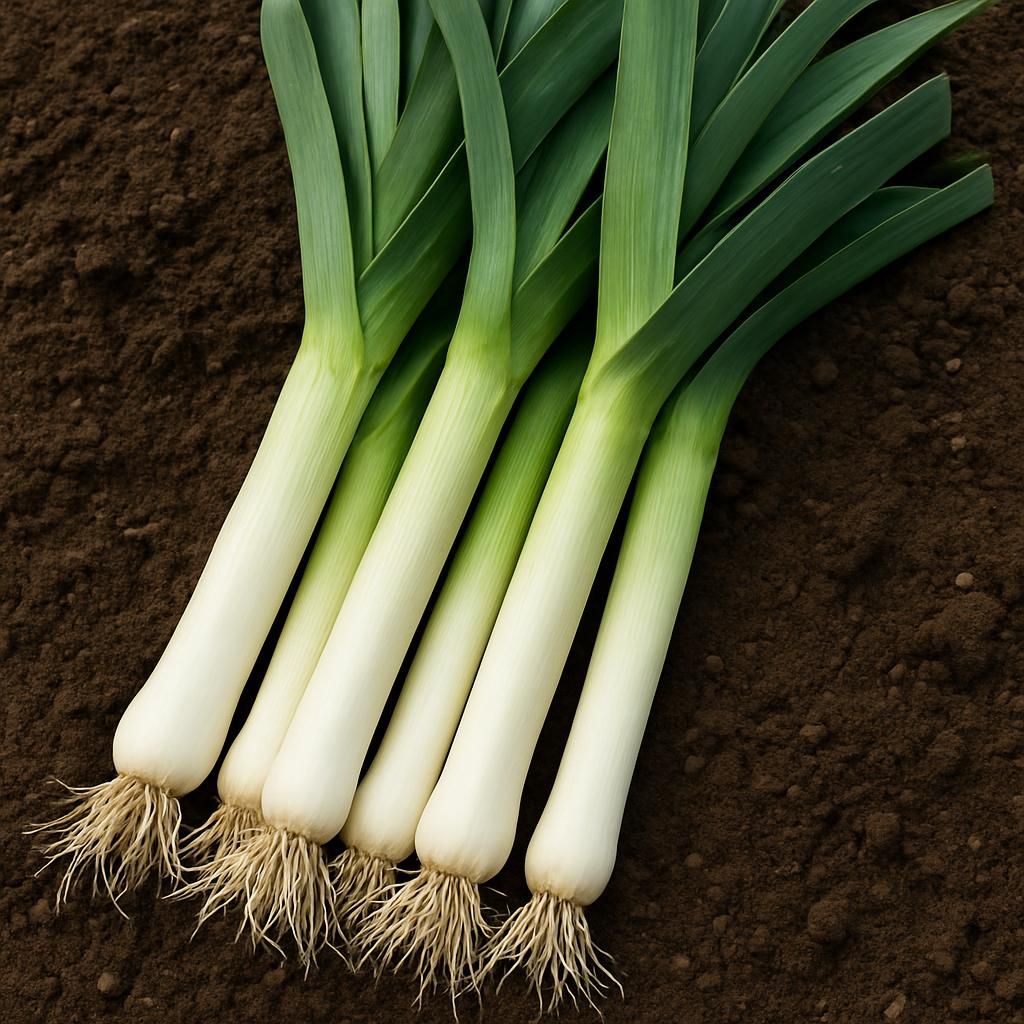
Introduction to Leek (King Richard)
Leek (King Richard) is a cool-season biennial in the Allium family, valued by home gardeners and commercial growers for its slender, elongated white shanks and tender green foliage. Unlike many traditional leek cultivars, King Richard matures in 75–85 days, making it an ideal choice for short-season climates or succession plantings. Its mild, sweet flavor without excessive pungency suits both raw and cooked applications, from soups and stews to fresh salads.
Professional growers appreciate King Richard for its uniform growth habit and resistance to premature bolting under variable spring temperatures. The variety performs reliably across USDA zones 3–9 when planted in fertile, well-drained soil with consistent moisture. Its compact stature also makes it suitable for intensive raised-bed systems and container culture.
This definitive guide covers every stage of production, from soil preparation through harvest and post-harvest handling, incorporating the latest agronomic recommendations for sustainable leek cultivation.
Botanical Profile of Leek (King Richard)
Leek (King Richard) belongs to the Amaryllidaceae family and is botanically classified as Allium ampeloprasum var. porrum 'King Richard'. Unlike bulb onions, leeks do not form a distinct bulb; instead, they develop a thick, elongated pseudostem composed of tightly overlapping leaf bases. The plant produces long, strap-like leaves that emerge from a central growing point and can reach 60–75 cm in height at maturity.
The root system is fibrous and shallow, typically extending 20–30 cm deep, which makes leeks sensitive to drought stress and soil compaction. King Richard exhibits a slender shank diameter of 2–3 cm and a high leaf-to-shank ratio that contributes to its mild flavor profile. As a biennial, the plant will flower and set seed in its second year if allowed to overwinter, producing an umbel of small, six-petaled flowers attractive to pollinators.
Soil, pH, and Climate Requirements for Leek (King Richard)
Leek (King Richard) thrives in deep, fertile loamy soils with excellent structure and drainage. Heavy clay soils should be amended with organic matter to improve aeration and prevent waterlogging, which can lead to root rot. Raised beds or ridges are recommended in regions with high rainfall or poor drainage.
| Parameter | Ideal Range/Value | Notes |
|---|---|---|
| Soil Type | Loam or sandy loam | Deep, friable structure preferred |
| Soil pH | 6.2–7.0 | Slightly acidic to neutral |
| Organic Matter | 3–5% | Incorporate well-rotted compost or manure |
| Temperature (Day) | 15–24 °C | Optimal vegetative growth |
| Temperature (Night) | 7–13 °C | Tolerates light frost |
| Frost Tolerance | Hardy to -7 °C | Protect seedlings from hard freezes |
| Sunlight | Full sun (minimum 6 hours) | Partial shade reduces shank diameter |
| Soil Moisture | Consistent, 60–70% field capacity | Avoid waterlogging |
The variety performs best in cool spring and fall conditions; excessive summer heat can induce bolting or produce tough, fibrous shanks. In warmer climates, provide afternoon shade or select a fall planting window.
Step-by-Step Planting & Propagation
- Start seeds indoors 8–10 weeks before the last expected spring frost. Sow ¼ inch deep in sterile seed-starting mix and maintain 18–21 °C until germination (7–10 days).
- Harden off seedlings for 7–10 days when they reach 10–15 cm tall and have three true leaves.
- Prepare the planting site by incorporating 5–8 cm of well-rotted compost and a balanced organic fertilizer (e.g., 4-4-4 NPK) at 1–1.5 kg per 10 m².
- Transplant seedlings 10–15 cm apart in rows 30–45 cm apart. Plant deeply so that only the top 5 cm of leaves remain above soil level to encourage long white shanks.
- For direct seeding, sow ½ inch deep in early spring or late summer; thin to final spacing when seedlings are 5 cm tall.
- Hill soil around stems every 3–4 weeks to blanch shanks and increase marketable length.
Care & Maintenance regimes for Leek (King Richard)
Consistent moisture and balanced nutrition are critical for tender, high-quality leeks. Mulch with 5–8 cm of straw or shredded leaves to conserve moisture, suppress weeds, and moderate soil temperature.
| Growth Stage | Water Schedule | Fertilizer Application | Pruning/Maintenance Actions |
|---|---|---|---|
| Seedling (0–4 wks) | Keep evenly moist; 2–3 mm/day | Light fish emulsion (½ strength) every 10 days | Remove any yellow or damaged leaves |
| Vegetative (4–8 wks) | 25–30 mm/week; deep watering twice weekly | Side-dress with 4-4-4 organic fertilizer at 4 wks | Hill soil 5–8 cm; weed weekly |
| Shank Development (8–12 wks) | Maintain 60–70% field capacity | Second side-dress with high-nitrogen fertilizer | Continue hilling; remove flower stalks if present |
| Pre-Harvest (12+ wks) | Reduce to 15–20 mm/week to firm tissue | No additional fertilizer; foliar kelp tea optional | Final hilling; remove competing weeds |
Monitor leaf color; pale yellow foliage indicates nitrogen deficiency. Avoid over-fertilization late in the season, which can produce soft, low-quality shanks.
Pests, Diseases & Organic Management
Common pests of Leek (King Richard) include onion thrips, cutworms, and slugs. Thrips cause silvery streaking on foliage; manage with reflective mulch and insecticidal soap. Cutworms can be deterred with collars around young plants and by removing crop debris. Slugs are controlled with iron-phosphate baits and by maintaining clean field margins.
Major diseases include downy mildew, purple spot, and fusarium basal rot. Rotate leeks with non-allium crops every 3–4 years. Ensure good air circulation through proper spacing and avoid overhead irrigation. Copper-based fungicides or Bacillus subtilis products provide organic suppression when applied preventively.
Harvesting, Curing & Optimal Storage
Harvest Leek (King Richard) when shanks reach 1.5–2.5 cm diameter and 15–20 cm of white shaft. Loosen soil with a fork and lift plants carefully to avoid bruising. Trim roots to 1 cm and remove damaged outer leaves.
For short-term storage, keep leeks in perforated plastic bags at 0–2 °C and 90–95% relative humidity for up to 3 weeks. For longer storage, wash, blanch in boiling water for 30 seconds, cool rapidly, and freeze. Alternatively, leave plants in the ground with heavy mulch in mild climates for winter harvest.
Companion Planting for Leek (King Richard)
Leek (King Richard) benefits from association with carrot, celery, and strawberry. Carrots help deter onion flies while leeks repel carrot rust flies. Avoid planting near beans or peas, which may inhibit allium growth through allelopathy. Aromatic herbs such as rosemary and thyme further reduce pest pressure when interplanted.
Companion Planting: 10 Organic Pairings to Boost Small Farm Resilience