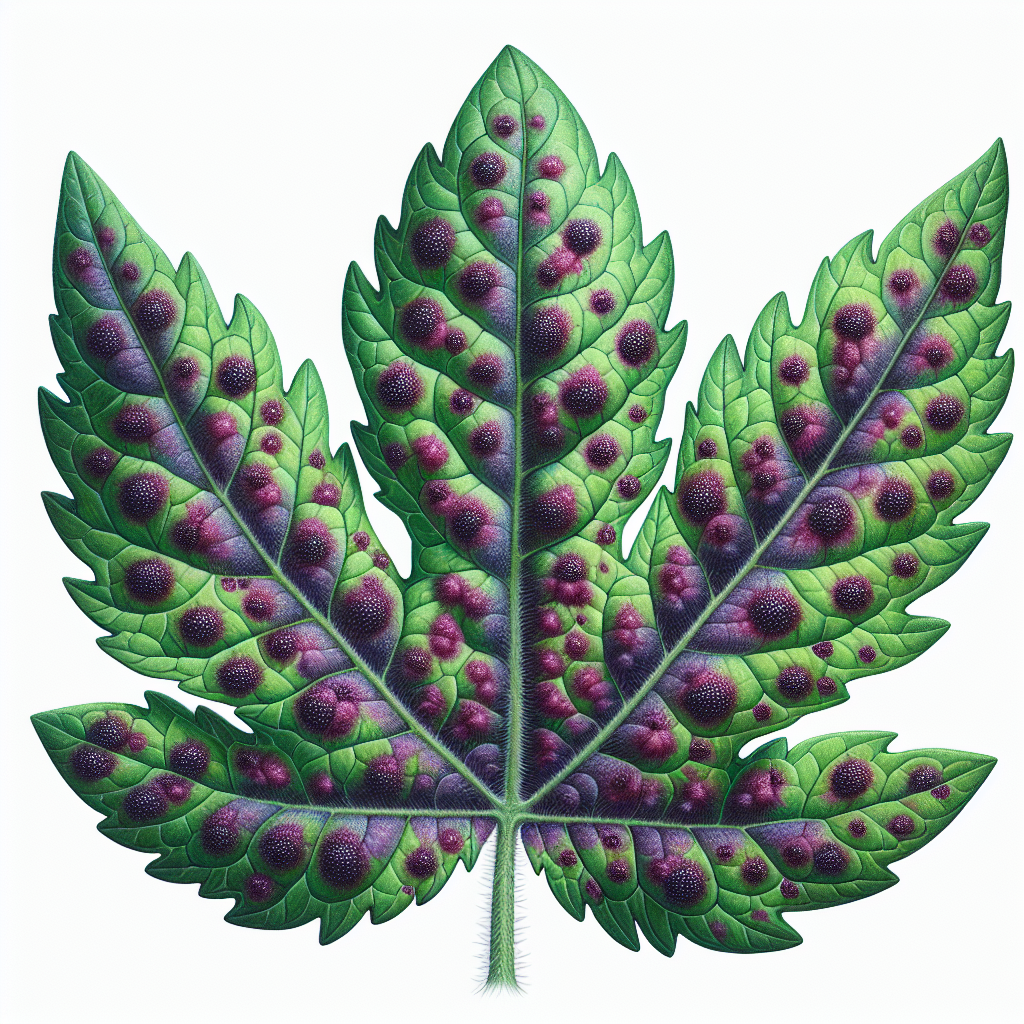
Introduction to Purple spot
Purple spot, caused by the bacterium Pseudomonas syringae pv. tomato, is a significant foliar and fruit disease affecting solanaceous crops worldwide. First identified in the early 20th century, it gained notoriety in the 1990s due to outbreaks in greenhouse and field tomatoes. This disease manifests as small, dark purple spots that can coalesce, leading to leaf drop, fruit blemishes, and up to 50% yield losses in severe cases. Unlike fungal leaf spots, purple spot is distinctly bacterial, producing angular lesions bounded by veins and often accompanied by a oily sheen.
Farmers often confuse it with early blight or Septoria leaf spot, but the purple hue and rapid progression under cool, moist conditions set it apart. Early detection is crucial, as the bacterium can survive in crop debris, weeds, and even on seeds. This guide provides comprehensive diagnostics, lifecycle insights, and organic management strategies to protect your crops. For more on affected varieties, see our detailed tomato cultivation wiki.
Understanding purple spot empowers growers to implement preventive measures, minimizing chemical inputs while maximizing harvest quality. In commercial settings, losses from unaddressed infections can exceed $10,000 per acre, making proactive management essential. Dive into symptoms, triggers, and treatments below to safeguard your fields.
Identifying Symptoms & Damage
Purple spot begins with tiny, water-soaked spots on the underside of lower leaves, typically 7-10 days after prolonged leaf wetness. These spots evolve into angular, purple-black lesions 1-3 mm in diameter, often surrounded by a chlorotic halo. As they expand, centers may turn black and necrotic, sometimes dropping out to form 'shot-hole' appearance. Upper leaf surfaces show faint purple discoloration, progressing to yellowing and necrosis.
On fruits, symptoms appear as small, sunken purple spots near the calyx, expanding into larger blemishes that render produce unmarketable. Stems rarely affected, but severe defoliation exposes fruits to sunscald. Damage severity peaks in cool weather (55-75°F), with high humidity (>90%). Yield impacts include 20-30% fruit loss from spotting and up to 100% defoliation in untreated fields.
Differentiate from lookalikes: Unlike Alternaria leaf spot, purple spots are vein-limited and lack concentric rings. Bacterial ooze under magnification confirms diagnosis—smear lesions on agar for fluorescent pigment test. Scout weekly from transplant, focusing on lower canopy. Economic thresholds: Treat at 5-10% leaf area affected.
Lifecycle and Progression of Purple spot
The Pseudomonas syringae pv. tomato bacterium overwinters in infected plant debris, seeds, and alternate hosts like weeds or potatoes. Primary inoculum spreads via windblown rain or overhead irrigation in spring. Infection requires free water on leaves for 6-12 hours at optimal temperatures (60-70°F). Bacteria enter through stomata or wounds, multiplying in apoplast and producing toxins that kill leaf tissue.
Latent period is 3-5 days, followed by spot formation. Secondary spread via rain splash accelerates epidemics, with peak activity during frequent dews. A single lesion can produce 10^6-10^8 bacteria per cm², disseminating to new leaves. Cycle repeats every 7-10 days under favorable conditions, leading to polycyclic epidemics.
In greenhouses, aerosols from pruning exacerbate spread. Overwinter survival drops with hot composting (>140°F) or tillage burying debris >6 inches. Seed transmission rates up to 1% amplify risks in transplants. Lifecycle completion ties to host availability, underscoring debris management.
Environmental Triggers & Risk Factors
Cool, wet weather is the primary trigger: optimal infection at 59-68°F with >10 hours leaf wetness. High nitrogen fertilizers promote succulent growth, enhancing susceptibility. Overhead irrigation and dense canopies create microclimates ideal for spread. Poor air circulation in tunnels or high tunnels amplifies humidity.
Soil pH extremes (<5.5 or >7.5) stress plants, increasing vulnerability. Contaminated tools, workers' hands, or shared equipment vector bacteria between fields. Volunteer tomatoes and nearby potato crops serve as reservoirs. Seedborne inoculum risks rise with non-treated seeds.
Risk factors include: new plantings near old debris, excessive N (>150 lbs/acre), and clay soils retaining moisture. Climate change may shift patterns, with more erratic rains favoring outbreaks. Monitor forecasts; avoid working in wet foliage. For hyper-local predictions, check Why 80% of Small Farms Battle Weather Disasters - And How Hyper-Local AI Forecasts Can Save Your Harvest.
Organic Control & Treatment Plans
Cultural controls form the backbone: Rotate 2-3 years away from solanaceous crops. Bury debris post-harvest or hot compost. Use drip irrigation; stake/trellis for airflow. Apply copper-based bactericides (e.g., Bordeaux mix) at 7-10 day intervals during wet periods—OMRI-listed products like Liqui-Cop at 1-2 qts/100 gal. Tank-mix with Serenade (Bacillus subtilis) for antagonism.
Biologicals: Apply Actinovate (Streptomyces lydicus) preventively every 7 days. Streptomycin alternatives like AgriPhage show promise in trials (80% control). Prune infected leaves into bags, disinfect tools with 10% bleach or alcohol. Foliar nutrition: Calcium (Cal-Mag) and potassium silicate bolster cell walls.
Integrated plan: Scout weekly, apply copper at first symptoms, follow with biologicals. Remove >20% affected leaves. In severe cases, rogue plants. Efficacy: Cultural + copper yields 70-90% control vs. 40% copper alone. Avoid resistance by alternating modes (FRAC M1 + biologicals).
Treatment timeline: Preventive sprays weeks 1-4 post-transplant; therapeutic at 5% incidence. Harvest marketable fruit promptly; cull spotted ones. Post-season, sanitize greenhouses with quaternary ammonium.
Preventing Purple spot in the Future
Select resistant varieties like 'Mountain Merit' or 'Phoenix'. Treat seeds with hot water (122°F/25 min) or thermotherapy. Site selection: Well-drained soils, full sun, windbreaks for drying. Mulch suppresses splash; reflective mulches deter vectors.
Sanitation protocols: Foot baths, boot scrubs, worker training. Monitor with sticky traps for bacterial aerosols. Build soil health via cover crops (clover) to enhance resilience. Forecast-driven timing: Spray pre-rain events.
Long-term: Scout grids (1/acre), threshold apps. Companion plant with thai-basil for repellency. Annual soil tests guide balanced fertility. Success metrics: <5% incidence via IPM stacks to zero losses.
Crops Most Affected by Purple spot
Primarily tomatoes (beefsteak-tomato, roma-tomato, cherries), with potato as key alternate host. Eggplant and peppers occasionally affected. Global impact highest in humid temperate zones; U.S. (Midwest, Northeast), Europe, Asia report epidemics. Yields drop 30-50% in tomatoes; potatoes show minor spotting.