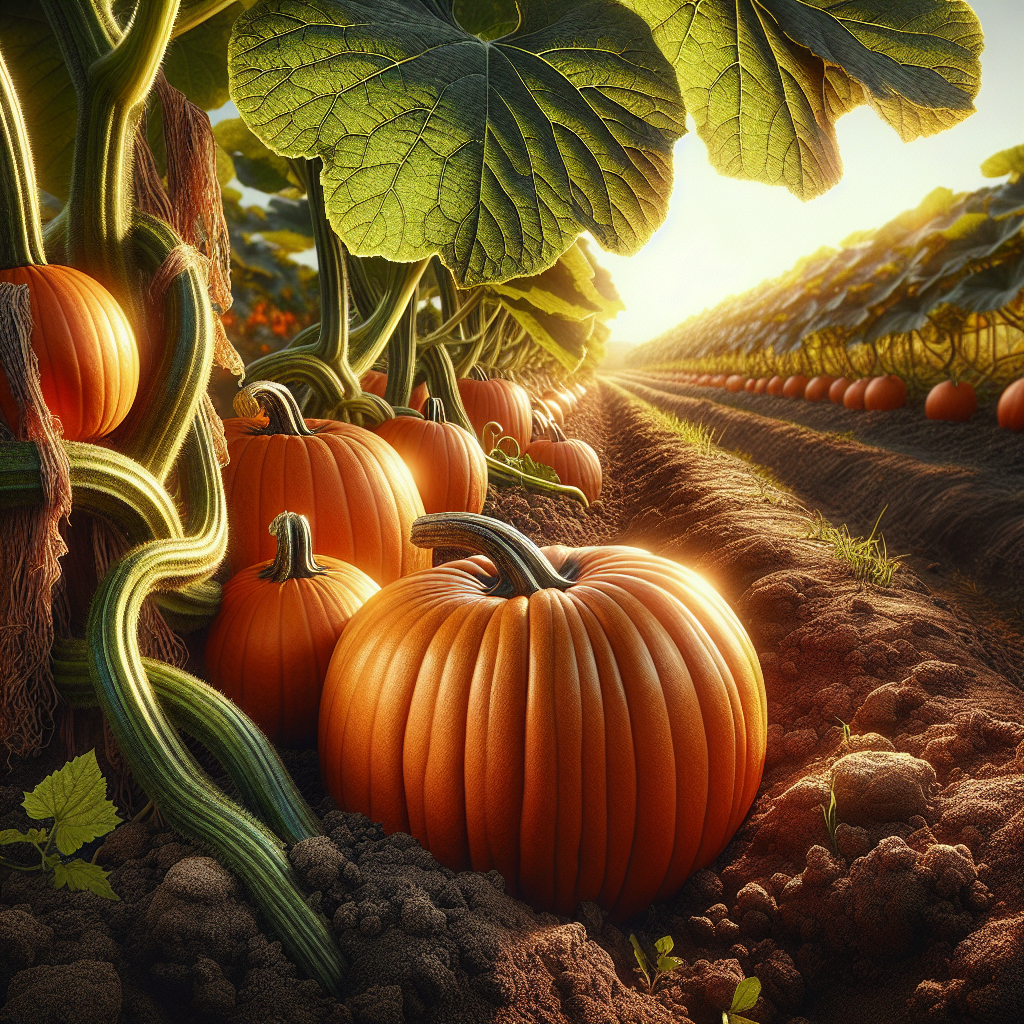
Introduction to Jack-o'-Lantern Pumpkin
Best known as the iconic Halloween pumpkin, this type is grown primarily for appearance, size uniformity, thick orange skin, and a strong, well-attached stem rather than elite eating quality. Most jack-o'-lantern strains are selected within Cucurbita pepo for medium to large fruits that are easy to carve, visually symmetrical, and mature in time for the fall market.
Historically, pumpkins became central to autumn celebrations in North America after Old World turnip-lantern traditions merged with New World squash cultivation. Modern jack-o'-lantern selections reflect that cultural role: growers want bold color, dependable maturity, and fruits large enough to carve but not so oversized that vines sacrifice total yield. That means management differs slightly from pie pumpkins or giant exhibition types. The crop must balance vegetative growth with fruit set, maintain healthy foliage long enough to size fruit, and avoid stress during the critical 20- to 35-day window after pollination when rind expansion is rapid.
For commercial gardeners and serious home growers, success depends on timing. Sow too early into cold soils and seeds rot or emerge unevenly. Sow too late and fruit may size poorly before cool nights and powdery mildew shorten the canopy. In many regions, the goal is to count backward from the intended harvest window, allowing roughly 95 to 120 days from sowing to full color, depending on strain, climate, and fertility.
If you want broader context on pumpkin culture across related types, see our Pumpkin guide. For soil-building principles that directly improve cucurbit performance, the practical framework in soil health strategies is especially relevant.
Botanical Profile of Jack-o'-Lantern Pumpkin
This crop belongs to the family Cucurbitaceae, a group that includes squash, melons, and cucumbers. Jack-o'-lantern pumpkins are usually open-vining annuals with coarse, prickly stems and large palmately lobed leaves. The species is monoecious, meaning it bears separate male and female flowers on the same plant. Male flowers typically appear first, followed by female flowers identified by the miniature ovary at the base of the bloom.
The root system is relatively shallow in its densest feeding zone, though vigorous plants can extend laterally well beyond the crown. Most nutrient and water uptake occurs in the upper 20 to 30 cm of soil, which is why surface moisture consistency and mulch management matter so much. Waterlogged topsoil quickly reduces oxygen around feeder roots, while repeated drying at flowering can trigger blossom drop, misshapen fruits, or aborted sets.
Typical jack-o'-lantern fruit traits include:
- Mature weight of roughly 4 to 10 kg, though some cultivars run smaller or larger
- Deep orange to orange-red rind depending on strain and temperature during ripening
- Moderately ribbed exterior for visual appeal
- Thick, hard shell suitable for carving and short-term display
- Strong, dark green to corky stem handle that should remain intact through harvest
- Stringier, lower-density flesh than specialty culinary pumpkins
Pollination is insect-dependent, with bees doing most of the work. Pollen is most viable in the morning, and flowers are ephemeral, generally opening for only a single day. Poor bee activity during hot, rainy, or windy weather often translates directly into reduced fruit set.
A key nuance with C. pepo is its readiness to cross-pollinate with other C. pepo squash types grown nearby, such as many zucchini and summer squash. This does not affect the current season's fruit quality, but it matters if seed saving is planned.
Soil, pH, and Climate Requirements for Jack-o'-Lantern Pumpkin
This crop performs best in fertile, well-drained loam or sandy loam with strong organic matter content and excellent aeration. Heavy clay is not automatically disqualifying, but it must be improved with compost, cover-crop residue, and raised beds or hills to prevent water stagnation. The ideal soil pH is 6.0 to 6.8. Below pH 5.8, nutrient uptake can become uneven, especially phosphorus and calcium. Above about 7.2, micronutrient availability may decline, contributing to chlorosis and weak growth.
Target soil conditions include:
- Organic matter: 3% to 6% for reliable moisture buffering and nutrient cycling
- Drainage: no standing water after moderate rain for more than 24 hours
- Texture: friable enough that a hand-squeezed moist sample crumbles rather than forming a slick ribbon
- Soil temperature at planting depth: at least 18 to 21b0C for fast emergence, with 24 to 32b0C being ideal for vigorous germination
Jack-o'-lantern pumpkins are warm-season plants that need a long frost-free period. Air temperatures of 21 to 30b0C support strong vine growth. Growth slows below about 15b0C, and any frost can kill the crop. Extended temperatures above 35b0C, especially with warm nights, may reduce pollen viability and stress vines, leading to poor fruit set.
Moisture management should be deliberate. The goal is evenly moist but never saturated soil in the primary root zone. As a practical field benchmark, soil should remain slightly damp 5 to 10 cm below the surface between irrigations. If squeezed soil at that depth feels cool and coherent but not muddy, moisture is usually adequate. Overwatered fields show dull, bluish foliage, slowed growth, yellowing lower leaves, and increased root disease pressure. Underwatered plants show midday wilting that persists into evening, rough leaf texture, flower abortion, and fruits that size slowly or develop unevenly.
Wind exposure also matters. Constant abrasion from dry winds can shred leaves and interfere with bee foraging. Sheltered but sunny fields are ideal. Full sun is non-negotiable; at least 8 hours of direct light is preferred for strong flowering and proper rind coloration.
Step-by-Step Planting & Propagation
Propagation is by seed. Direct seeding is usually superior because cucurbits dislike root disturbance, though transplants can be used in short-season climates if grown in large biodegradable pots or deep cells and transplanted young.
Prepare the bed 2 to 3 weeks before planting. Work in well-finished compost and correct pH if necessary. Avoid fresh manure immediately before planting because excessive soluble nitrogen can push lush vines at the expense of fruiting and may increase disease susceptibility.
Form raised hills or broad mounds where drainage is marginal. A hill should be about 15 to 30 cm high and 45 to 60 cm across. In larger production, many growers use flat rows with drip irrigation and plastic or organic mulch instead, but the principle is the same: warm, well-drained rooting conditions.
Time sowing carefully. Plant only after the last frost and when soil is genuinely warm. Cold, wet conditions are a common reason for patchy stands. In cooler regions, black mulch or clear pre-warming plastic can advance planting by several days.
Sow at proper depth and spacing. Plant seeds 2.5 to 4 cm deep. Space hills 1.2 to 2.4 m apart depending on cultivar vigor, with 2.4 to 3.6 m between rows for full-vining types. For smaller-fruited or semi-bush selections, spacing may be tightened, but overcrowding sharply increases foliar disease pressure.
Thin seedlings early. Place 3 to 5 seeds per hill, then thin to the strongest 1 to 2 plants once true leaves appear. In row culture, thin to one plant every 60 to 90 cm if cultivar vigor allows.
Use transplants only when season length demands it. Start seeds indoors 2 to 3 weeks before field set-out. Harden seedlings gradually for 5 to 7 days. Transplant before they become root-bound; older cucurbit transplants often stall after planting.
Protect young plants. Floating row cover can accelerate early growth and exclude cucumber beetles, but it must be removed at flowering unless pollinators are manually introduced. Remove covers earlier in very hot weather to prevent overheating.
Support early nutrition, not excess vine growth. At planting, phosphorus availability is important for root establishment. Nitrogen should be present but moderate. Excess early nitrogen creates giant vines and delayed flowering.
Germination usually occurs in 5 to 10 days under warm conditions. Emergence beyond 14 days often indicates cool soil, crusting, or seed decay.
Care & Maintenance regimes for Jack-o'-Lantern Pumpkin
Once established, the crop needs even growth without major stress cycles. Consistency matters more than occasional heavy intervention.
Irrigation should deliver roughly 25 to 40 mm of water per week early in growth, increasing to 40 to 50 mm per week during flowering and fruit bulking depending on heat, wind, and soil type. Sandy soils may need smaller, more frequent applications, while heavier loams can be irrigated less often but more deeply. Drip irrigation is strongly preferred because overhead watering extends leaf wetness periods and accelerates powdery mildew and foliar blights.
The most critical moisture window is from first female flowers through fruit enlargement. Drought during this period can cause:
- Female flower drop
- Incomplete pollination symptoms
- Misshapen fruit from uneven cell expansion
- Premature fruit abortion
- Hard, stunted fruit with poor color development
At the same time, chronically wet soil leads to oxygen deprivation and root stress. Signs include pale foliage, weak new growth, sudden vine collapse in warm weather, and a sour smell in poorly drained beds.
Nutrient management should be staged. Pumpkins are moderately heavy feeders, but overfertilization is common. A balanced program often includes:
- Pre-plant compost or base fertilizer for foundational phosphorus and potassium
- Moderate nitrogen at establishment
- A side-dress when vines begin to run
- A second light feeding around early fruit set if foliage is pale or growth is slowing
Potassium is especially important for rind strength, color development, and stress tolerance. Calcium supports cell wall integrity, though in most field systems calcium issues are more related to erratic moisture than outright deficiency. Avoid late heavy nitrogen after fruit set; it can delay maturity and produce sprawling canopy at the expense of harvestable fruit quality.
Mulching is highly beneficial. Organic mulch suppresses weeds, buffers soil temperature, and reduces soil splash onto leaves and fruit. However, it must not trap excessive moisture against crowns in humid climates. Plastic mulch can improve earliness and weed control but requires careful irrigation monitoring underneath.
Weed control is essential during the first 4 to 6 weeks, before vines close canopy. Weeds competing at establishment can permanently reduce yield. Cultivate shallowly to avoid damaging feeder roots. Once vines spread, hand removal of major escapes is safer than deep hoeing.
Fruit load management depends on your goal. For large, showier carving pumpkins, some growers limit plants to 2 to 4 fruits so the vine allocates more resources to each one. For general production, allow natural set but remove obviously misshapen or damaged fruit early.
To improve fruit quality:
- Rotate developing fruits gently once or twice when small, if needed, to encourage symmetrical shape
- Keep fruits off persistently wet ground using straw or a thin board in humid areas
- Avoid stepping on vines; damaged vines reduce carbohydrate flow
- Protect stems from breakage, because handle quality strongly affects market value
Pests, Diseases & Organic Management
Jack-o'-lantern pumpkins face a classic cucurbit pest complex. Prevention and early intervention are far more effective than rescue treatments.
Common insect pests include squash bugs, striped and spotted cucumber beetles, squash vine borers, aphids, and pickleworms in warm regions. cucumber beetles are especially dangerous early because they feed on seedlings and may vector bacterial wilt. squash bugs suck sap, causing stippling, yellowing, and eventual leaf collapse. Vine borers can suddenly wilt runners or entire crowns by tunneling into stems.
Organic management tactics include:
- Row covers before flowering to exclude cucumber beetles and borers
- Crop rotation of at least 3 years away from cucurbits
- Weekly scouting under leaves for bronze squash bug egg clusters
- Hand removal of eggs and nymphs in small plantings
- Kaolin clay as a feeding deterrent on young plants where practical
- Timed Bacillus thuringiensis applications for vine borer prevention in susceptible regions
- Maintaining flowering habitat nearby to support predatory insects and pollinators
Major diseases include powdery mildew, downy mildew, bacterial wilt, anthracnose, gummy stem blight, and various root rots. powdery mildew is the most common late-season issue, appearing as white talcum-like patches on older leaves, then spreading until photosynthesis drops and fruit maturation slows. downy mildew often presents as angular yellow lesions with gray-purple growth on the leaf underside under humid conditions. bacterial wilt may cause sudden collapse of individual vines, often following cucumber beetle activity.
Organic disease management should focus on:
- Wide spacing and airflow
- Drip irrigation instead of overhead watering
- Morning irrigation if overhead watering is unavoidable
- Sanitizing crop residues after harvest
- Rotation away from all cucurbits for multiple years where disease pressure is severe
- Using resistant or tolerant strains when available
- Sulfur, potassium bicarbonate, or labeled biofungicides at first sign of powdery mildew, not after severe canopy loss
Do not underestimate sanitation. Diseased vines left in place after season end can carry inoculum into the next cycle. Also, avoid handling wet plants during pruning or scouting, as this can spread pathogens mechanically.
Pollinator protection must remain part of any pest program. Never spray insecticidal products on open flowers when bees are active. Apply only at dusk if treatment is necessary.
Harvesting, Curing & Optimal Storage
Harvest timing is driven by rind maturity, market date, and weather risk. A fully mature jack-o'-lantern should have reached its characteristic color, with a hard rind that resists fingernail puncture. The stem should be firm and beginning to cork slightly, and the vine often starts to decline naturally as fruit finishes.
Harvest before hard frost. Light frost can scar exposed fruit, while freezing damages rind and shortens storage life drastically. Wet, chilly autumn conditions also increase rot risk, so many growers harvest slightly ahead of peak decoration season and cure under cover.
To harvest properly:
- Use pruning shears or a sharp knife
- Cut the stem, leaving 7 to 10 cm or more as a handle
- Never lift by the stem; it can crack away and create a rot entry point
- Handle gently to avoid bruising, which may not be visible immediately but later develops as soft spots
Curing improves skin hardness and storage performance. Cure fruit for 10 to 14 days at about 24 to 27b0C with good ventilation and relative humidity around 70% to 80% if possible. This allows minor surface injuries to dry and the rind to toughen. In home-scale settings, a warm, shaded porch or airy shed often works better than direct sun, which can overheat fruit and bleach color.
For storage, keep pumpkins at 10 to 15b0C with 50% to 70% relative humidity in a dry, well-ventilated space. Temperatures below about 10b0C can cause chilling injury in some conditions, while warmer rooms accelerate dehydration and decay. Do not stack fruits directly on one another for long periods; airflow around each fruit reduces soft rot development.
Even under good storage, jack-o'-lantern pumpkins are not long-keepers compared with some winter squash. Expect best decorative quality for several weeks to a few months, depending on cultivar, maturity, and disease history in the field. Inspect regularly and remove any fruit with sunken lesions, mold, or seepage.
Companion Planting for Jack-o'-Lantern Pumpkin
The most classic planting system for pumpkins is the "Three Sisters" pattern with Corn and beans, where corn provides structure, beans contribute nitrogen cycling, and pumpkin vines shade the soil. In modern production, the agronomic value depends on spacing and management, but the principle remains useful: combine vertical growth, nitrogen support, and living ground cover without crowding the pumpkin canopy.
Sunflower can serve as a pollinator attractant and wind buffer when planted on bed margins rather than directly among vines. Nasturtium is valuable near pumpkin patches as a trap and distraction plant for certain sap-feeding pests, while also drawing beneficial insects. Peas can be used as an early-season companion in cooler regions, especially when grown ahead of vine spread, helping occupy space before pumpkins dominate the bed.
Companion planting works best when it does not create shade, root competition, or harvest obstacles. Keep large companion species on borders, not inside dense vine zones. Avoid pairing with other sprawling cucurbits in the same bed because shared pests and diseases increase quickly. Strong companion systems support pollination, soil cover, and biodiversity, but pumpkins still need generous spacing, sunlight, and airflow above all else.