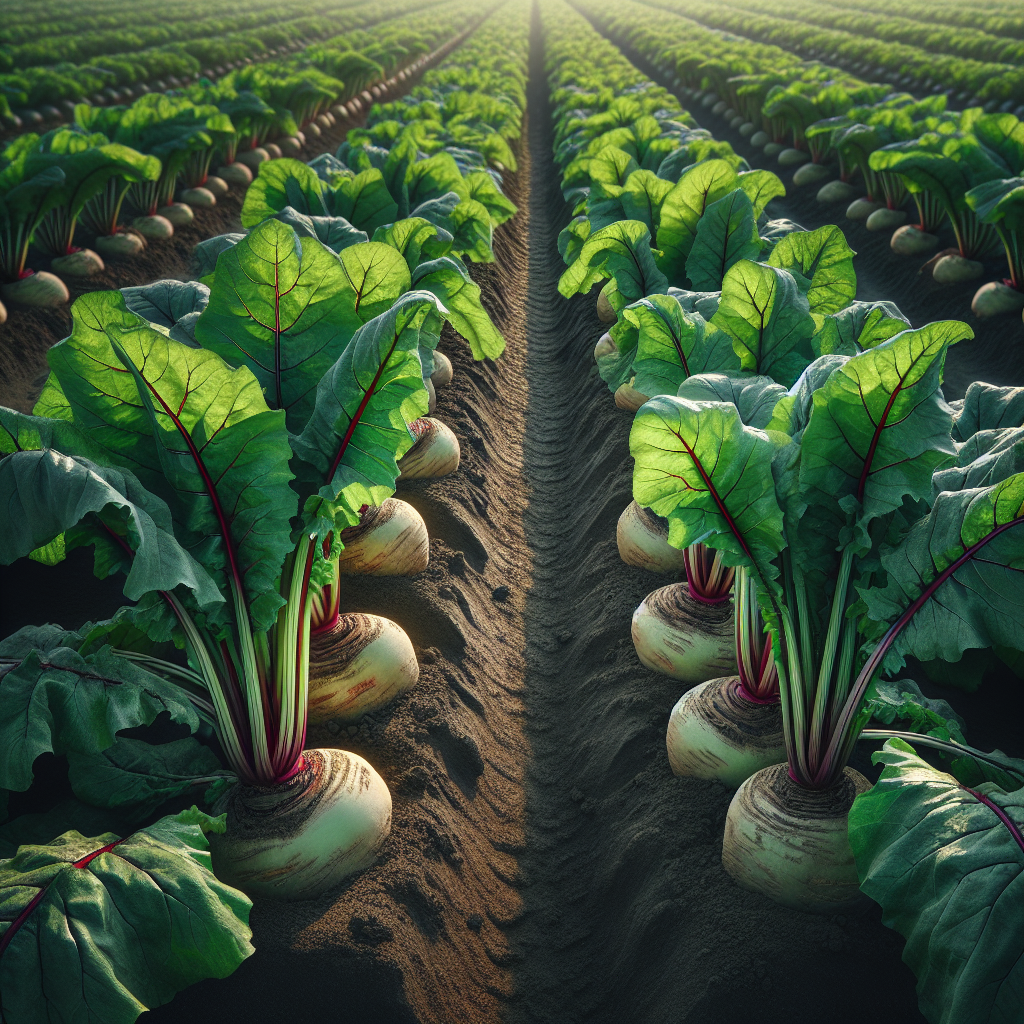
Introduction to High-Sugar Beet
A high-sucrose beet belongs to the sugar beet class rather than the table beet class, though both trace back to the same species. Its agricultural value comes from the white-fleshed storage root, which is selected for sucrose concentration, root uniformity, and relatively low levels of impurities such as sodium, potassium, and alpha-amino nitrogen that interfere with sugar extraction. Unlike garden beets grown primarily for fresh eating, this type is managed to maximize recoverable sugar per hectare or per acre.
Modern sugar beet breeding emerged from European work in the 18th and 19th centuries, when growers learned that certain white fodder-like beets had unusually high sugar levels. Continuous selection transformed those early roots into the modern high-sugar types used for commercial sugar production. Today, growers choose cultivars not only for sugar percentage, but also for disease tolerance, bolting resistance, storability, and adaptability to local day length and temperature patterns.
For growers, the central challenge is balancing root yield with sugar concentration. Excess nitrogen, prolonged heat, waterlogging, and severe foliar disease can all produce large-looking roots with disappointing sugar content. The best crops are not simply bulky; they are physiologically efficient, with a healthy canopy early in the season, then a strong late-season shift toward sucrose storage in the root.
For broader beet background, see our Beet guide. For field fertility planning, the principles in soil health strategies are especially relevant where root quality matters.
Botanical Profile of High-Sugar Beet
This crop is a biennial by life cycle, although it is usually cultivated as an annual root crop. In its first year, it forms a rosette of leaves and enlarges a storage root. If exposed to sufficient cold followed by long days, it may vernalize and bolt in the second phase of its life cycle, sending up a flowering stalk that can exceed 1 meter. In sugar production, bolting is undesirable because it diverts carbohydrates away from root storage and reduces harvest quality.
Taxonomically, it belongs to the Amaranthaceae family. The plant produces broad, glabrous to slightly textured leaves with long petioles emerging from a crown at soil level. The storage organ commonly called the root is botanically a swollen taproot-hypocotyl complex. In high-sugar types, flesh is typically pale cream to white rather than red or golden, because the breeding goal is sugar recovery rather than pigment accumulation.
Seed is actually a dried fruit cluster, often called a seedball, though modern monogerm seed has been bred to produce a single seedling more consistently and reduce thinning labor. Germination is epigeal, and seedlings are sensitive to crusted soils, deep planting, and salinity during emergence. The crop develops a fibrous network of secondary roots beneath the enlarged taproot, which helps it exploit deeper soil moisture once established.
A typical production cycle runs 150 to 220 days depending on climate, planting date, and target sugar accumulation. Early vegetative growth builds leaf area and photosynthetic capacity; midseason supports root expansion; late season is critical for sucrose loading into the root. This is why canopy health late into the season matters so much: leaves are the sugar factory, but the root is the storage reservoir.
Soil, pH, and Climate Requirements for High-Sugar Beet
Deep soil is one of the most important yield determinants. The ideal profile is at least 45-60 cm deep, friable, stone-free, and without compacted layers. Hardpans, plow pans, and shallow subsoil restrictions cause forked roots, shortened roots, and uneven maturity. Heavy clay can work if it is structured and drains well, but sugar beet performs best in silt loams, loams, or sandy loams with strong water-holding capacity and good aeration.
Soil pH should generally fall between 6.5 and 8.0, with a practical optimum around 6.8-7.5. This crop tolerates mildly alkaline conditions better than many vegetables, but strongly acidic soils reduce nutrient availability and can increase problems with manganese toxicity or poor root development. If pH is below about 6.2, liming is usually justified well before planting so the amendment is fully integrated into the root zone.
Drainage is non-negotiable. Saturated soil for even 24-48 hours during warm weather can trigger oxygen deprivation around the root, leading to stunting, root rot, and lower sugar accumulation. A healthy stand should occupy moist but aerated soil; in practical terms, the soil should form a weak ball in the hand and crumble with slight pressure, not smear into a sticky mass. Persistent puddling, gray-blue subsoil, or a sour odor after rain indicates drainage problems severe enough to reduce both tonnage and sugar percentage.
The crop prefers cool to moderate temperatures. Germination begins at low soil temperatures, roughly 5-7°C, but emergence is much faster and more uniform at 10-18°C. Vegetative growth is vigorous at 15-24°C. Sustained temperatures above 30°C reduce photosynthetic efficiency, increase respiration losses, and can suppress sugar storage, especially if nights remain warm. Cool nights late in the season are beneficial because they reduce respiration and favor net sucrose accumulation.
High-sugar production is most reliable in temperate climates with a long frost-free season, moderate summer heat, and a dry or semi-dry harvest window. Light frosts on mature plants are usually tolerated, but severe freezing can damage crowns and reduce storage life. Young seedlings are more vulnerable to cold shock if they have emerged and then face prolonged low temperatures, which can also increase bolting risk in susceptible cultivars.
Nutrient demand is substantial but must be carefully balanced. Nitrogen drives canopy formation, yet excessive late nitrogen depresses sugar concentration and increases root impurities. Phosphorus supports early rooting and energy metabolism; potassium aids water regulation and carbohydrate transport, but very high soil K can be associated with processing impurities. Boron is especially important; deficiency leads to blackened internal tissue, cracked roots, and crown disorders. Sodium may partially substitute for potassium physiologically in some beet systems, but salinity overall still requires caution.
Step-by-Step Planting & Propagation
Propagation is almost always by direct seeding. Transplanting is rarely recommended because root disturbance causes deformation and uneven stands. Start with a clean, fine, firm seedbed. The top 2-3 cm should be well crumbled, but not powdery; beneath that, the seed zone should be firm enough to maintain capillary moisture. Overworked seedbeds are prone to crusting after rain or irrigation, which can trap emerging seedlings.
Time sowing for a period when soil is warming but not hot. In cool temperate zones, this is often early spring as soon as fields are workable. In milder winter regions, late fall to winter sowing may be possible if severe frost is unlikely. The goal is to establish the crop early enough to exploit the full season, while avoiding conditions that trigger bolting or rot.
Use high-quality, treated or untreated monogerm seed depending on your production standard. Precision sowing is preferred. Plant seed 1.5-3 cm deep; use the shallower end in heavier, cooler soils and the deeper end in lighter soils that dry quickly. Depth uniformity matters more than pushing seed too deep for moisture. Deep planting delays emergence and weakens seedlings.
Row spacing usually ranges from 45-60 cm for mechanized systems, while in smaller-scale plots 30-45 cm can work if weed pressure is controlled. In-row spacing is commonly set to achieve a final stand of about 80,000-120,000 plants per hectare, or roughly 20-30 cm between plants in garden-scale culture. Overcrowding produces smaller roots and more competition for light and nutrients; wide spacing can increase oversized roots with inconsistent sugar content.
If multigerm seed is used, thin early when plants have 2-4 true leaves. Delayed thinning wastes moisture and nutrients and can permanently reduce uniformity. Remove weak, off-type, or crowded seedlings first. Avoid disturbing neighboring roots during thinning.
Before sowing, conduct a soil test. Apply phosphorus and potassium according to test recommendations, incorporating them before planting because deep-rooted crops benefit from nutrient availability below the immediate surface. Nitrogen should be split where possible: a modest pre-plant portion to support establishment, then the remainder early in vegetative growth. Avoid heavy late applications once the canopy has closed, because they favor leaf growth at the expense of root sugar storage.
Irrigate immediately after sowing only if the seed zone lacks moisture. Frequent very light irrigation can create surface crusts and shallow rooting. It is better to wet the seed zone evenly and then wait until moisture begins to decline before irrigating again. Emergence typically takes 7-21 days depending on temperature and soil conditions.
Care & Maintenance regimes for High-Sugar Beet
Uniform moisture is essential from emergence through root bulking. The crop performs best when soil moisture remains in a moderate, stable range rather than cycling between drought and saturation. In practical field terms, maintain roughly 60-80% of available water in the active root zone during vegetative growth and early bulking. If moisture falls too low during these phases, plants reduce leaf expansion, older leaves wilt during midday, and root enlargement slows. Severe drought followed by heavy irrigation can cause cracking, impurity accumulation, and erratic sugar partitioning.
Overwatering is equally harmful. Warning signs include yellowing lower leaves despite wet soil, slow growth, surface algae, persistent footprints in the field, and roots with soft or water-soaked crown tissue. Where possible, irrigate more deeply and less frequently to encourage rooting depth. Drip irrigation offers precise control in smaller plantings; furrow or sprinkler systems work in field-scale production if scheduling is disciplined.
Nitrogen management is the most common nutritional error. A high-sugar crop needs enough nitrogen for rapid canopy establishment early, because strong leaf area drives total sugar production. But once canopy development is adequate, excess nitrogen delays maturity and keeps the plant in a vegetative state. As a rule, leaves should be a healthy medium green, not dark lush blue-green late in the season. Very dark, succulent tops paired with low root solids usually indicate nitrogen excess.
Boron deserves separate emphasis. Sugar beet has a relatively high boron requirement, particularly in sandy, alkaline, or drought-prone soils where uptake becomes erratic. Deficiency often appears as heart rot, blackened growing points, brittle leaves, and internal brown or corky areas in the root. Apply boron only according to soil or tissue tests because overapplication can become toxic.
Weed control is critical during the first 6-10 weeks, when seedlings grow slowly and compete poorly. Keep rows clean early through shallow cultivation, stale seedbed techniques, hand hoeing, mulches in small plots, or approved organic methods. Do not cultivate too deeply once roots expand; pruning side roots reduces vigor. After canopy closure, a healthy crop suppresses many later weeds through shading.
Mulching can help regulate moisture and reduce crusting in smaller-scale systems, but keep heavy mulch slightly away from the crown to reduce humidity-driven disease. In larger fields, cover crops terminated ahead of planting can improve tilth, though residues must not interfere with seed placement or early soil warming.
Bolting control starts with variety selection and sowing date. Exposure of young plants to prolonged cold after emergence can induce flowering in susceptible genetics. Bolted plants are easy to recognize by the tall central stalk; rogue them if feasible, especially in seed-sensitive production systems, because they divert resources and complicate harvest.
Routine crop monitoring should include canopy color, row closure rate, petiole turgor in late afternoon, crown health, and root shape in random pulls. Mature, high-performing stands usually maintain functional leaves well into late season without excessive rank top growth.
Pests, Diseases & Organic Management
The crop can be affected by seedcorn maggot, flea beetles, aphids, leaf miners, and beet webworms depending on region. Early seedling injury is especially serious because stand gaps cannot be fully compensated later. Use crop rotation, rapid emergence, clean field margins, and floating row covers in small plantings where practical. aphids matter not only because they sap vigor but because they can vector virus diseases.
Leaf diseases are among the greatest threats to sugar accumulation. Cercospora leaf spot is especially damaging in warm, humid conditions. It begins as small circular spots with tan to gray centers and darker borders; severe infection causes premature defoliation, and the plant then spends energy regrowing leaves instead of storing sugar. Powdery mildew may appear later in dry climates with humid nights, while rust and ramularia can also occur regionally.
Organic management relies on prevention more than rescue. Rotate away from beets and related crops for at least 3-4 years where disease pressure is established. Improve airflow with proper spacing, irrigate early in the day if using overhead systems, and avoid excessive nitrogen that creates lush, disease-prone canopies. Remove cull piles and volunteer beets, which can harbor pathogens between seasons.
Damping-off caused by Pythium or Rhizoctonia can thin stands in cold, wet, compacted seedbeds. Rhizoctonia crown and root rot later in the season produces blackened lesions near the crown and can cause sudden wilting despite adequate soil moisture. Aphanomyces root rot is favored by warm, saturated soils and often causes stunting and a bearded root appearance. The most reliable defense is drainage, rotation, and avoiding repeated beet culture on the same land.
Nematodes, especially beet cyst nematode in some regions, can severely reduce yield and sugar content. Symptoms include patchy stunting, midday wilt, and reduced root enlargement despite fertilization. Long rotations and biofumigant or non-host cover crop strategies are key where this pest is present.
For organic foliar disease suppression, copper or biological products may have limited usefulness depending on local rules and timing, but they work best when started preventively. Once a severe epidemic is underway, cultural control alone may not fully protect sugar levels. Disease forecasting and vigilant scouting are therefore essential.
Beneficial insect habitat around fields can help moderate aphids and caterpillars. Border plantings of Clover or Yarrow can support predatory insects, though they should be managed so they do not become alternate pest reservoirs. Onion nearby may also help diversify the planting pattern and discourage some pest buildup in mixed garden systems.
Harvesting, Curing & Optimal Storage
Harvest timing determines both tonnage and sugar recovery. The crop is ready when roots are fully sized, crowns are solid, and the canopy begins natural aging without catastrophic foliar collapse. In commercial systems, harvest often begins when sucrose testing indicates an acceptable balance between root yield and sugar percentage. In small-scale settings, mature roots are typically firm, heavy, and well filled, often with diameters of 7-15 cm depending on spacing and cultivar.
Do not confuse oversized roots with superior quality. If roots are left too long under heat, excessive nitrogen, or repeated stress, purity can decline even while size increases. The best harvest window is often after cool nights have begun enhancing sugar storage but before hard freezes or prolonged wet weather damage field conditions.
Lift roots carefully to avoid cuts and bruises. Wounds accelerate dehydration and invite storage rots. Remove foliage by topping close to the crown, but do not gouge deeply into the crown because this sacrifices stored sugar. Conversely, leaving too much leafy crown tissue increases respiration losses in storage.
Unlike bulb onions or winter squash, sugar beet is not typically cured with a prolonged warm drying phase. Instead, it is cleaned lightly, surface-dried if muddy, and cooled promptly. For short-term storage, hold roots at 0-4°C with 90-95% relative humidity and good air circulation. At these conditions, water loss is minimized while respiration remains low. Warmer storage increases sugar loss because the root remains metabolically active.
Check stored roots regularly. Softening at the crown, sour odor, black lesions, or internal translucency indicate rot or freezing injury. Condensation on roots is a warning sign that ventilation or temperature balance is inadequate. Never store damaged roots with sound ones if storage duration matters.
If processing for syrup or on-farm sugar extraction, use the freshest roots possible. Sucrose declines gradually after harvest, especially if roots are bruised or stored too warm. Wash thoroughly, trim damaged sections, and process before sprouting begins.
Companion Planting for High-Sugar Beet
This crop benefits most from companions that either improve biological diversity without competing heavily for root-zone resources, or that support beneficial insects and soil structure. Shallow-rooted aromatic or insectary neighbors are generally more useful than aggressive feeders.
Onion is one of the best practical companions because it occupies a relatively different rooting pattern and canopy shape, helping diversify the bed without heavily shading young beet plants. It also fits similar cool-season planting windows in many temperate gardens.
Clover can be used nearby or in pathways rather than directly crowding the row. Managed properly, it protects soil, improves traffic tolerance, and supports pollinators and beneficial insects. However, it must be mowed or suppressed so it does not compete with young beet seedlings for moisture.
Yarrow is valuable on margins as an insectary plant. Its flowers attract hoverflies, parasitic wasps, and other beneficial species that help regulate aphids and small caterpillars. Keep it at bed edges rather than within the crop row.
Other suitable associates include lettuces and some low-growing herbs in small gardens, provided they do not force repeated irrigation cycles that keep beet crowns too wet. Avoid planting with sprawling, shading crops or with dense brassica blocks that can increase humidity and complicate airflow. Also avoid repeated close association with other chenopod relatives when disease pressure is known, since shared pathogens can build over time.
In production planning, companion planting should complement, not replace, rotation. The most successful high-sugar beet systems still rely on a clean seedbed, measured fertility, and careful moisture control as the foundation of crop performance.