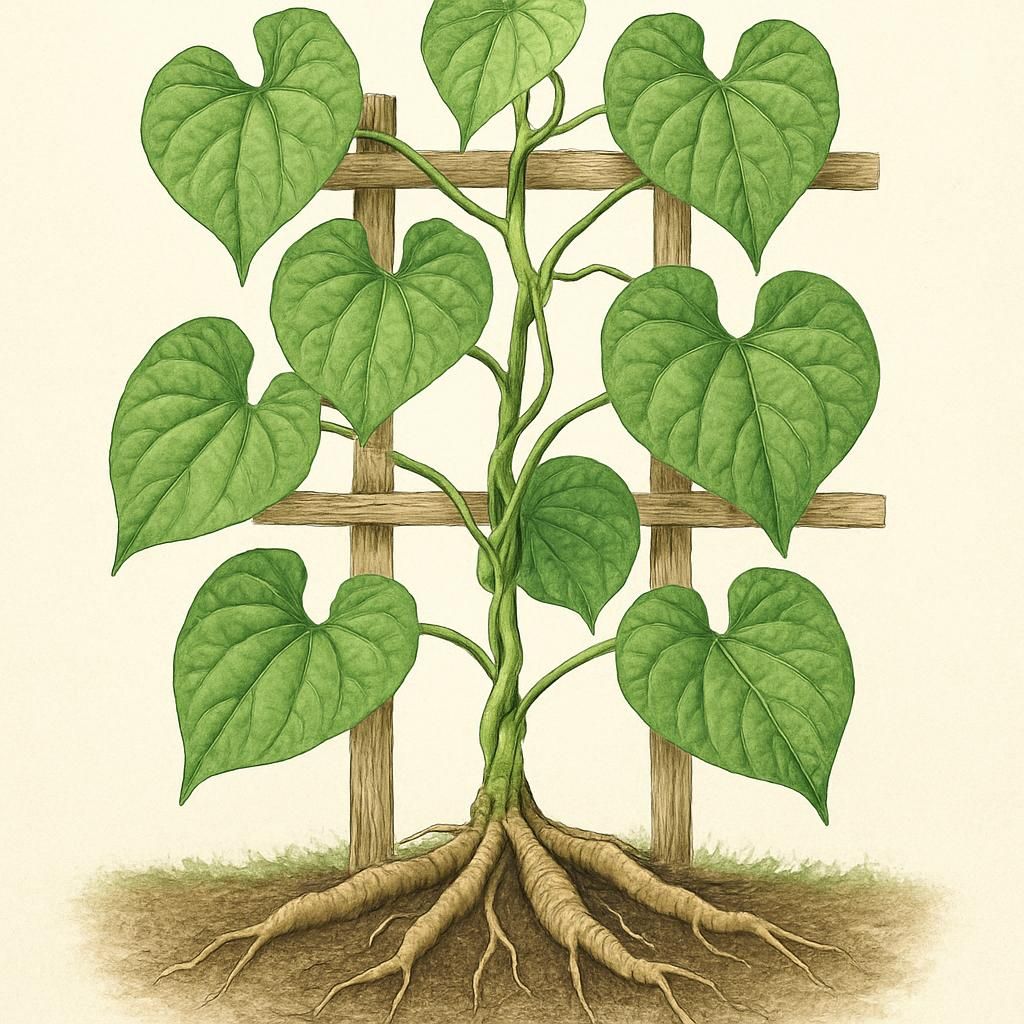
Introduction to Giloy Root
Giloy Root (Tinospora cordifolia) is a vigorous, deciduous climbing shrub native to the Indian subcontinent and parts of Southeast Asia. Grown primarily for its tuberous roots that contain alkaloids, diterpenoid lactones, and polysaccharides, this crop has gained attention among commercial growers seeking high-value medicinal and nutraceutical markets. The plant’s ability to regenerate from stem cuttings and its tolerance to partial shade make it suitable for diversified small-farm systems and agroforestry models.
Successful cultivation begins with selecting healthy mother plants and providing sturdy vertical supports such as trellises or living poles. Because Giloy is a heavy feeder during the active growth phase, soil fertility management and timely irrigation are critical. Organic growers often integrate Ginger or Turmeric in the same plot to optimize land use and improve soil microbial activity.
Botanical Profile of Giloy Root
Tinospora cordifolia belongs to the Menispermaceae family. It produces long, twining stems that can reach 10–15 meters when supported. The leaves are alternate, cordate, and glabrous with prominent palmate venation. Small, greenish-yellow unisexual flowers appear in axillary racemes during the pre-monsoon period. The plant develops underground stolons that thicken into fleshy, light-brown roots rich in starch and secondary metabolites. These roots are harvested after 18–24 months when starch content peaks.
Soil, pH, and Climate Requirements for Giloy Root
Giloy performs best in deep, friable loamy soils with good drainage. Heavy clay soils should be amended with organic matter and raised beds to prevent waterlogging. The crop tolerates a wide pH range but shows maximum biomass accumulation between 6.5 and 7.5.
| Parameter | Ideal Range | Notes |
|---|---|---|
| Soil Type | Sandy loam to loamy | Avoid compacted or saline soils |
| Soil pH | 6.5–7.5 | Liming recommended below 6.0 |
| Temperature | 25–35 °C day / 15–22 °C night | Growth slows below 15 °C |
| Annual Rainfall | 1000–2500 mm | Supplemental irrigation needed in dry spells |
| Relative Humidity | 60–80 % | Higher humidity favors vegetative growth |
| Altitude | 0–1200 m | Performs well up to mid-hills |
Step-by-Step Planting & Propagation
- Select healthy, disease-free mother vines and take 15–20 cm semi-hardwood cuttings with 2–3 nodes.
- Dip cuttings in 0.2 % carbendazim or Trichoderma suspension for 10 minutes.
- Prepare raised beds 30 cm high with a 1:1:1 mix of soil, well-rotted FYM, and sand.
- Plant cuttings at 45° angle, leaving one node above soil; maintain 30 cm × 30 cm spacing within rows.
- Provide immediate shade and misting until new shoots emerge (7–10 days).
- Train emerging shoots onto 1.8–2 m trellises or living supports such as Gliricidia.
- Transplant rooted cuttings to the main field at 4–6 leaf stage during early monsoon.
Care & Maintenance regimes for Giloy Root
Regular weeding, mulching, and nutrient management ensure consistent root development. Drip irrigation is preferred to maintain even soil moisture without waterlogging.
| Growth Stage | Watering Schedule | Fertilizer (per plant) | Pruning Schedule |
|---|---|---|---|
| Establishment (0–3 mo) | 2–3 L every 3 days | 5 kg FYM + 50 g neem cake | Remove weak shoots at 60 days |
| Vegetative (3–12 mo) | 4–6 L every 4–5 days | 100 g NPK 10-26-26 split into 3 doses | Tip prune at 1.5 m to encourage branching |
| Maturity (12–24 mo) | 6–8 L every 7 days | 2 kg vermicompost + 100 g bone meal | Remove dead stems post-harvest |
Pests, Diseases & Organic Management
Common issues include Aphids, Spider mites, and Root rot caused by Pythium and Phytophthora. Weekly scouting and neem oil sprays (0.5 %) at 10-day intervals provide effective control. Soil solarization and raised beds reduce fungal incidence. Infected plants should be uprooted and destroyed; crop rotation with Garlic or Onion breaks disease cycles.
Harvesting, Curing & Optimal Storage
Harvest 18–24 months after planting when leaves begin to yellow. Dig carefully around the plant base to extract stolons and roots. Wash gently to remove soil, then sun-dry for 4–6 days until moisture drops below 10 %. Store in jute bags with silica gel sachets at 15–20 °C and <60 % RH. Properly cured roots retain >85 % of key alkaloids for up to 18 months.
Companion Planting for Giloy Root
Giloy benefits from nitrogen-fixing companions such as Pigeon pea and Sesame that improve soil fertility. Aromatic herbs like Rosemary and Thyme deter aphids and spider mites. Avoid planting near solanaceous crops that share common soil pathogens. Intercropping with low-growing Coriander provides additional income during the first season while suppressing weeds.