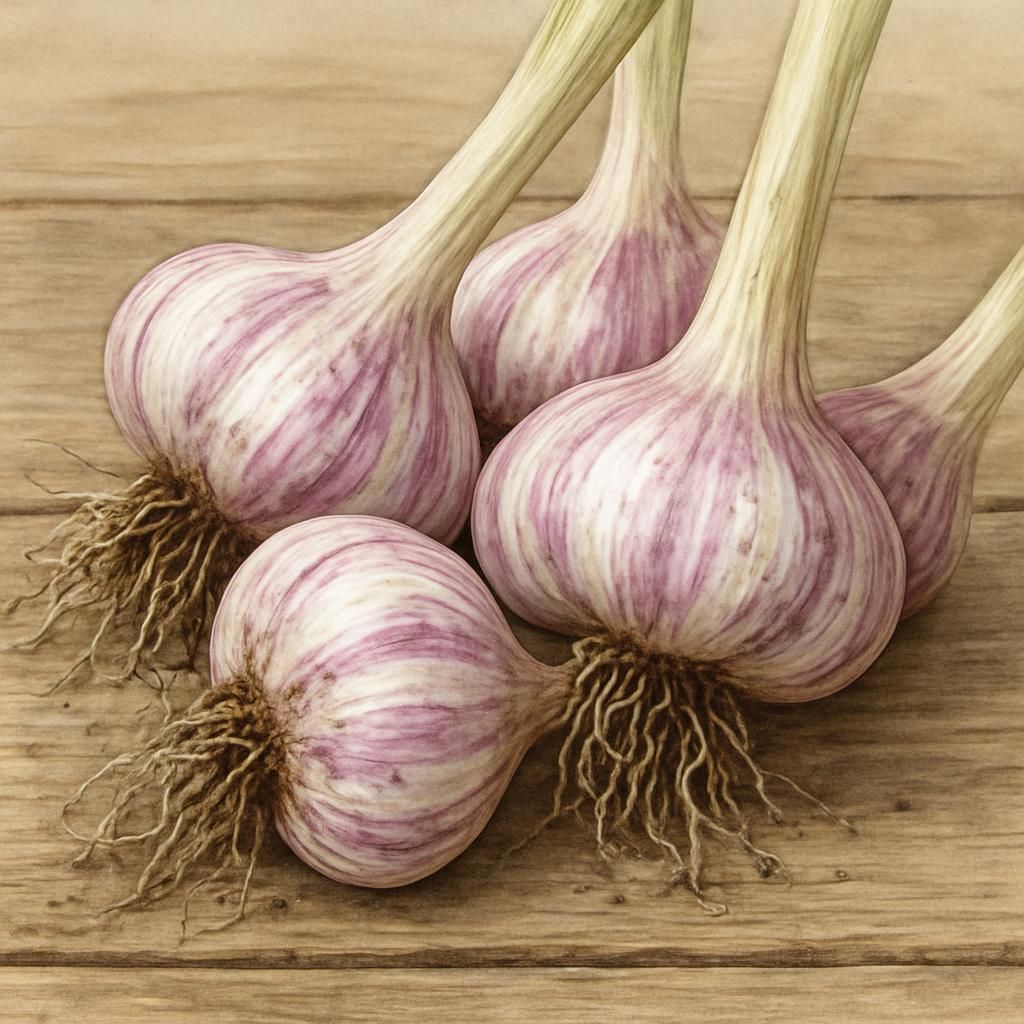
Introduction to Garlic (Spanish Roja)
Spanish Roja is a hardneck garlic cultivar originating from the Pacific Northwest and renowned among chefs and market growers for its rich, complex flavor profile with lingering heat. The variety produces medium-large bulbs wrapped in white skins marked by distinctive purple stripes and typically yields 8–12 plump cloves per head. Because it is a hardneck type, it sends up a scape in late spring that must be removed to direct energy into bulb development. Spanish Roja excels in cold-winter climates and stores for 4–6 months when properly cured, making it a favorite for both home gardeners and small-scale commercial operations.
Botanical Profile of Garlic (Spanish Roja)
Garlic (Allium sativum) belongs to the Amaryllidaceae family and is propagated vegetatively through individual cloves rather than true seeds. Spanish Roja exhibits classic hardneck traits: a stiff central stalk (scape), fewer but larger cloves arranged in a single circle around the stem, and pronounced purple anthocyanin pigmentation on the bulb skins. The plant produces long, flat, bluish-green leaves and reaches 60–90 cm in height at maturity. Flowering is rare; instead, the plant forms bulbils at the top of the scape that can be used for propagation but generally produce smaller bulbs than clove-planted stock.
Soil, pH, and Climate Requirements for Garlic (Spanish Roja)
Garlic demands loose, fertile, well-drained soil with high organic matter content. Heavy clay soils should be amended with compost or aged manure and raised beds are strongly recommended in regions with poor drainage. Spanish Roja performs best in USDA zones 5–8 and requires a cold period of 6–8 weeks below 10 °C to vernalize properly.
| Parameter | Ideal Range | Notes |
|---|---|---|
| Soil Type | Loamy sand to sandy loam | High organic matter; avoid compaction |
| Soil pH | 6.0–7.0 | Slightly acidic to neutral |
| Soil Temperature | 10–15 °C at planting depth | Cloves will rot if soil is too warm |
| Air Temperature Range | −10 °C to 24 °C | Requires winter chill for bulb formation |
| Drainage | Excellent | Raised beds or amended rows essential |
| Organic Matter | 5–8 % | Incorporate 5–8 cm compost before planting |
Step-by-Step Planting & Propagation
- Select large, firm, disease-free cloves from certified stock or saved seed garlic.
- Separate cloves 24–48 hours before planting to allow the basal plate to callus slightly.
- Prepare beds by incorporating 5–8 cm of well-aged compost and a balanced organic fertilizer (approximately 2–3 kg N-P-K 5-5-5 per 10 m²).
- Plant individual cloves 5–7 cm deep with the pointed end up and 10–15 cm apart in rows spaced 30–45 cm apart.
- Mulch immediately with 5–8 cm of straw or shredded leaves to moderate soil temperature and suppress weeds.
- In regions with mild winters, plant in late September to early October; in colder zones, plant 3–4 weeks before soil freezes.
Care & Maintenance regimes for Garlic (Spanish Roja)
Consistent moisture and timely nutrient applications are critical during the rapid spring growth phase. Scapes should be harvested when they form a single curl to improve bulb size. Over-fertilization, especially with nitrogen late in the season, can reduce storage life.
| Growth Stage | Water Schedule | Fertilizer Application | Pruning/Scape Management |
|---|---|---|---|
| Planting–Emergence | Keep top 5 cm moist; 2–3 cm/week | None; rely on pre-plant compost | None |
| Vegetative (Spring) | 2.5–3.5 cm/week until bulbing begins | Side-dress with 1 kg N-P-K 5-5-5 per 10 m² at 15 cm height | Remove weeds only |
| Bulbing (Late Spring) | Reduce to 1.5–2 cm/week | Apply 0.5 kg potassium-rich organic fertilizer per 10 m² | Cut scapes when curled once; use in pesto |
| Pre-Harvest (2 weeks before) | Withhold water 10–14 days prior | None | None |
Pests, Diseases & Organic Management
Spanish Roja is susceptible to onion maggot, aphids, and thrips. Fungal issues include white rot and botrytis. Practice strict crop rotation (minimum 3–4 years) and avoid planting after other Alliums. Use floating row covers at planting to exclude onion maggot flies. Encourage beneficial insects with nasturtium and yarrow borders. For aphids, apply insecticidal soap or neem oil at the first sign of infestation. Maintain good airflow by proper spacing and remove senescing foliage promptly to reduce botrytis risk.
Harvesting, Curing & Optimal Storage
Harvest when 50–60 % of the leaves have turned brown, typically mid-to-late July in most temperate regions. Gently lift bulbs with a garden fork to avoid bruising. Cure in a shaded, well-ventilated area at 20–25 °C with 60–70 % humidity for 2–3 weeks. Once necks are dry and papery, trim roots and tops to 2–3 cm and store in mesh bags or braids at 0–5 °C with 60–70 % humidity. Properly cured Spanish Roja will keep 4–6 months without sprouting.
Companion Planting for Garlic (Spanish Roja)
Garlic repels aphids, carrot rust fly, and Japanese beetles, making it an excellent neighbor for tomato, carrot, beet, and strawberry. Avoid planting near peas, beans, and other legumes, as garlic can inhibit their growth through allelopathy. Interplant with thai basil or rosemary to further deter pests and maximize bed space.