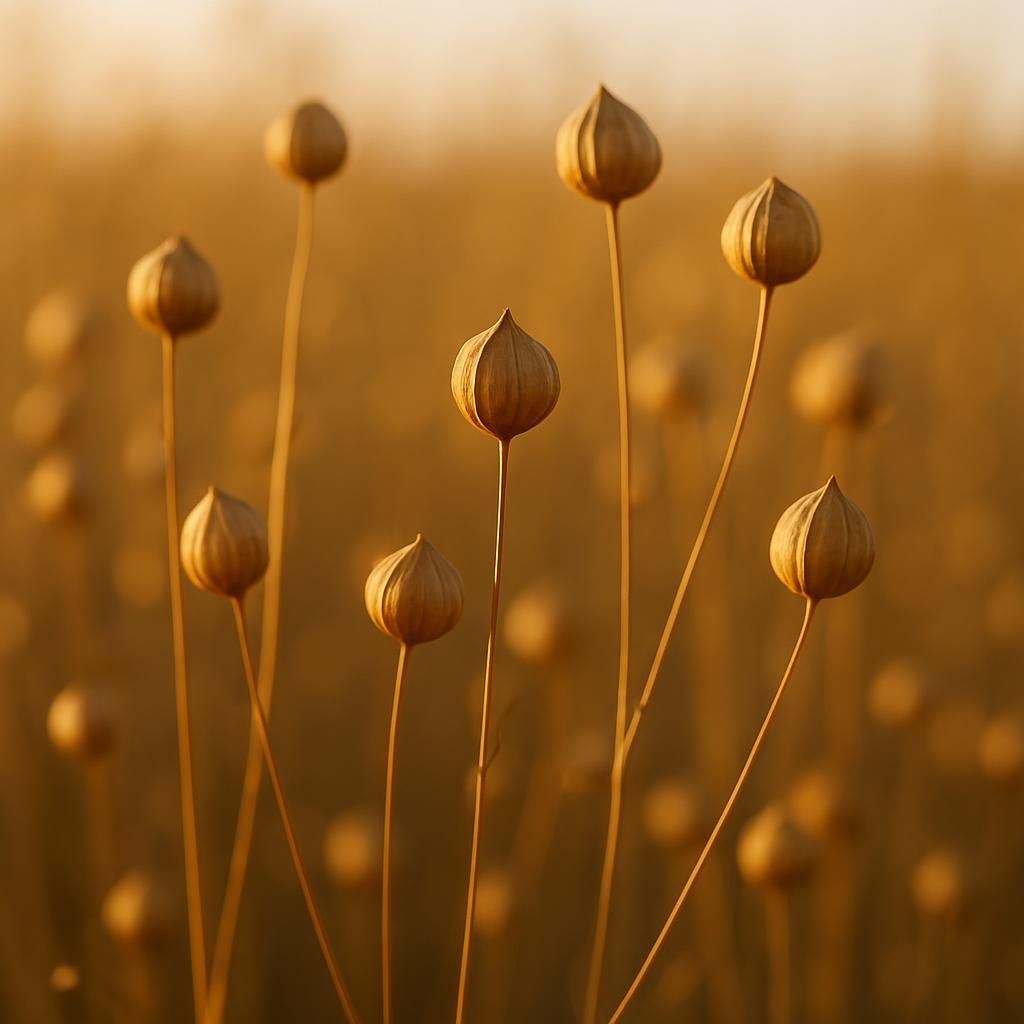
Introduction to Flax Seed (Golden)
Golden flax is a cool-season annual grown primarily for its nutrient-dense seeds, which are rich in alpha-linolenic acid (ALA) and soluble fiber. The crop also produces fine-quality straw suitable for linen fiber production. Farmers value golden flax for its relatively short 90–110 day cycle, drought tolerance once established, and ability to fit into diverse rotations with Wheat, Barley, and Oats. Global demand for organic golden flax continues to rise due to its use in human nutrition, animal feed, and industrial applications.
Botanical Profile of Flax Seed (Golden)
Linum usitatissimum belongs to the Linaceae family. Plants reach 60–120 cm in height with slender, branched stems bearing alternate, lanceolate leaves 20–40 mm long. The pale blue or white five-petaled flowers appear in terminal cymes and develop into spherical capsules containing 8–10 glossy, golden-brown seeds. Golden varieties differ from brown flax mainly in seed coat color and slightly milder flavor; both share identical agronomic requirements.
Soil, pH, and Climate Requirements for Flax Seed (Golden)
Golden flax performs best on well-drained loams and sandy loams with good fertility. Heavy clays increase lodging risk, while very sandy soils require supplemental organic matter. The crop tolerates a broad pH range but yields decline below 5.5 or above 7.5.
| Parameter | Ideal Range | Notes |
|---|---|---|
| Soil Type | Loam to sandy loam | Avoid compacted or waterlogged soils |
| Soil pH | 6.0–7.0 | Lime if below 5.8; sulfur if above 7.3 |
| Temperature (Day) | 15–24 °C | Cool-season crop; heat during flowering reduces seed set |
| Temperature (Night) | 5–12 °C | Frost tolerant to −4 °C at seedling stage |
| Annual Rainfall | 400–750 mm | Supplemental irrigation only during prolonged drought |
| Growing Degree Days | 1,100–1,400 GDD (base 5 °C) | Typical cycle 90–110 days |
Step-by-Step Planting & Propagation
- Site selection: Choose fields with at least two years without flax or canola to reduce disease carry-over.
- Soil testing: Sample to 15 cm depth; target 40–60 kg/ha available nitrogen and 20–30 kg/ha phosphorus.
- Seedbed preparation: Perform shallow tillage or direct-seed into standing stubble to conserve moisture.
- Seeding rate: 40–50 kg/ha of certified seed (approximately 400–500 seeds/m²) for solid stands.
- Seeding depth: 1–2 cm; deeper placement delays emergence.
- Row spacing: 15–20 cm; narrower rows improve weed competition.
- Timing: Plant when soil temperature reaches 7–10 °C, typically 2–3 weeks before last spring frost.
- Inoculation: Not required; flax does not form symbiotic nitrogen fixation.
Care & Maintenance regimes for Flax Seed (Golden)
Golden flax requires minimal intervention once established. Focus on early-season weed control and balanced nutrition.
| Growth Stage | Irrigation Schedule | Fertilizer Application | Pruning/Other Operations |
|---|---|---|---|
| Pre-plant | None; ensure seedbed moisture | Incorporate 30–40 kg N, 20 kg P₂O₅, 15 kg K₂O | Soil test & adjust pH if needed |
| Emergence–Branching | None unless drought >14 days | Side-dress 10–15 kg N at 4–6 leaf stage | Scout for weeds; cultivate if necessary |
| Flowering | Light irrigation if soil <30% field capacity | Avoid excess N; apply 5 kg S if deficient | Monitor lodging risk; no pruning required |
| Seed Fill | Withhold water 10–14 days before harvest | None | Swath or direct combine when 75% brown |
Pests, Diseases & Organic Management
Common insect pests include cutworms, grasshoppers, and Aphids. Spider mites may appear during hot, dry spells. Primary diseases are pasmo, Fusarium wilt, and Powdery mildew. Implement a three-year rotation, use certified seed, and apply Bacillus thuringiensis or neem-based sprays for early caterpillar control. Beneficial insect habitats such as strips of Buckwheat or Clover enhance natural enemy populations.
Harvesting, Curing & Optimal Storage
Harvest when 75–80% of capsules have turned brown and seed moisture is 10–12%. Swathing followed by 5–7 days of field curing reduces shatter losses. Combine at cylinder speeds below 600 rpm to minimize seed damage. Dry seed to 8% moisture before storage. Store in cool, dark bins at <15 °C and <65% relative humidity. Monitor for Storage Beetles and Bruchids every 30 days.
Companion Planting for Flax Seed (Golden)
Flax benefits from nitrogen-fixing companions such as Peas and Lentils planted in alternate rows. Aromatic herbs including Thyme and Rosemary deter aphids. Avoid planting near Sunflower or Rapeseed to reduce shared disease pressure. Under-sowing with low-growing Clover provides living mulch and improves soil structure for the following crop.