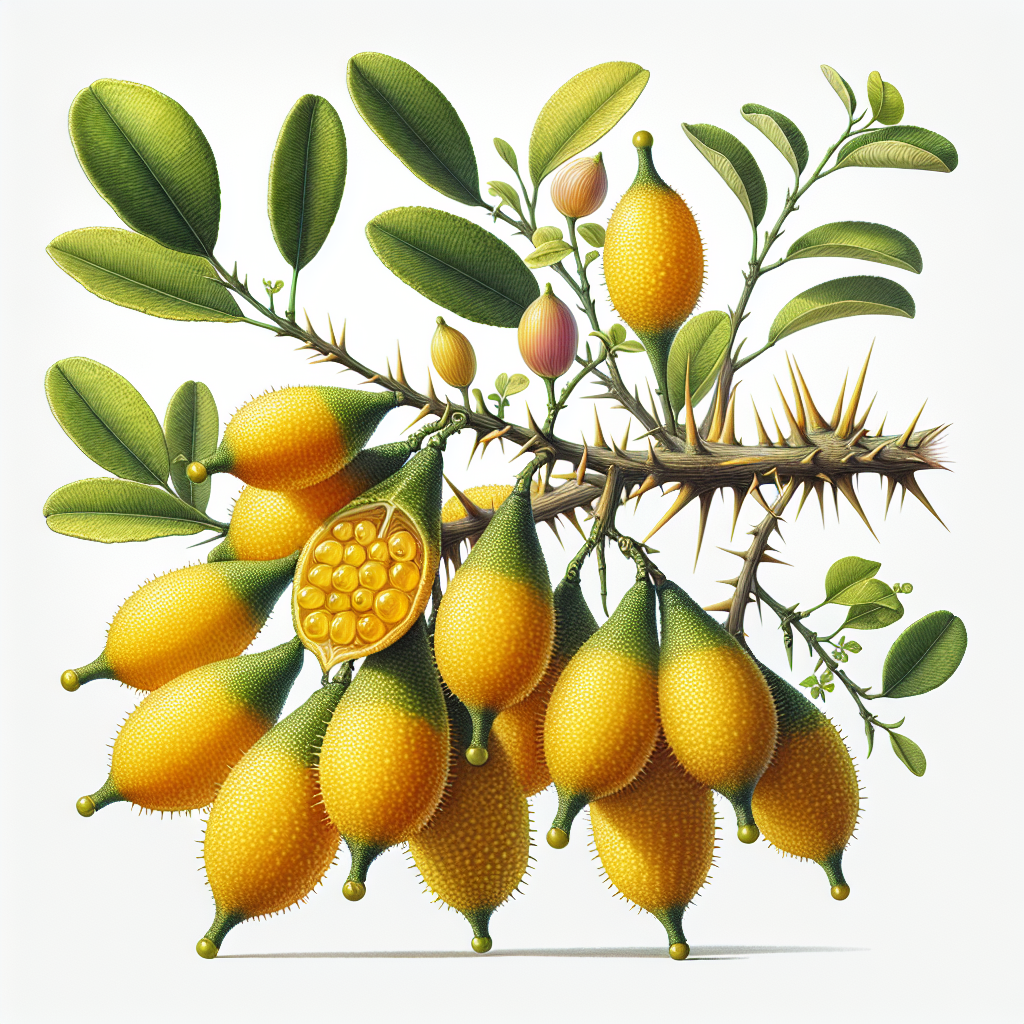
Introduction to Finger Lime (Byron Sunrise)
Finger Lime (Byron Sunrise), a standout selection of the Australian native Citrus australasica, has revolutionized gourmet cuisine with its finger-like fruits filled with vibrant yellow pearls that pop with intense citrus flavor. Originating from the rainforests of Byron Bay, this variety is prized for its striking golden skin, high oil content, and superior pearl retention, making it a favorite among chefs for garnishing seafood, cocktails, and desserts. Unlike traditional round limes, Byron Sunrise offers a caviar-like texture that elevates dishes, commanding premium prices in markets—often $50-$100 per kilo for fresh pearls.
This comprehensive growing guide equips professional growers, small farmers, and enthusiasts with evidence-based techniques to maximize yields. As demand surges in fine dining and health food sectors, Byron Sunrise represents a lucrative niche crop, resilient to many common citrus challenges. With proper site selection and care, trees can produce 10-20 kg of fruit annually after 3-4 years, thriving in USDA zones 9-11 or containers in cooler climates. Finger Lime (crop) provides foundational species info, while this deep-dive focuses on the Byron Sunrise cultivar's unique traits.
Botanical Profile of Finger Lime (Byron Sunrise)
Byron Sunrise belongs to the Rutaceae family, specifically the Citrus australasica var. Sunrise group, distinguished by its thorny, scandent growth habit reaching 3-6 meters if untrained. Leaves are glossy, lanceolate, 4-8 cm long, with new growth flushing pinkish-red, adding ornamental appeal. Flowers are small, white, fragrant, hermaphroditic, blooming spring through fall in flushes, enabling extended harvests.
Fruits are cylindrical, 6-12 cm long, 1.5-3 cm diameter, with thin, glossy yellow rind rich in essential oils. Internally, the pulp forms translucent yellow vesicles (pearls) that burst with lemon-lime flavor, higher acidity (pH 2.5-3.0), and limonene content than standard finger limes. Seeds are few, small, and polyembryonic, aiding propagation. This variety shows hybrid vigor from its rainforest heritage, with improved cold tolerance (-4°C brief) over tropical citrus. Rootstock compatibility is excellent with trifoliate orange or flying dragon for dwarfing in pots.
Byron Sunrise matures in 8-12 months, with peak flavor post-maturity indicated by full yellow color and slight softening. Nutritionally, it's packed with vitamin C (100mg/100g), folate, and antioxidants, positioning it as a superfood. Genetic stability ensures true-to-type from seed, though grafting enhances vigor. Compared to Persian Lime (crop), it offers novelty and higher value.
Soil, pH, and Climate Requirements for Finger Lime (Byron Sunrise)
Byron Sunrise demands well-drained, slightly acidic soils (pH 5.5-6.5) mimicking its native basalt-derived loams. Heavy clays lead to Phytophthora (disease) root rot, so amend with 30-50% coarse sand, perlite, or pine bark for pots. Organic matter like compost boosts microbial activity, but avoid fresh manure to prevent burns. Test soil annually; lime if below 5.5, using dolomite for magnesium supply.
Ideal climate is subtropical (15-30°C average), with 1000-1500 mm rainfall or equivalent irrigation. Humidity above 60% enhances pearl formation, but excellent drainage prevents fungal issues. Frost tolerance is moderate; protect below -2°C with frost cloth. Full sun (6-8 hours) is essential, though light shade mitigates leaf scorch in extreme heat. Windbreaks are crucial, as thorns make pruning tricky.
Mulch with 10 cm pine bark or lucerne hay to retain moisture and suppress weeds. In cooler zones, use south-facing microclimates or heated greenhouses. Soil salinity tolerance is low (EC <1.5 dS/m), so flush with rainwater periodically. For optimal growth, integrate Soil Health Mastery: 5 Proven Strategies for Small Farms to Build Fertile Ground Without Breaking the Bank principles like cover cropping with clover.
Step-by-Step Planting & Propagation
Propagation
Seed sowing: Extract seeds from ripe fruit, rinse, sow fresh in 50/50 sand-seedling mix at 25°C. Germination in 2-4 weeks; 80% success. Polyembryonic nature yields nucellar (true-to-type) seedlings. For elites, T-bud or chip graft onto trifoliate rootstock in spring, achieving 90% take.
Cuttings: Semi-hardwood 10 cm tips root in perlite under mist, with IBA 2000 ppm.
Planting
- Select 1-2 year tubelings (30-50 cm).
- Dig hole twice pot width, incorporate gypsum if sodic.
- Plant at soil level, stake if windy.
- Space 3-4 m in rows, hedging for bushy form.
- Water deeply post-plant, mulch.
Container growing: 50-100 L pots with citrus mix; repot every 2 years. Fertilize monthly spring-summer with citrus-specific NPK 8-4-8 + trace micronutrients (Fe, Zn, Mn). Prune to vase shape annually post-harvest for light penetration.
Care & Maintenance regimes for Finger Lime (Byron Sunrise)
Water: Deep weekly (20-30 L/tree) until established, then drought-tolerant. Deficit irrigation pre-harvest boosts flavor. Irrigate via drip to avoid wet foliage.
Fertilization: Balanced 10-10-10 slow-release March/June/September. Foliar Fe chelate if chlorosis appears. Micronutrients critical; Byron Sunrise is sensitive to deficiencies.
Pruning: Annual tip pruning for compact shape, remove deadwood. Thin crowded fruitlets for size.
Pollination: Self-fertile, but bees enhance set. Hand-pollinate in greenhouses.
Weed control: Mulch + shallow cultivation. Organic pre-emergents like corn gluten.
Monitoring: Weekly scouts for pests; sap flow test for irrigation needs.
Pests, Diseases & Organic Management
Common pests: Citrus leafminer (pest) – neem oil weekly on flushes. Scale insects (pest) – horticultural oil + ladybugs. Mealybugs (pest) – alcohol swabs, predatory beetles.
Diseases: Root rot (disease) – improve drainage, Trichoderma drench. Phytophthora root rot (disease) – phosphite sprays. Powdery mildew (disease) – potassium bicarbonate.
Organic IPM: Introduce predatory mites for Spider mites (pest), yellow sticky traps for Whiteflies (pest). Companion herbs deter aphids. Refer to Why 90% of Small Farms Fail at Pest Management - And 8 Organic Fixes That Actually Work for advanced strategies. Rotate copper fungicides sparingly.
Harvesting, Curing & Optimal Storage
Harvest when fully yellow, slightly soft—twist or clip with secateurs. Yield peaks November-March in southern hemisphere. Pearls extracted by halving lengthwise, scooping gently.
Curing: Store whole fruit 4°C 4-6 weeks to mellow acidity, enhance pearl pop. Post-extraction pearls freeze at -18°C up to 12 months, retaining 90% flavor.
Storage: 85-90% RH, 5-8°C for 2-3 months. Avoid ethylene producers like bananas. Market fresh or process into pastes, oils. Yields increase 20% with girdling 6 weeks pre-harvest.
Companion Planting for Finger Lime (Byron Sunrise)
Pair with Thai Basil (crop) for pest repulsion, nitrogen fixers like pigeon pea for soil health. Avoid Tomato (crop) due to shared pathogens. Marigolds deter nematodes, nasturtiums trap aphids. Underplant with clover for mulch/erosion control. Benefits: enhanced biodiversity, reduced inputs. See Why Companion Planting Feels Like Guesswork for Small Farms - And How AI Makes It Foolproof.