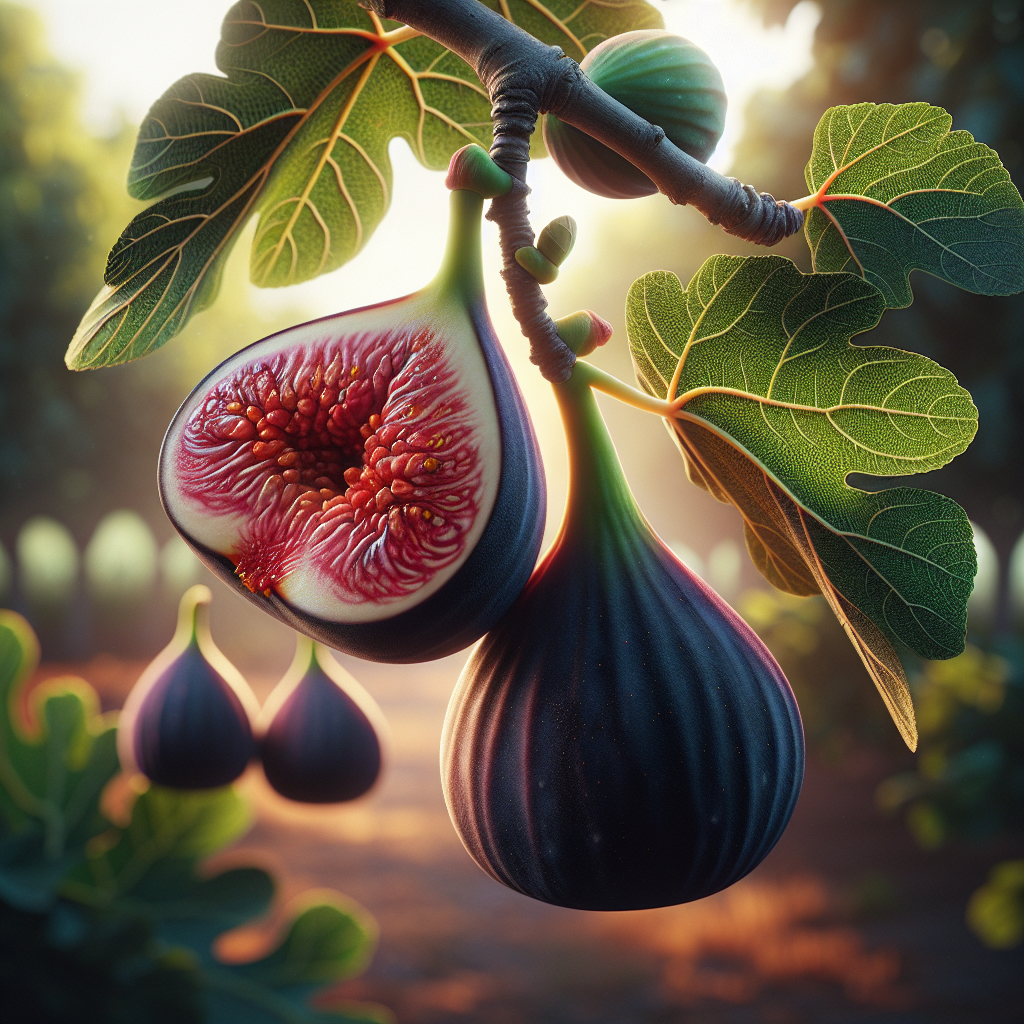
Introduction to Fig (Black Genoa)
A long-cultivated common fig with Mediterranean heritage, this variety is grown primarily for its medium to large pear-shaped fruit, dark purple to nearly black skin, and dense, jammy interior. Black Genoa is typically considered a high-quality fresh-eating fig, but it also performs well for drying, preserves, baking, and small-scale market production where flavor matters more than extreme shipping durability.
Its growth habit is usually vigorous and somewhat spreading, forming a broad-headed small tree or large shrub if left unpruned. In warm districts it can crop heavily once established, and in favorable conditions it may produce an early light breba crop on overwintered wood followed by a more important main crop on current season growth. Compared with some lighter-colored cultivars, Black Genoa is especially prized for its rich sweetness when fully mature, though that same soft texture means harvest timing must be precise.
Like most common figs, it is self-fruitful and does not require pollination by the fig wasp to set edible fruit. That makes it practical for home orchards and many commercial plantings outside traditional Smyrna-type fig regions. Growers familiar with Mission Fig will recognize some similarities in dark fruit presentation, but Black Genoa is often described as broader in form and deeply flavored when fully tree-ripened.
For best results, think of this cultivar as a plant that rewards restraint rather than excess. It tolerates drought better than many fruit trees once mature, yet quality declines if the tree is repeatedly stressed during fruit swell. It appreciates fertility, but overfeeding pushes leafy growth at the expense of concentrated sweetness and can worsen splitting, cold sensitivity, and pest pressure. The best Black Genoa figs come from trees grown in full sun, with steady but not excessive moisture, modest nitrogen, and an open canopy that allows air and light into the fruiting zone.
Botanical Profile of Fig (Black Genoa)
This cultivar belongs to the mulberry family, Moraceae, and shares the distinctive botany of Ficus carica: milky latex in stems and leaves, palmately lobed deciduous foliage, and a unique enclosed inflorescence known as a syconium, which is what growers call the fig fruit. The edible interior is actually a structure lined with many tiny flowers and later seed-like achenes that contribute the characteristic texture.
Black Genoa trees usually reach 3-6 m tall under managed orchard conditions, though they can exceed that in old plantings with deep soil and minimal pruning. In container culture they are commonly maintained between 1.5-2.5 m. Leaves are large, rough-textured, and deeply lobed, usually with three to five lobes, helping the tree intercept high summer light efficiently.
Fruit characteristics are central to identifying this cultivar. The skin matures to a dark purplish black, often with lighter neck shading depending on climate and sun exposure. Flesh is typically red to deep strawberry, moderately seed-rich, very sweet, and aromatic when fully ripe. The eye is usually fairly small to medium, an advantage in humid weather because a large open ostiole can invite souring organisms, vinegar flies, and rain intrusion.
As a common fig type, Black Genoa sets parthenocarpic fruit. That means the fruit develops without fertilization, which simplifies production dramatically. The root system is wide-ranging and opportunistic rather than deeply tap-rooted in most cultivated soils. Most active feeder roots occupy the upper 30-60 cm of soil, especially where oxygen is abundant. That explains why figs respond strongly to mulching, surface composting, and shallow irrigation management, but also why they are vulnerable to chronic waterlogging.
One important nuance for growers is that figs fruit on different wood ages depending on the crop. Breba figs, if produced, arise on previous season wood, while the main crop forms on new shoots. Pruning strategy must therefore reflect whether your climate reliably matures both crops or mainly the main crop. In cool summer areas, heavy winter pruning can reduce overall performance by eliminating potentially fruitful wood and stimulating rank vegetative regrowth instead of balanced fruiting.
Soil, pH, and Climate Requirements for Fig (Black Genoa)
This cultivar performs best in well-drained loam, sandy loam, or gravelly loam with moderate organic matter and strong aeration. Heavy clay is not automatically unsuitable, but it must be improved or planted on raised mounds because prolonged saturation is one of the fastest ways to weaken fig roots. A good target is soil that can hold moisture but still drain enough that a 30 cm deep hole filled with water empties within 12-24 hours. If water stands beyond a day, the site is too wet without significant correction.
The preferred pH range is roughly 6.0-7.5, though figs tolerate slightly more alkaline ground better than many fruit crops. Optimum nutrient uptake is usually seen near pH 6.2-6.8. Below pH 5.8, calcium and magnesium availability can become limiting and root vigor often declines. Above pH 7.8, iron chlorosis may appear, especially in calcareous soils with poor drainage. Chlorotic leaves show interveinal yellowing on younger growth while veins remain green. If this occurs, address drainage first, then organic matter balance, then consider chelated micronutrient correction.
Black Genoa is best adapted to Mediterranean, subtropical, and warm temperate climates with hot summers, low summer humidity if possible, and mild winters. Ideal fruit ripening occurs where daytime temperatures during the main season stay around 26-34b0C, nights remain warm, and rainfall is limited as fruit softens. It is generally suitable for USDA zones about 7-10, though top growth may suffer winter injury in colder parts of that range. In zone 7, plant against a south-facing wall or in a protected courtyard if possible.
Cold tolerance of dormant wood can reach roughly -9 to -12b0C for short periods in hardened trees, but young plants and container specimens are less resilient. Spring frost is often more damaging than winter cold because swelling buds and tender shoots are easily burned. Where late frost is common, avoid pushing early growth with heavy late-winter nitrogen.
Although figs are drought-tolerant, do not confuse survival with premium productivity. For Black Genoa, the best fruit size and texture usually come when root-zone moisture is allowed to cycle between moist and slightly dry, not wet and not bone-dry. As a practical benchmark, the top 10-15 cm of soil may dry slightly between irrigations, but the 15-30 cm layer should retain cool, faintly moist structure during active fruiting. If a squeezed handful from that zone forms a weak ball that breaks apart easily, moisture is often near ideal. If it smears, glistens, or smells sour, the root zone is too wet. If it is dusty and cannot hold shape at all during fruit swell, the tree is under drought stress.
Wind exposure matters more than many growers expect. Hot desiccating wind can cause fruit drop, leaf edge scorch, and poor swell. Conversely, stagnant humid pockets increase rust, fruit souring, and scale problems. Good orchard design means sun, airflow, and protected but not enclosed conditions. For broader site fertility planning, see soil health tips.
Step-by-Step Planting & Propagation
Start with disease-free dormant cuttings, rooted liners, or container-grown nursery stock. Hardwood cuttings are the standard and easiest propagation method because figs root readily from mature wood. Select pencil-thick to thumb-thick one-year shoots during dormancy, ideally 20-25 cm long with 3-5 nodes. Make a flat cut below the basal node and a slanted cut above the top node so orientation is clear.
For rooting, insert cuttings so two-thirds of their length is buried in a sharply drained propagation mix such as 50% coarse sand or perlite and 50% composted bark or coco coir. Bottom warmth around 21-24b0C improves rooting speed, while top growth should be kept moderate to avoid desiccation before roots form. Keep the medium evenly moist, never saturated. A cutting medium that remains dripping wet often leads to basal rot before roots emerge.
When planting in the ground, choose a site with at least 8 hours of direct sun. Dig a hole only as deep as the root ball and about twice as wide. Do not create a deep amended pit in dense native soil, as this can form a bathtub effect that traps water. In marginal drainage, plant on a mound 20-40 cm above grade. Set the tree with the root flare just above surrounding soil level. Backfill mostly with native soil, firm gently, water thoroughly once, and mulch 5-8 cm deep while keeping mulch 10-15 cm away from the trunk.
Spacing depends on training system. For backyard free-form trees, allow 4-6 m between plants. For more intensively pruned low-headed trees, 3-4 m may suffice. Container-grown trees need a large pot, preferably 45-75 liters at minimum, with multiple drainage holes and a coarse, mineral-rich mix.
The best planting time is early spring after severe frost risk has passed, though mild-winter climates can also plant in late autumn to early winter. Spring planting is safer in colder zones because roots establish before next winter.
A strong establishment sequence looks like this:
- Water deeply after planting to settle soil.
- Head back excessively tall whips to encourage low scaffold formation.
- Select 3-5 main shoots for an open vase or multi-stem framework.
- Mulch broadly over the root zone.
- Irrigate regularly through the first growing season, especially during the first 10-12 weeks.
If planting bare-root or freshly rooted cuttings, remove any tiny immature fruit in year one so energy goes into root and framework development. Early cropping on weak young wood commonly delays long-term productivity.
Care & Maintenance regimes for Fig (Black Genoa)
Irrigation must be adjusted by tree age, soil texture, and crop stage. Newly planted trees need consistent moisture until roots move into surrounding soil. In loam, that may mean one deep irrigation every 5-7 days in warm weather; in sand, every 2-4 days; in clay, less often but more carefully monitored. Mature in-ground trees usually benefit from deep, infrequent watering rather than frequent shallow sprinkling. During shoot growth and early fruit set, wet the soil to roughly 30-45 cm depth. During final ripening, reduce extremes: sudden heavy watering after drought can cause fruit splitting, diluted flavor, and root oxygen stress.
Visual cues are extremely useful. Mild water deficit appears as slightly dull leaves and slower shoot extension by midday, but the tree recovers by evening. Harmful drought shows persistent wilting in the morning, leaf yellowing from lower canopy upward, fruit drop, and hard undersized figs that fail to soften. Overwatering shows soft yellowing leaves, little new growth despite wet soil, sour odor in the root zone, algae or fungus gnats in containers, and sometimes fruit cracking with watery flesh.
Fertilization should be modest. Black Genoa generally needs less nitrogen than apples or peaches of similar size. Excess nitrogen produces long, lush shoots with fewer well-finished fruits. In reasonably fertile soil, apply 2-5 cm of mature compost under the mulch in late winter or early spring. If growth is weak, supplement with a balanced organic fertilizer. Young trees may receive a split dose equivalent to roughly 50-100 g actual nitrogen per year, while mature trees often need little more than maintenance feeding unless leaves pale or annual growth drops below about 15-20 cm.
Pruning is best done during dormancy, with light summer pinching where necessary. Train young Black Genoa to an open center or multi-stem bush, both of which suit fig physiology. Remove dead, crossing, inward-growing, or crowded wood. Preserve enough one-year and two-year structure to support both potential breba and main crop production. Avoid severe annual heading cuts unless renovating an old neglected tree. Heavy pruning stimulates water sprouts and delays balanced fruiting.
Root restriction is a traditional technique with figs and can improve fruiting in excessively vigorous sites. Planting near a wall, growing in a container, or using a partially confined root zone can reduce vegetative excess and improve sweetness. However, do not over-restrict in hot climates where water stress becomes difficult to manage.
Mulching is highly beneficial. A 5-8 cm layer of wood chips, leaf mold, or composted bark moderates temperature, feeds soil biology, and stabilizes moisture. Keep mulch clear of the trunk collar to prevent bark rot and rodent shelter.
In colder climates, winter protection may be necessary. Young trees can be wrapped with breathable insulation, caged with straw, or bent and covered in traditional fig-overwintering systems. Container plants should be moved into an unheated but frost-protected shed or garage once fully dormant.
Pests, Diseases & Organic Management
Black Genoa is relatively robust, but fruit quality can decline quickly when pests or moisture-related disorders are ignored. The most common problems are scale insects, mealybugs, spider mites in hot dry conditions, nematodes in sandy soils, birds, ants, and fruit-invading vinegar flies where figs split or sour.
Scale and mealybugs cluster on stems and leaf undersides, sucking sap and producing honeydew that leads to sooty mold. Manage them by pruning crowded wood, controlling ants that protect them, washing light infestations with water, and applying horticultural oil during dormancy or low-heat periods. Avoid spraying oils during very high temperatures or when the tree is drought-stressed.
spider mites become problematic in dusty, hot sites. Symptoms include stippled bronzing leaves and fine webbing. Increase canopy humidity only indirectly by reducing dust and improving plant vigor, not by overhead watering late in the day. In organic systems, insecticidal soap and predator conservation are helpful.
Bird pressure can be severe because figs advertise ripeness visually and aromatically. Netting is the most reliable control. Install before the first fruits soften, not after damage begins. Harvest once fruits droop, soften, and color fully; waiting one extra day can mean losing a large percentage to pecking.
Fruit splitting and souring are often disorder-disease combinations rather than a single pathogen. Rain near ripening, erratic irrigation, high humidity, and ostiole entry by insects all contribute. Improve airflow, harvest promptly, avoid overhead irrigation, and maintain even soil moisture. Remove spoiled fruit immediately from the ground and canopy.
rust is one of the more frequent foliar diseases in humid climates. It appears as yellow spots on upper leaf surfaces and rusty pustules beneath, often causing early defoliation late in the season. Sanitation is essential: remove fallen infected leaves, improve airflow, and avoid prolonged leaf wetness. Copper-based organic sprays may help prevent spread if applied early and according to label guidance, but cultural control is more important than repeated spraying.
root rot is the most serious long-term threat in poorly drained soils. Symptoms include chronic decline, sparse yellow leaves, dieback, and poor response to fertilizer. Once established, correction is difficult. Prevention through drainage, mound planting, and careful irrigation is far more effective than treatment.
nematodes may stunt trees in very sandy warm soils. Organic suppression includes heavy compost use, periodic cover cropping, and understory plant diversity. Beneficial companions like Clover, Thyme, and Yarrow can improve orchard ecology, support predatory insects, and protect exposed soil, though they should be managed so they do not compete heavily with young trees for water.
Harvesting, Curing & Optimal Storage
Harvest Black Genoa only when truly ripe. Unlike some fruits, figs do not improve significantly after picking. A mature fig shows full dark coloration, neck softening, a slight droop from the stem, and a gentle give when pressed. Tiny sugar cracks in the skin and a drop of nectar at the eye can indicate peak ripeness. Immature fruit feels firm and upright, with flatter flavor and less developed internal color.
Pick in the cool of morning once surface moisture has dried. Handle carefully because ripe figs bruise with very little pressure. Wear gloves if sensitive to fig latex, especially when harvesting less-ripe fruit or pruning nearby branches.
Fresh figs are highly perishable. At room temperature, peak-ripe fruit may last only 1-2 days. Under refrigeration at about 0-2b0C with high relative humidity around 90-95%, storage is usually limited to 5-7 days before collapse, fermentation, or flavor loss begins. Store in shallow single layers on absorbent liners, never piled deeply. Good airflow reduces mold.
For drying, select sound fully ripe but not burst fruit. Halve if needed for faster drying, then dry in a dehydrator or well-managed solar dryer at about 52-57b0C until leathery but still pliable. Properly dried figs should not exude free moisture when pressed, yet should remain supple rather than brittle. Condition dried fruit in jars for 5-7 days, shaking daily to equalize residual moisture. If condensation appears, return them to drying immediately.
For preserves, process the same day as harvest for highest sugar and aroma. Black Genoa's richly colored flesh makes excellent jam, paste, and oven-roasted fig products.
Companion Planting for Fig (Black Genoa)
The best companions are low-competition, insectary, and soil-support species rather than large nutrient-hungry crops planted directly into the fig root zone. Because figs cast dense shade once mature and have shallow feeder roots, companion plants should occupy the orchard margin or outer mulch ring, not the immediate trunk area.
Clover is one of the best living understory options because it suppresses weeds, protects soil from summer heat, supports pollinators, and contributes biologically fixed nitrogen when managed as a mow-and-drop groundcover. Keep a vegetation-free ring around young trunks so the tree is not outcompeted during establishment.
Thyme works well on the dry sunny edge of the tree basin or along pathways. Its low habit reduces weed pressure, attracts beneficial insects, and tolerates the same lean, well-drained conditions that favor good fig flavor.
Yarrow is especially useful nearby rather than directly under the canopy. It attracts parasitoid wasps, hoverflies, and predatory insects while adding deep-rooted diversity to orchard strips. Cut it before seed set if you want to keep it tidy.
Nasturtium can also be used as a sacrificial and insectary companion in small plantings, especially where aphid diversion and pollinator support are desired. Place it where irrigation is slightly more available than in the driest central root zone.
Avoid planting thirsty annual vegetables directly beneath mature Black Genoa trees. Their irrigation needs often conflict with ideal fig management, and regular cultivation can damage shallow roots. A better strategy is a stable perennial guild around the drip line and a clean, mulched inner basin close to the trunk.