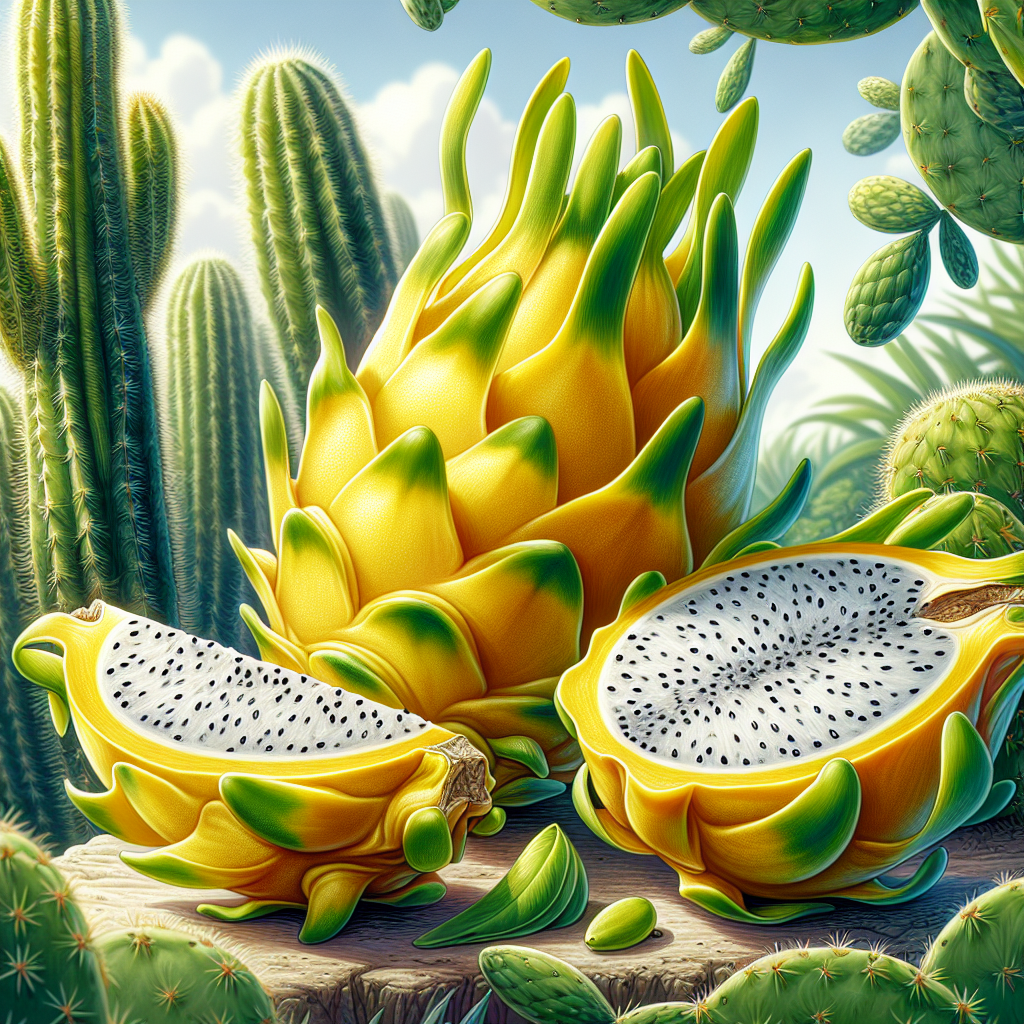
Introduction to Dragon Fruit (Yellow Selenicereus)
Yellow Dragon Fruit, scientifically known as Selenicereus megalanthus, stands out among cacti for its vibrant yellow skin and exceptionally sweet, white-fleshed fruit with tiny black seeds. Native to the Andean regions of Colombia, Ecuador, and Peru, this variety is often called 'pitahaya amarilla' or 'yellow pitaya.' Unlike the more common red-skinned Dragon Fruit (crop), the yellow type offers superior flavor—described as a blend of pear, kiwi, and melon—with Brix levels reaching 20-25, making it a premium crop for fresh markets, smoothies, and gourmet desserts.
This crop thrives as a climbing vine, reaching 6-10 meters in height when supported, and is increasingly popular for small farms due to its low water needs, high profitability (up to $5-10 per kg), and resilience to heat. Commercial yields can hit 20-30 tons per hectare after 3-4 years, with plants producing 30-50 fruits annually. For growers in USDA zones 9-11 or equivalent tropical/subtropical areas, Yellow Selenicereus represents a low-maintenance, high-reward investment. Proper management yields fruit in 12-18 months from propagation, with harvests peaking in summer.
Botanical Profile of Dragon Fruit (Yellow Selenicereus)
Selenicereus megalanthus belongs to the Cactaceae family, characterized by epiphytic, scandent stems that are 3-6-sided with shallow ribs and small, yellowish spines (1-2 cm long) spaced 1-2 cm apart. Stems are fleshy, segmented, and can grow 20-30 cm per season under ideal conditions. The plant flowers nocturnally from May to November, producing large, fragrant white blooms (20-30 cm diameter) that open at dusk and wither by dawn. Pollination is primarily by bats, moths, or hand-pollination for optimal set.
Fruits are ovoid, 8-12 cm long and 6-9 cm wide, weighing 200-500g, with vivid yellow skin covered in small green scales. The white pulp is seed-speckled, juicy, and low in acidity (pH 5.0-5.5). Roots are shallow and fibrous, extending 1-2 meters laterally, adapted for quick nutrient uptake in poor soils. Self-sterile in many clones, cross-pollination with red varieties like Hylocereus undatus boosts yields by 20-40%. Plants are long-lived (20+ years) and drought-tolerant, storing water in stems during dry spells.
Soil, pH, and Climate Requirements for Dragon Fruit (Yellow Selenicereus)
Yellow Dragon Fruit demands well-draining, sandy loam or volcanic soils with 50-70% sand content to prevent root rot. Organic matter should comprise 5-10% for fertility, amended with perlite or pumice for aeration. Ideal pH is 6.0-7.5; test soil annually and adjust with dolomite lime if below 6.0. Avoid heavy clays, which retain moisture and promote Phytophthora (disease).
Optimal climate is tropical/subtropical with daytime temps 25-35°C (77-95°F) and nights above 15°C (59°F). It tolerates brief dips to 5°C but growth halts below 10°C. Annual rainfall of 800-1500 mm is perfect, concentrated in the growing season; supplement with drip irrigation during dry periods (500-1000 L/plant/year). Full sun (6-8 hours daily) is essential, though 20-30% shade cloth mitigates intense heat. Humidity of 60-80% supports flowering, but excellent airflow prevents fungal issues. For more on heat management, see Why Summer Heatwaves Are Silently Killing Small Farm Yields - And 7 Organic Strategies to Fight Back.
Step-by-Step Planting & Propagation
Propagation
Cuttings are the fastest method: select 30-50 cm stem segments (pencil-thick) from healthy, disease-free plants. Air-dry cuts for 7-10 days to callus, then plant 10-15 cm deep in 1:1 sand:perlite mix. Rooting occurs in 4-6 weeks at 25-30°C. Seeds are viable but slow (2-3 years to fruit); sow in sterile media, germinate at 80% humidity in 2-3 weeks.
Planting
Plant in late spring after frost risk. Space 2.5-3 m apart along sturdy trellises (concrete posts 2 m tall, 4-5 m between rows) or living trees. Dig 50x50x50 cm holes, fill with 60% native soil + 30% compost + 10% sand. Insert rooted cutting, firm soil, and water lightly. Mulch with 10 cm organic matter to retain moisture. For 1-acre setups, aim for 400-500 plants.
Initial fertilizer: 10-10-10 NPK at 50g/plant, followed by monthly half-strength applications.
Care & Maintenance regimes for Dragon Fruit (Yellow Selenicereus)
Watering
Irrigate deeply but infrequently: 20-30 L/plant weekly during establishment, reducing to biweekly in maturity. Allow top 5 cm soil to dry between waterings. Drip systems (2-4 L/hour/plant) prevent wet foliage. Overwatering causes root rot (disease).
Fertilization
Apply balanced 10-5-20 NPK monthly during growth (spring-fall), increasing potassium for fruiting. Foliar sprays of micronutrients (Fe, Zn, B at 2g/L) every 4 weeks address deficiencies—yellowing stems signal iron lack. Compost tea or worm castings (5 kg/plant quarterly) build soil biology.
Pruning
Annually after harvest, remove 30-40% of older stems to promote new growth. Thin crowded branches for light penetration. Support heavy fruit loads with slings.
Training
Train 3-5 main stems up trellises in a fan shape. Pinch tips to bush out at 1.5-2 m height.
Pests, Diseases & Organic Management
Common pests include ants (pest), mealybugs (pest), and scale insects (pest). Scout weekly; blast with water jets or apply neem oil (2 ml/L) + insecticidal soap. Beneficials like ladybugs control aphids (pest). For integrated strategies, check Why 90% of Small Farms Fail at Pest Management - And 8 Organic Fixes That Actually Work.
Diseases: Anthracnose (disease) causes stem lesions—remove infected parts, apply copper fungicide. Fusarium wilt (disease) from poor drainage; use biofungicides like Trichoderma. Prevent with sterile cuttings and good airflow. Birds and bats ravage fruit—netting essential.
Harvesting, Curing & Optimal Storage
Harvest when skin shifts from green to full yellow and scales lift slightly (45-55 days post-bloom). Fruits detach easily when ripe; yield 10-20 kg/plant/year after year 3. Cut with pruners, handle gently to avoid bruises.
Cure at 20-25°C, 85-90% RH for 3-5 days to enhance sweetness. Store at 10-12°C, 85-90% RH for 3-4 weeks; freezing at -18°C preserves pulp for 12 months. Market fresh or process into juice/puree—high vitamin C (25 mg/100g) and antioxidants drive demand.
Companion Planting for Dragon Fruit (Yellow Selenicereus)
Pair with shallow-rooted legumes like peanuts (crop) for nitrogen fixation without competition. Thai Basil (crop) repels insects; marigolds deter nematodes. Avoid deep-rooted mango (crop) trees that shade and compete. Trellis under guava (crop) for partial shade and wind protection. Legumes improve soil, enhancing dragon fruit vigor by 15-20%.