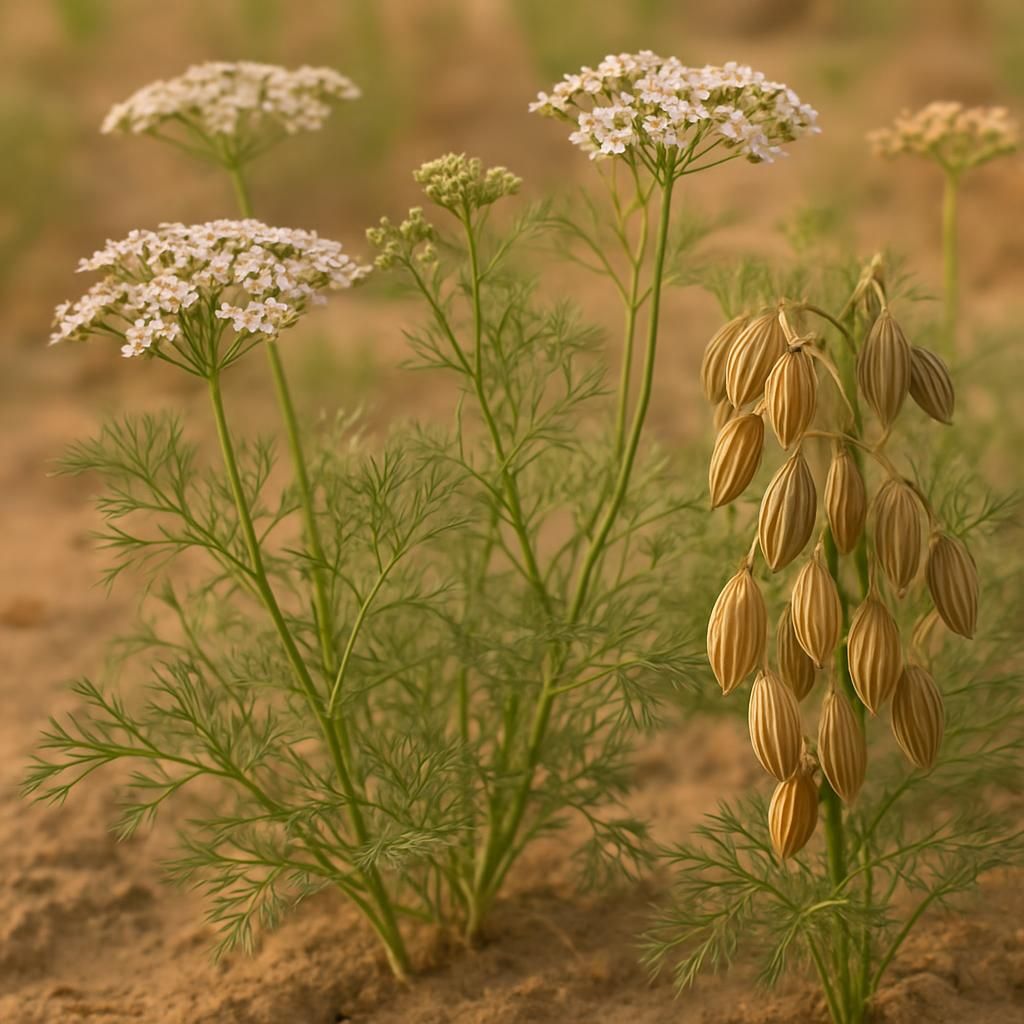
Introduction to Cumin
Cumin (Cuminum cyminum) ranks among the world’s most important spice crops, cultivated primarily for its distinctive, pungent seeds used in curries, breads, cheeses, and traditional remedies. Native to the eastern Mediterranean and southwest Asia, cumin has been traded for millennia and remains a high-value cash crop for smallholders in arid zones. Its short 100–120 day cycle, low water demand, and strong export market make it attractive for farmers seeking resilient, profitable options. Success depends on precise sowing windows, well-drained soils, and integrated pest management. This definitive guide covers every stage of professional cumin production.
Botanical Profile of Cumin
Cumin belongs to the Apiaceae family alongside Carrot and Parsley. The slender, branched plant reaches 15–50 cm in height with finely divided, feathery leaves and small white or pinkish flowers arranged in compound umbels. Each flower produces a schizocarp fruit that splits into two elongated, ridged mericarps commonly called cumin “seeds.” These seeds contain 2–5 % essential oil dominated by cuminaldehyde, responsible for the warm, earthy aroma. The crop is predominantly self-pollinated, although some cross-pollination occurs via insects. Seed color ranges from light brown to dark gray depending on variety and growing conditions.
Soil, pH, and Climate Requirements for Cumin
Cumin performs best on light to medium-textured, well-aerated soils that warm quickly in spring. Heavy clays or poorly drained soils promote Root rot and reduce germination. The crop tolerates moderate salinity but is sensitive to waterlogging.
| Parameter | Ideal Range | Notes |
|---|---|---|
| Soil Type | Sandy loam to loam | Good drainage critical; avoid heavy clays |
| Soil pH | 6.8–8.3 | Slightly alkaline preferred |
| Temperature (Day) | 20–30 °C | Optimal flowering at 25–28 °C |
| Temperature (Night) | 10–18 °C | Frost below 5 °C damages seedlings |
| Annual Rainfall | 300–600 mm | Supplemental irrigation needed in drier zones |
| Growing Season | 100–120 days | Short-day plant; sensitive to photoperiod |
Step-by-Step Planting & Propagation
- Site Selection & Preparation: Choose a south-facing, well-drained field. Perform deep ploughing (20–25 cm) followed by two to three harrowings to create a fine tilth. Incorporate 8–10 t ha⁻¹ well-rotted farmyard manure 3–4 weeks before sowing.
- Seed Treatment: Use certified seed of recommended varieties (e.g., GC-4, RZ-19). Treat with 2 g kg⁻¹ carbendazim or Trichoderma viride (5 g kg⁻¹) to control seed-borne Fusarium.
- Sowing Window: In subtropical regions sow mid-October to mid-November; in Mediterranean climates sow late February to early March. Soil temperature must exceed 15 °C.
- Method & Spacing: Use line sowing at 22.5–30 cm row spacing and 5–7.5 cm plant spacing (40–60 kg seed ha⁻¹). Depth 1.5–2 cm. For broadcast sowing, increase seed rate to 70 kg ha⁻¹ and thin seedlings to the same density.
- Irrigation at Sowing: Give a light pre-sowing irrigation if soil moisture is below 50 % field capacity, then sow into moist seedbed.
Care & Maintenance regimes for Cumin
Cumin requires minimal but timely interventions. Weed competition during the first 40 days can reduce yields by 40 %. Apply first irrigation 30–35 days after sowing and subsequent irrigations at flowering and seed development. Avoid excess nitrogen, which promotes vegetative growth at the expense of seed yield.
| Stage | Water Schedule | Fertilizer Schedule | Pruning / Other Operations |
|---|---|---|---|
| Germination (0–15 DAS) | Light irrigation if soil dries | Basal: 20 kg N, 40 kg P₂O₅, 20 kg K₂O ha⁻¹ | None |
| Vegetative (15–45 DAS) | 1 irrigation at 30–35 DAS | Top-dress 20 kg N at 30 DAS | Hand weeding or shallow hoeing at 20 & 35 DAS |
| Flowering (45–70 DAS) | Critical irrigation at 50 % flowering | Foliar 1 % ZnSO₄ if deficiency appears | Avoid mechanical disturbance |
| Seed Fill (70–100 DAS) | One light irrigation if drought | None | Rogue off-type plants |
| Maturity (100–120 DAS) | Withhold irrigation 10–15 days before harvest | None | None |
Pests, Diseases & Organic Management
Major insect pests include Aphids, Thrips, and capsule borers. Spider mites become problematic under hot, dry conditions. Key diseases are Alternaria leaf spot, Fusarium wilt, and Powdery mildew. Adopt integrated strategies:
- Cultural: Use disease-free seed, rotate with cereals or legumes every 2–3 years, maintain 30 cm row spacing for airflow.
- Biological: Release Chrysoperla carnea (2,000 larvae ha⁻¹) against aphids; apply Trichoderma harzianum (2.5 kg ha⁻¹) at sowing for wilt control.
- Organic sprays: Neem oil (5 ml L⁻¹) or kaolin clay (5 %) for mites and thrips; sulfur dust (25 kg ha⁻¹) for powdery mildew at first appearance.
- Monitoring: Scout weekly from 20 DAS; intervene when 5 % plants show aphid colonies or 10 % leaf area affected by Alternaria.
Harvesting, Curing & Optimal Storage
Harvest when 50–60 % of fruits turn yellow-brown and seeds rattle inside capsules, typically 110–120 days after sowing. Cut plants at ground level in early morning to minimize shattering. Bundle and dry in shade or under ventilated structures for 5–7 days until seed moisture reaches 8–10 %. Thresh by gentle beating or mechanical thresher set at low RPM. Clean seeds and dry further to 6–7 % moisture for long-term storage. Store in jute bags lined with polythene or in hermetic silos at <15 °C and <65 % RH. Properly cured cumin retains aroma and germination (>80 %) for 2–3 years.
Companion Planting for Cumin
Cumin benefits from strategic companions that improve soil health, deter pests, and optimize land use. Intercrop with Chickpeas or Lentils at 2:1 ratio to fix nitrogen and break disease cycles. Border rows of Marigold repel nematodes and aphids while providing beneficial insect habitat. Avoid planting near Fennel or Dill due to cross-attraction of shared pests. Under hot conditions, light shade from taller Sesame can reduce heat stress during flowering. These pairings increase overall system resilience and can boost cumin seed yield by 10–20 %.
Carrot
Parsley
Root rot
Fusarium
Aphids
Thrips
Spider mites
Alternaria leaf spot
Fusarium wilt
Powdery mildew
Chickpeas
Lentils
Marigold
Sesame