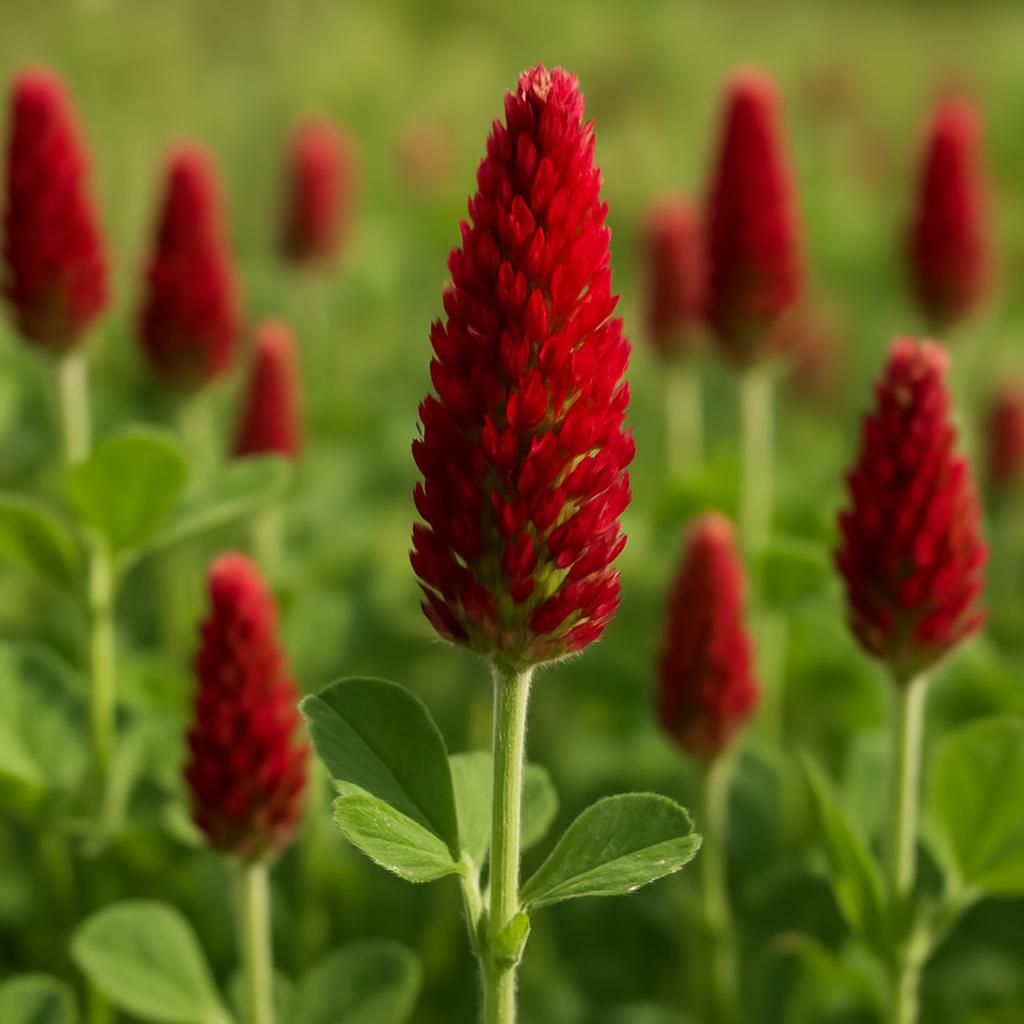
Introduction to crimson clover
Crimson clover (Trifolium incarnatum) is one of the most widely used winter annual legumes in temperate agriculture. Farmers value it for rapid biomass production, excellent nitrogen fixation, and vibrant crimson flower heads that attract bees and other beneficial insects. As a cover crop it protects soil from erosion during winter, suppresses weeds, and leaves behind residual nitrogen for the following cash crop. Gardeners often include it in pollinator mixes or as a living mulch beneath fruit trees. Because it matures earlier than many other clovers, it fits well into double-cropping systems common in the southern and mid-Atlantic United States.
Botanical Profile of crimson clover
Crimson clover belongs to the Fabaceae family. Plants produce hollow, ascending stems 30–60 cm tall with trifoliate leaves that are bright green and slightly hairy. The inflorescence is a dense, cylindrical spike 2–7 cm long consisting of numerous deep-red to crimson florets. Each floret contains ten stamens and a single pistil; pollination is primarily achieved by honeybees and bumblebees. Seeds are small (approximately 1 mm), yellow to reddish-brown, and number 300–400 per gram. The root system is fibrous with a shallow taproot that hosts Rhizobium bacteria capable of fixing 50–150 kg N ha⁻¹ under favorable conditions. Clover shares many of these traits with related species but is distinguished by its brilliant flower color and earlier flowering window.
Soil, pH, and Climate Requirements for crimson clover (MUST INCLUDE A MARKDOWN TABLE OF IDEAL CONDITIONS)
Crimson clover performs best on well-drained soils with moderate fertility. It tolerates a wide range of textures but struggles in waterlogged or highly acidic conditions. The species is adapted to USDA zones 6–9 and prefers cool, moist winters followed by mild springs. Excessive heat or drought during flowering reduces seed set.
| Parameter | Ideal Range | Notes |
|---|---|---|
| Soil pH | 5.8–7.0 | Below 5.5 may require lime |
| Soil Texture | Loam to sandy loam | Avoid heavy clays without drainage |
| Soil Temperature at Planting | 10–18 °C | Germination slows below 7 °C |
| Air Temperature (Growth) | 15–24 °C daytime | Tolerates light frost to –8 °C |
| Annual Rainfall | 600–1200 mm | Supplemental irrigation in dry springs |
| Drainage | Well-drained | Standing water causes root rot |
Step-by-Step Planting & Propagation
- Soil test and apply lime if pH is below 5.8; incorporate 30–45 days before seeding.
- Prepare a firm, weed-free seedbed by disking or shallow tillage followed by rolling.
- Inoculate seed with Rhizobium leguminosarum biovar trifolii specific to crimson clover unless the field has a recent history of the crop.
- Broadcast or drill seed at 15–22 kg ha⁻¹ pure live seed; aim for 1–2 cm depth.
- Roll or cultipack immediately after seeding to ensure good seed-to-soil contact.
- In no-till systems, seed into terminated summer cover or crop residue using a no-till drill.
- Irrigate lightly if rainfall is insufficient during the first 10–14 days after planting.
Care & Maintenance regimes for crimson clover (MUST INCLUDE A MARKDOWN TABLE OF WATER, FERTILIZER, AND PRUNING SCHEDULES)
Crimson clover requires minimal inputs once established. Nitrogen fertilizer is rarely needed because of biological fixation. Phosphorus and potassium should be applied according to soil test results. Mowing is used primarily to delay flowering or manage height in orchards.
| Growth Stage | Irrigation Frequency | Fertilizer (N-P-K) | Pruning / Mowing Schedule |
|---|---|---|---|
| Establishment (0–30 days) | Light irrigation every 3–4 days if dry | None; starter P if soil test low | None |
| Vegetative (30–90 days) | None unless drought exceeds 14 days | 0-20-20 at 150 kg ha⁻¹ if deficient | Mow to 10 cm once at 60–70 days to delay bloom |
| Flowering (90–120 days) | Avoid overhead irrigation | None | Mow or graze after 75 % bloom for green manure |
| Post-harvest / Termination | None | None | Incorporate or roll-crimp at early pod stage |
Pests, Diseases & Organic Management
Common insect pests include aphids, cutworms, and slugs. Fungal diseases such as powdery mildew and root rot may appear under cool, humid conditions. Cultural controls—crop rotation, proper seeding depth, and avoidance of compacted soils—are the first line of defense. Beneficial insects such as lady beetles and lacewings help suppress aphids. When populations exceed thresholds, insecticidal soaps or neem oil provide organic options. For slugs, iron-phosphate baits and habitat reduction through reduced mulch near seedlings are effective. Resistant varieties and timely termination limit disease carry-over.
Harvesting, Curing & Optimal Storage
For forage or hay, harvest at 25–50 % bloom to maximize protein and digestibility. Cut in the morning after dew has dried, and wilt to 40–50 % moisture before baling. For seed production, allow stands to reach physiological maturity (pods turning brown) and combine when seed moisture reaches 12–14 %. Clean seed to remove chaff and inert matter, then dry to 10 % moisture. Store in cool, dry conditions (below 15 °C and 50 % RH) in sealed containers or bulk bins; viability remains above 80 % for 3–5 years under proper storage.
Companion Planting for crimson clover
Crimson clover pairs well with cereal rye, oats, and annual ryegrass in cover-crop mixtures that extend soil coverage and scavenge residual nutrients. In vegetable systems it serves as a living mulch beneath tomato and pepper transplants, suppressing weeds and providing nitrogen. Orchardists often seed it under apple and peach trees to attract pollinators and improve soil biology. Avoid planting near established brassicas, which may suffer from shared pests, and terminate the clover before planting heavy nitrogen-demanding crops such as corn to prevent lodging. Summer Companion Planting: 10 Organic Pairings to Boost Small Farm Resilience