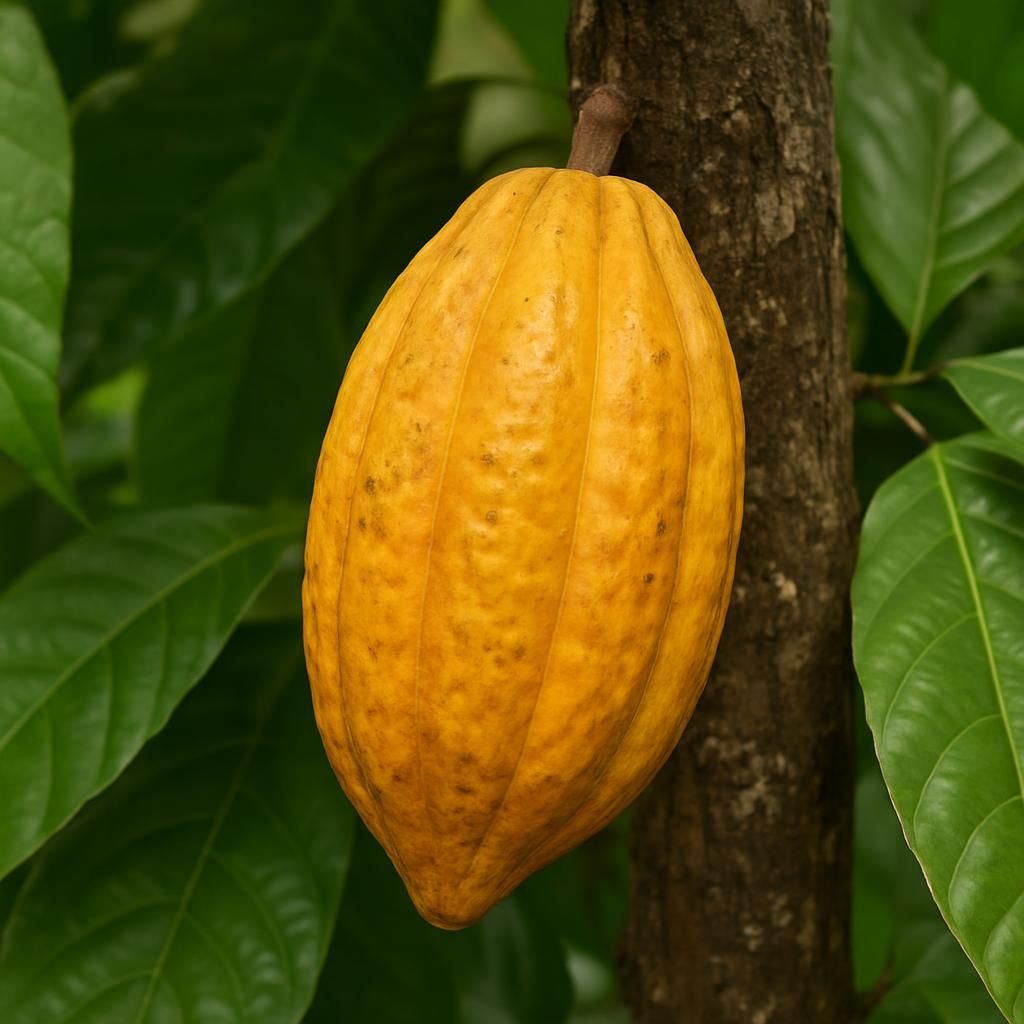
Introduction to Cocoa (Forastero)
Forastero cocoa accounts for more than 80 percent of global production because of its vigor, high pod set, and tolerance to many of the stresses that challenge other cacao types. Originating in the Amazon basin, the variety was spread through West Africa and Southeast Asia where it now forms the backbone of the bulk chocolate industry. Professional growers value Forastero for its predictable fermentation behavior and consistent flavor profile that blends well in mass-market chocolate. This guide delivers field-tested, professional-grade practices for establishing and managing productive Forastero Cacao orchards.
Botanical Profile of Cocoa (Forastero)
Forastero trees are vigorous evergreens that reach 4–8 m under cultivation when regularly pruned. The leaves are large, glossy, and alternate, with new flushes often showing a distinctive red-bronze color. Flowers are small, pinkish-white, and cauliflorous, emerging directly on the trunk and older branches. The resulting pods are thick-walled, deeply ridged, and typically yellow to orange when ripe, each containing 30–40 purple beans. Compared with Criollo Cacao and Trinitario Cacao, Forastero offers higher yields and greater resistance to many fungal and viral pressures.
Soil, pH, and Climate Requirements for Cocoa (Forastero)
Forastero performs best on deep, well-drained soils with high organic matter. The following table summarizes ideal conditions:
| Parameter | Ideal Range | Notes |
|---|---|---|
| Soil Type | Loam to clay loam | Avoid compacted or waterlogged sites |
| Soil pH | 5.5–7.0 | Slightly acidic to neutral |
| Organic Matter | 3–5 % | Maintain with regular mulching |
| Temperature | 21–32 °C daytime | Night lows above 15 °C |
| Annual Rainfall | 1500–2500 mm | Even distribution preferred |
| Relative Humidity | 70–90 % | Critical during flowering and pod set |
| Altitude | 0–600 m | Higher altitudes slow growth |
| Shade Requirement | 30–50 % during first 3 years | Reduce shade as canopy matures |
Step-by-Step Planting & Propagation
- Select certified disease-free Forastero budwood or seedlings from reputable nurseries.
- Prepare planting holes 60 cm wide by 60 cm deep; incorporate 10–15 kg well-rotted compost per hole.
- Space trees 3 m × 3 m for high-density systems or 4 m × 4 m for conventional orchards.
- Plant at the onset of the rainy season; keep the graft union 5 cm above soil level.
- Provide temporary shade using banana leaves or shade cloth for the first 12–18 months.
- Water immediately after planting and maintain consistent moisture for the first six weeks.
Care & Maintenance regimes for Cocoa (Forastero)
Consistent cultural practices drive both yield and bean quality. The table below outlines seasonal schedules:
| Operation | Frequency | Details |
|---|---|---|
| Irrigation | 2–3 times weekly (dry season) | Apply 20–30 L per tree; drip irrigation preferred |
| Fertilizer | 4 applications per year | 200 g NPK 15-15-15 + 50 g kieserite at months 3, 6, 9, and 12 |
| Pruning | 2 structural prunings | Remove basal suckers and crossing branches at end of wet and dry seasons |
| Mulching | Replenish twice yearly | 10–15 cm layer of shredded leaves or cocoa husk within 1 m radius |
| Weed Control | Monthly | Manual slashing or cover crops; avoid deep cultivation near roots |
Pests, Diseases & Organic Management
Forastero is relatively tolerant yet still requires vigilance. Key threats include Phytophthora palmivora, Anthracnose, Cocoa Swollen Shoot Virus (new_internal_link), and Mirids (new_internal_link). Implement weekly scouting and maintain orchard sanitation. Copper-based sprays or neem oil at 0.5 % concentration applied at first sign of infection provide organic control. Introduce predatory ants and maintain diverse understory plantings to reduce pest pressure naturally.
Harvesting, Curing & Optimal Storage
Harvest pods when they turn fully yellow-orange and emit a hollow sound when tapped. Use sanitized secateurs to cut the stalk, avoiding damage to the cushion. Ferment beans 5–7 days in wooden boxes with twice-daily turning to reach 45–50 °C internal temperature. Dry fermented beans on raised racks to 6–7 % moisture over 5–10 days. Store in breathable jute bags at 18–22 °C and 60 % relative humidity; monitor regularly for Storage Beetles.
Companion Planting for Cocoa (Forastero)
Interplant with Gliricidia for nitrogen fixation and light shade. Banana provides temporary shade and wind protection during establishment. Coconut offers long-term upper canopy while allowing sufficient light penetration. Leguminous cover crops such as Pigeon pea and Clover improve soil structure and suppress weeds. Aromatic herbs like Thai Basil deter certain sucking insects. Rotate understory species seasonally to break pest and disease cycles.