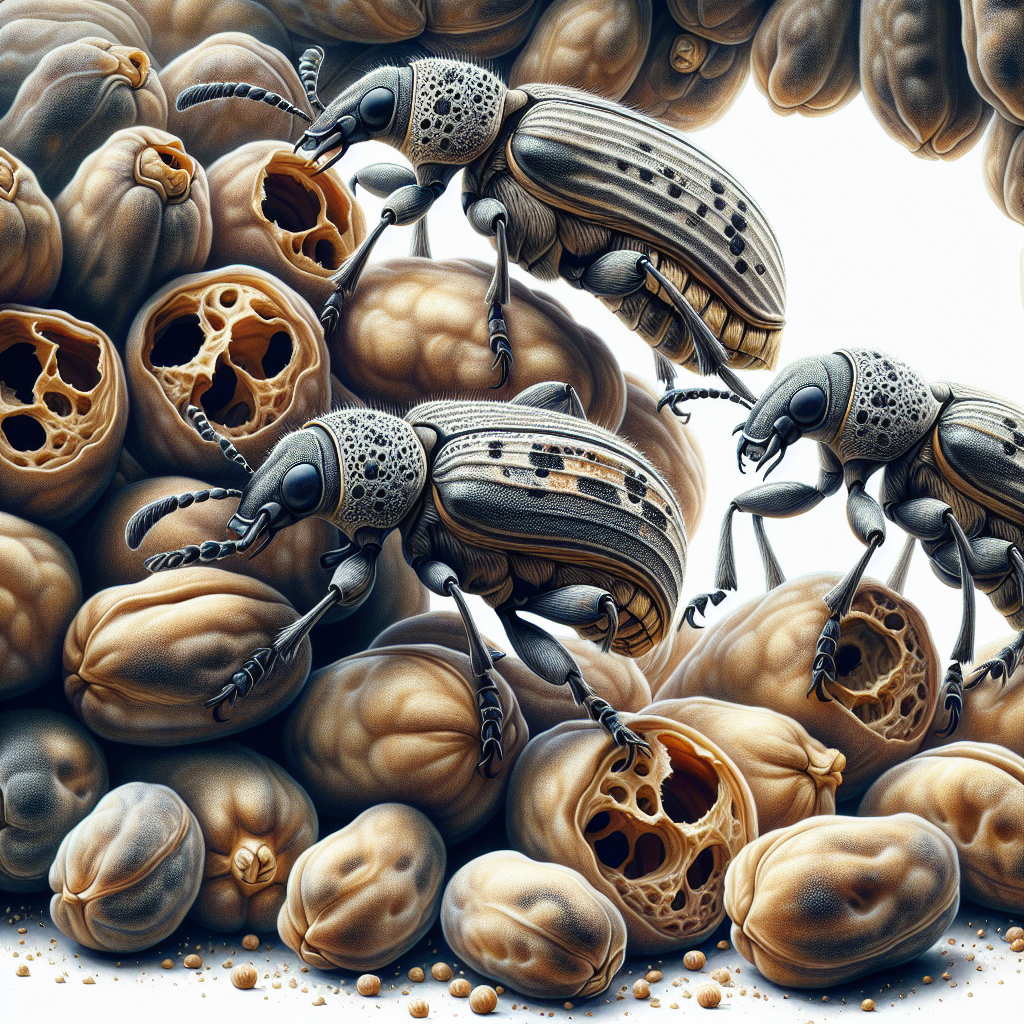
Introduction to Bruchid Beetles
Bruchid beetles, also known as bean weevils or cowpea weevils, represent a major threat to global legume production, particularly in stored grains and pulses. Belonging to the family Bruchidae, these pests are specialized seed feeders that target dry beans, chickpeas, peas, lentils, cowpeas, and other leguminous crops. Unlike generalist storage pests like storage beetles, bruchids complete their entire lifecycle within a single seed, making them insidious invaders of pantries, warehouses, and farm storage.
Farmers and gardeners often discover infestations too late, as adult beetles emerge leaving behind riddled seeds filled with frass and exit holes. Native to tropical and subtropical regions, bruchids have spread worldwide through international trade, thriving in warm climates and causing up to 100% losses in unmanaged storage. This guide provides professional-grade diagnostics, lifecycle insights, organic controls, and prevention strategies to safeguard your soybeans, lentils, and other pulse crops from these destructive invaders. Early detection and integrated management can preserve seed quality, reduce mycotoxin risks, and maintain market value for small farms and commercial operations alike.
Identifying Symptoms & Damage
Recognizing bruchid beetle damage requires careful inspection of seeds and storage areas. Adult beetles measure 2-4 mm long, with characteristic humpbacked thoraxes, rounded abdomens, and patterned elytra—often mottled gray, brown, or black. Look for tiny white eggs (0.5-1 mm) glued to seed surfaces, especially in cracks or hilum areas. Larvae are legless, white, C-shaped grubs that tunnel inward, invisible externally until pupation.
Primary symptoms include:
- Emergence holes: Neat, 1-2 mm round holes in seeds, often with powdery frass around them.
- Hollowed seeds: Infested seeds rattle when shaken, containing frass and dead larvae/pupae.
- Adult beetles: Crawling on seeds or flying weakly in storage; males have larger eyes.
- Secondary damage: Mold growth on frass-contaminated seeds, weight loss (up to 30%), and reduced germination (near 0%).
Damage appears first on older or cracked seeds. Differentiate from bean weevils by bruchids' lack of snout and seed-specific habits. In fields, check pods for eggs during late maturation; in storage, sift through bulk legumes. Severely infested batches show 10-50 holes per seed, signaling total loss. Use a 10x hand lens for eggs/larvae confirmation. For visual diagnostics, see our comprehensive Spring Pest Patrol blog post on early-season monitoring techniques.
Lifecycle and Progression of Bruchid Beetles
Bruchids exhibit 4-8 complete generations per year in tropical conditions, with lifecycles of 20-40 days at 25-30°C. Adults live 7-15 days, females laying 50-150 eggs singly on seeds. Eggs hatch in 4-7 days into larvae that bore in, feeding on cotyledons for 10-20 days across 4 instars. Pupae form within seed (5-10 days), adults emerge chewing exit holes.
Progression stages:
- Egg (4-7 days): White, shiny, attached to seed.
- Larva (10-25 days): Bores to seed center, excavates chamber.
- Pupa (5-10 days): Obtect form inside seed.
- Adult (7-21 days): Non-feeding but disperses to new seeds.
Optimal conditions: 27-32°C, 60-75% RH; development halts below 15°C. Overwinter as diapausing larvae in temperate zones. One female can infest 100+ kg of beans in weeks. Monitor with seed traps: place 100g sample in jar, check holes after 30 days (>5% infested = action needed). Lifecycle syncs with harvest, emphasizing pre-storage cleaning.
Environmental Triggers & Risk Factors
Bruchid outbreaks spike with warm temperatures (>25°C), high humidity (>60% RH), and poor storage hygiene. Key triggers include importing infested seeds, delayed harvest leaving mature pods exposed, and inadequate drying (seeds >12% moisture). Tropical/subtropical farms face year-round pressure; temperate regions see post-harvest surges in unheated storage.
Risk factors:
- Storage conditions: Poor ventilation, high pile temps (>35°C internal).
- Crop residues: Leftover pods/fields harboring pupae.
- Trade: Contaminated imports from Asia/Africa.
- Varietal susceptibility: Thin-seeded legumes like mung beans over thick peanuts.
Infestations explode in organic systems without fumigants. Companion risks from aphids vectoring viruses weakening plants. Climate change extends seasons, increasing generations. Scout fields 2 weeks pre-harvest; test storage RH weekly.
Organic Control & Treatment Plans
Organic management emphasizes prevention over cures, as larvae inside seeds are untreatable. Integrated Pest Management (IPM) plans:
Immediate Actions:
- Sieving & Winnowing: Remove adults/eggs; discard >5% infested.
- Heat Treatment: 55°C for 30 min kills all stages (solarization in black bags).
- Cold Treatment: 0°C for 4 days or -18°C for 3 days.
Biological Controls:
- Parasitoids: Release Trichogramma wasps or Anisopteromalus calandrae (lab-reared, 1:100 ratio).
- Nematodes: Steinernema feltiae drench on floors.
Botanicals:
- Diatomaceous earth (DE): 1-2% on seeds, abrades exoskeletons.
- Neem oil: 2% seed dip pre-storage.
- Essential oils: Clove/lemongrass sprays (repel oviposition).
Treatment Protocol:
- Clean/harvest dry (<10% MC).
- Hermetic bags (PICS) for 3 months suffocates.
- Monitor traps (pheromone lures).
- Rotate stocks FIFO.
Efficacy: Hermetic storage achieves 99% control; combine with DE for residual. Avoid mixing infested lots.
Preventing Bruchid Beetles in the Future
Long-term prevention builds resilient systems:
- Resistant Varieties: Plant 'Blackeye' cowpeas or 'Teagarden' mung beans.
- Sanitation: Deep plow residues; clean equipment.
- Storage Best Practices: Elevated racks, metal bins, 10% MC, <25°C.
- Trap Crops: Border plantings of susceptible varieties.
- Monitoring: Weekly seed probes, pheromone traps.
Farm blueprint: Zone storage away from fields, use solar dryers. Educate supply chains on inspections. Annual audits reduce risks 90%. Integrate with Bruchids wiki for variety resistance charts.
Crops Most Affected by Bruchid Beetles
Bruchids devastate pulses:
- Cowpea (Callosobruchus maculatus primary)
- Chickpea (Kabuli Chickpeas, Desi)
- Mung bean, urd bean
- Lentils (Red, Green Puy)
- Common bean, adzuki
- Peanuts, soybean
- Faba bean, pigeon pea
Global losses: 10-30% in developing countries. Field attacks rare; storage dominant. Protect these staples for food security.