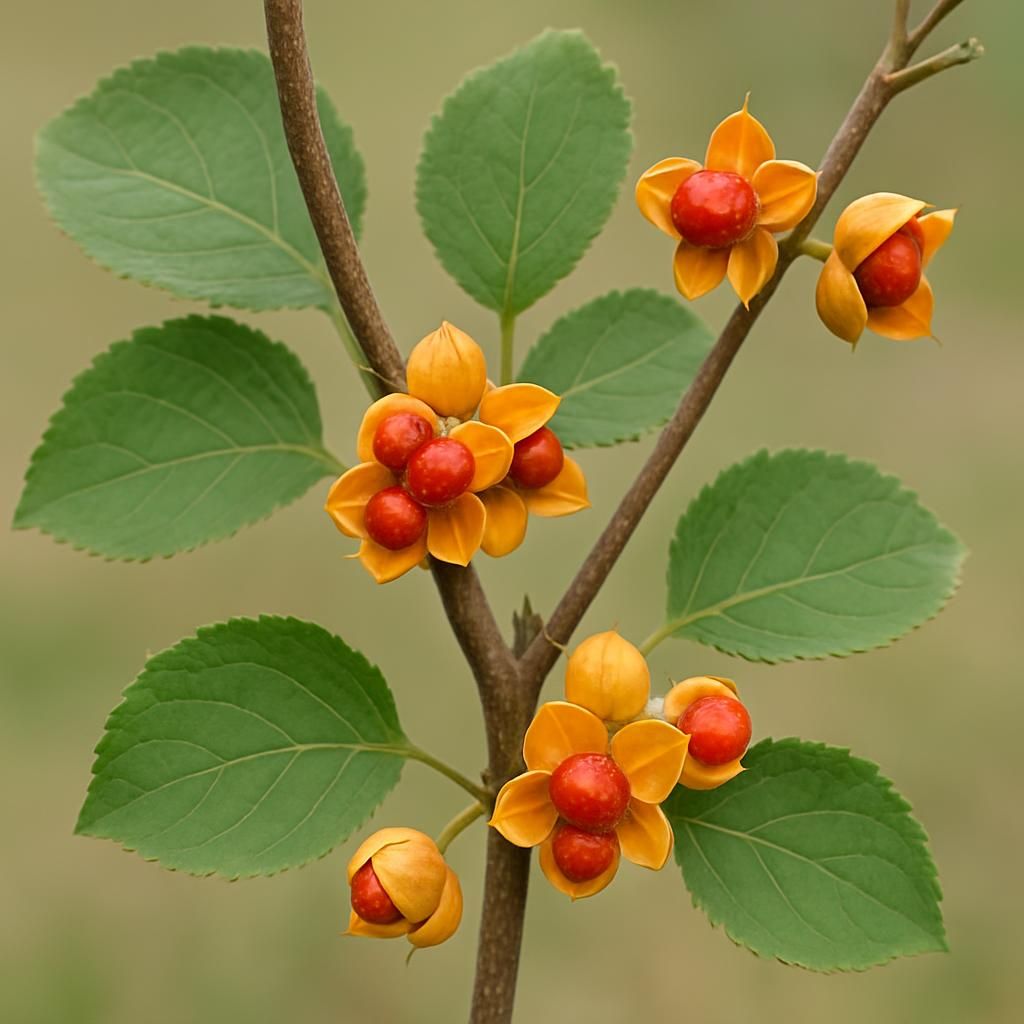
Introduction to Celastrus orbiculatus
Celastrus orbiculatus is a deciduous woody vine native to East Asia that has become a major invasive species across North America and parts of Europe. In agricultural contexts, it rapidly climbs and girdles trees, shrubs, and fence lines, reducing light penetration and competing aggressively for soil nutrients and water. Its ability to resprout from extensive root systems makes eradication challenging once established.
Professional growers encounter Celastrus orbiculatus most frequently along field margins, in orchards, and in hedgerows where birds disperse its bright red-orange fruits. Early recognition and sustained management are essential to protect crop productivity and prevent long-term economic losses.
Identifying Symptoms & Damage
The most visible sign of Celastrus orbiculatus is its twining growth habit that spirals clockwise around host plants. Stems are light brown with prominent lenticels and can reach 10 cm in diameter. Leaves are alternate, simple, and nearly circular with finely toothed margins, turning bright yellow in autumn.
Damage includes girdling of trunks and branches that restricts nutrient flow, leading to canopy dieback. Heavy vine loads increase wind-throw risk in orchards and shade out understory crops. Roots form dense mats that deplete soil moisture, particularly affecting shallow-rooted species such as Strawberry and Blueberry.
Lifecycle and Progression of Celastrus orbiculatus
Celastrus orbiculatus exhibits a multi-year lifecycle with distinct vegetative, reproductive, and dispersal phases.
| Stage | Timing | Description | Key Indicators |
|---|---|---|---|
| Seed Germination | Early spring | Seeds require cold stratification; germination occurs when soil temperatures reach 10–15 °C | Cotyledons emerge near parent vines |
| Vegetative Growth | Spring–Summer | Rapid shoot elongation up to 3 m per season; twining begins immediately | Bright green leaves and flexible stems |
| Flowering | Late spring–early summer | Small, inconspicuous greenish-yellow flowers in axillary clusters | Visible only on female plants |
| Fruit Development | Summer–fall | Green capsules mature to yellow-orange, splitting to reveal red arils | High visibility attracts birds |
| Seed Dispersal | Fall–winter | Birds and mammals spread seeds up to several kilometers | New seedlings appear in disturbed soil |
| Dormancy & Resprouting | Winter | Aboveground portions die back; extensive root system remains viable | Regrowth from root crowns in spring |
Environmental Triggers & Risk Factors
Celastrus orbiculatus thrives in full sun to partial shade and tolerates a wide range of soil types, though it prefers well-drained loams with pH 5.5–7.5. Disturbed sites, fence lines, and areas with recent tillage are high-risk zones.
| Factor | Optimal Range | Risk Level |
|---|---|---|
| Soil pH | 5.5–7.5 | High |
| Temperature | 15–30 °C daytime | Moderate |
| Moisture | Moderate, well-drained | High |
| Light | Full sun to partial shade | High |
| Disturbance | Recent tillage or clearing | Very High |
Proximity to woodland edges and bird perches significantly increases invasion pressure.
Organic Control & Treatment Plans
Integrated management combines mechanical removal, targeted organic herbicides, and follow-up monitoring.
| Treatment Option | Frequency | Application Notes | Expected Efficacy |
|---|---|---|---|
| Hand pulling (seedlings <30 cm) | Every 4–6 weeks during growing season | Remove entire root crown; bag and dispose off-site | High on young plants |
| Cut-stump with 20% acetic acid | Once in late summer/fall | Cut stem 5 cm above soil; immediately apply acid | Moderate to high |
| Repeated mowing or brush-cutting | Every 3–4 weeks | Prevent seed set; deplete root reserves over 2–3 years | Moderate |
| Mulching with 15 cm wood chips | Annual reapplication | Smother resprouts; maintain 1 m radius around crops | Moderate |
| Grazing with goats | Continuous during active growth | High stocking density for 7–10 days; repeat as regrowth occurs | Moderate |
Always monitor treated areas for at least three growing seasons.
Preventing Celastrus orbiculatus in the Future
Prevention begins with rigorous sanitation of equipment and vehicles moving between fields. Establish 3–5 m buffer strips of dense, competitive vegetation such as Clover or Rye along property boundaries. Regular scouting during late summer when fruit is visible allows early detection. Avoid importing topsoil or mulch from unknown sources.
Crops Most Affected by Celastrus orbiculatus
Celastrus orbiculatus impacts a broad range of perennial and annual crops. Orchards of Apple, Peach, and Grapes suffer trunk girdling and reduced light. Berry plantings including Raspberry and Blackberry are quickly overwhelmed. Vegetable systems near field edges, particularly Tomato and Cucumber, experience competition and physical damage from vine encroachment.