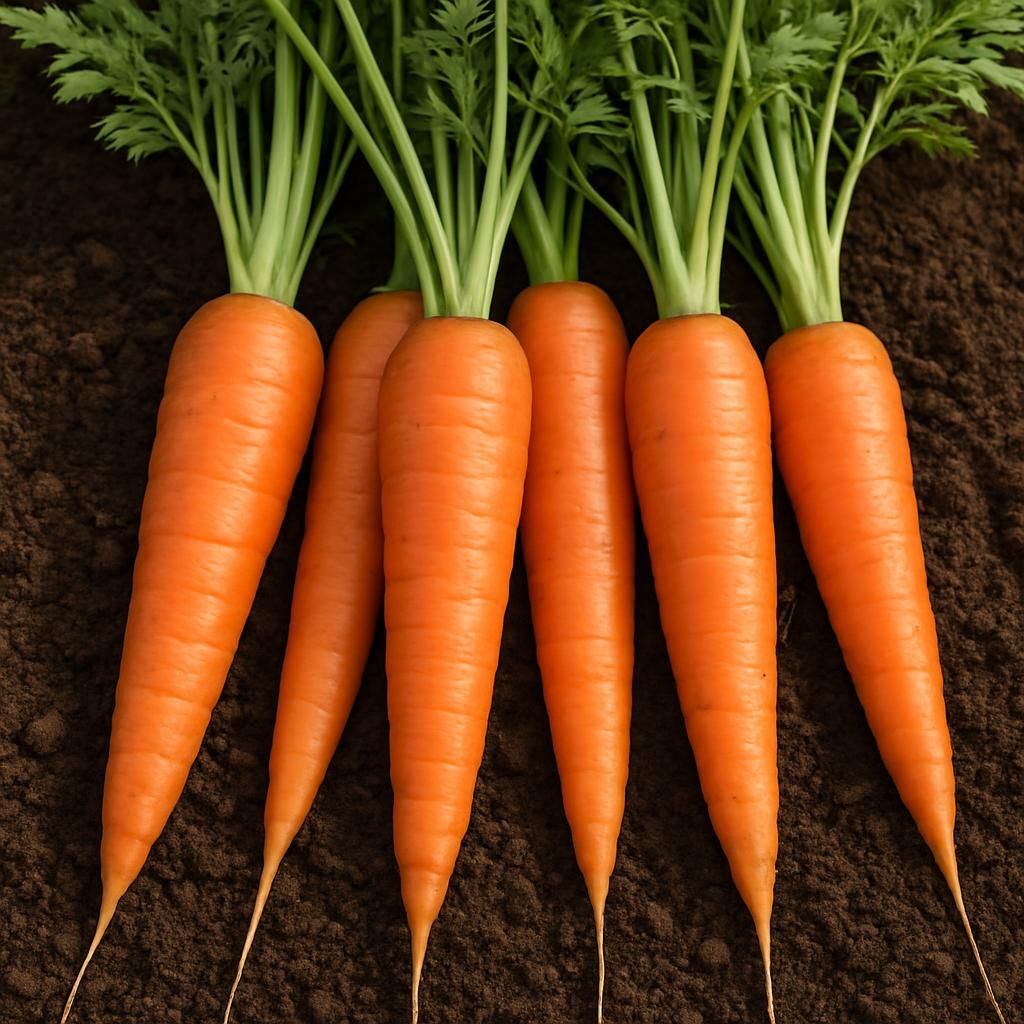
Introduction to Carrot (Imperator 58)
Imperator 58 is a high-yielding, long-rooted carrot cultivar developed for both fresh market and processing. Its straight, tapered roots reach 8–10 inches with bright orange color and crisp texture. The variety tolerates mechanical harvesting and stores exceptionally well, making it a staple for professional growers seeking consistent quality.
Botanical Profile of Carrot (Imperator 58)
Carrot (Imperator 58) belongs to the Apiaceae family. It produces a biennial taproot that is harvested in the first year. The foliage forms a rosette of finely divided, feathery leaves. Roots develop a conical shape with a blunt to slightly pointed tip and smooth skin when grown in loose, stone-free soil.
Soil, pH, and Climate Requirements for Carrot (Imperator 58)
Imperator 58 performs best in deep, well-drained sandy loam or loam soils free of stones and clods. Heavy clay soils should be amended with organic matter and sand to prevent forking.
| Parameter | Ideal Range | Notes |
|---|---|---|
| Soil Type | Sandy loam to loam | Stone-free, deep tilth |
| Soil pH | 6.0–6.8 | Slightly acidic to neutral |
| Soil Temperature | 55–75 °F (13–24 °C) | Optimal germination 60–70 °F |
| Air Temperature | 60–75 °F (15–24 °C) | Tolerates light frost; avoid >85 °F |
| Spacing | 2–3 in within row, 12–18 in between rows | 18–24 in beds for mechanical harvest |
| Days to Maturity | 70–80 days | From direct seeding |
Step-by-Step Planting & Propagation
- Prepare beds by deep tilling to 12–14 inches and removing all stones.
- Sow seed directly ¼–½ inch deep in moist soil; do not transplant.
- Maintain consistent moisture for 7–14 days until germination.
- Thin seedlings to 2–3 inches apart once true leaves appear.
- Use floating row covers early season for temperature and insect protection.
Care & Maintenance regimes for Carrot (Imperator 58)
Consistent moisture and balanced fertility prevent cracking and forking. Side-dress nitrogen lightly at 4–6 weeks after emergence.
| Task | Frequency / Rate | Timing |
|---|---|---|
| Irrigation | 1–1.5 inches/week, keep top 6 in moist | Throughout growing season |
| Fertilizer (N-P-K) | 50-30-60 lb/acre at planting; sidedress 20 lb N at 4–6 weeks | Pre-plant and mid-season |
| Mulching | 2–3 inches organic mulch | After thinning |
| Weeding | Hand or shallow cultivation | Every 2–3 weeks until canopy closes |
| Thinning | Once at 2–3 true leaves | 3–4 weeks after germination |
Pests, Diseases & Organic Management
Common issues include carrot rust fly, root-knot nematodes, and Alternaria leaf spot. Use floating row covers, crop rotation, and beneficial nematodes for control. Avoid planting after parsley or celery family crops.
Harvesting, Curing & Optimal Storage
Harvest when roots reach full color and diameter (usually 70–80 days). Loosen soil with a fork and pull gently. Remove tops to ½ inch, wash lightly, and cool rapidly to 32–34 °F at 95–100 % humidity. Store in perforated plastic bags or bins for 4–6 months.
Companion Planting for Carrot (Imperator 58)
Pair with onion and leek to deter carrot rust fly. Lettuce and radish provide light shade and mark rows. Avoid planting near dill or parsley which can cross-pollinate or attract similar pests. Tomato nearby improves overall garden biodiversity.
For more on small-farm soil strategies, read The Hidden Power of Mulching: 8 Organic Strategies to Transform Small Farm Soil.