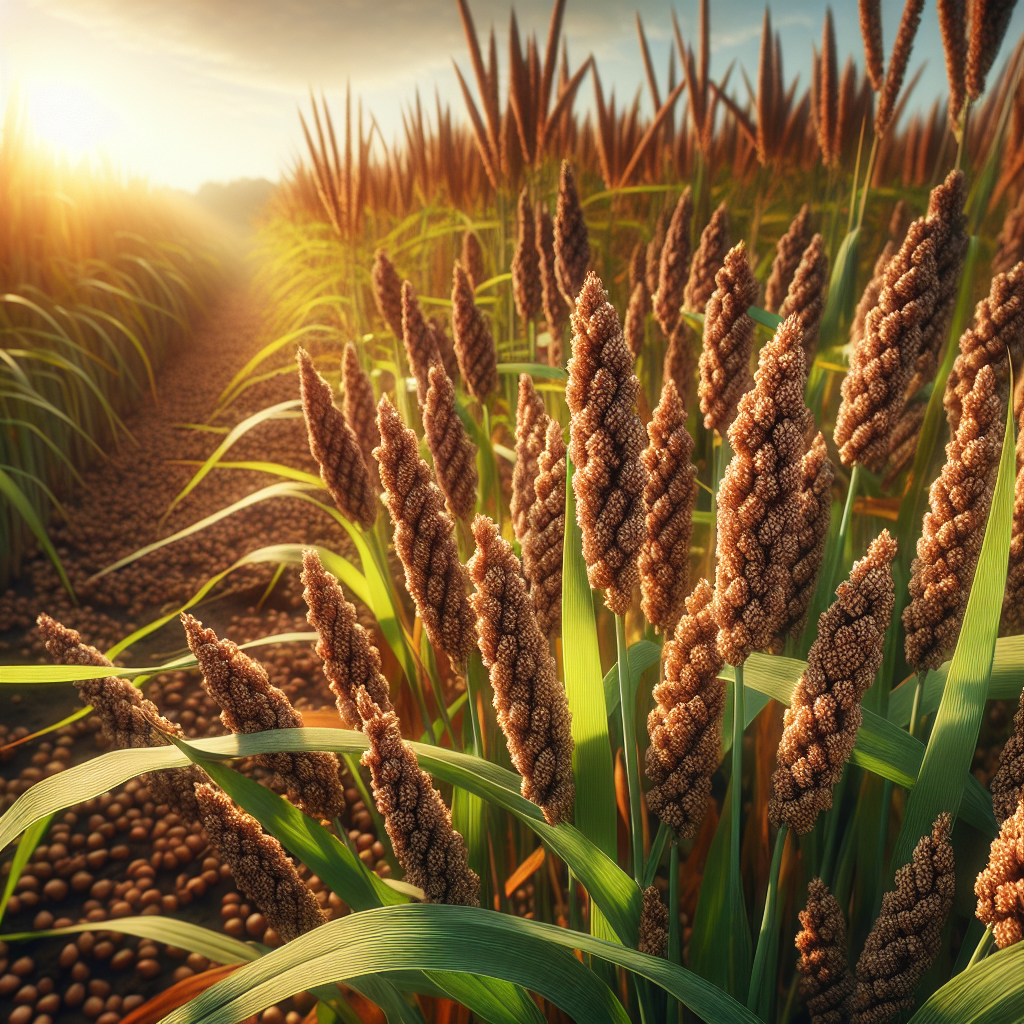
Introduction to Browntop Millet
A warm-season annual grass with deep roots in South Asian agriculture, this crop has long been grown in India and surrounding regions as a resilient food and fodder cereal for dryland farming. In modern regenerative systems, it has also gained attention as a short-duration grain and summer cover crop because it establishes quickly, suppresses weeds effectively, and performs where more demanding cereals often fail.
Compared with larger cereals such as Sorghum or maize, it is finer-stemmed, typically shorter, and much more forgiving of poor soils and intermittent rainfall. Farmers value it for its ability to produce usable biomass and grain in 60 to 90 days under favorable conditions, though timing varies with cultivar, latitude, temperature, and soil moisture. Nutritionally, the grain is small, gluten-free, and used in porridges, flatbreads, fermented foods, and Birdseed mixes.
Its practical strength is flexibility. It can be grown for grain, grazed in vegetative stages, cut for hay before heading, or incorporated as green manure. It also fits well into low-input systems where fertilizer budgets are limited. For broader dryland fertility planning, see soil health strategies.
Botanical Profile of Browntop Millet
This species is generally classified as Urochloa ramosa, though older literature may place it in Brachiaria ramosa. It belongs to the Poaceae family, the grass family, and behaves as a tufted annual with slender culms, narrow leaves, and an open, branched inflorescence. The seedheads are typically loose and delicate-looking compared with the denser heads of pearl millet or foxtail millet.
Plants commonly reach about 30 to 100 cm in height depending on moisture, fertility, sowing density, and whether they are managed for grain or forage. Under higher nitrogen and wider spacing, plants may grow taller and produce more vegetative biomass. Under stress, they remain shorter but often still complete their life cycle rapidly, which is one reason the crop is favored in uncertain rainfall environments.
The root system is fibrous rather than deeply taprooted, but it is efficient at colonizing the upper soil profile and stabilizing topsoil. This makes it useful for erosion-prone fields, sandy loams, and sloping sites where rapid ground cover matters. Tillering is moderate to strong under good establishment conditions. Leaves are soft, narrow, and generally lighter textured than many sorghums. Seeds are tiny, rounded to slightly oval, and brownish when mature, giving the crop its common name.
Flowering is sensitive to daylength and seasonal conditions in some landraces, so local adaptation matters. Improved or regionally adapted seed lots often show more predictable maturity. If you are sourcing seed, ask whether the strain is selected primarily for grain, forage, wildlife plots, or cover crop use, because plant architecture and maturity can differ noticeably.
Soil, pH, and Climate Requirements for Browntop Millet
This crop is notably tolerant of marginal soils, but tolerance should not be mistaken for indifference. It yields best on well-drained sandy loam to loam soils with moderate organic matter and a friable seedbed. It can survive on lighter, lower-fertility ground where other cereals struggle, but compaction, crusting, or prolonged saturation can sharply reduce emergence and stand uniformity.
The ideal soil pH range is about 5.5 to 7.5. It will often perform acceptably down to around pH 5.0, especially in low-input systems, but acidic soils with aluminum toxicity or strong phosphorus fixation can suppress early root growth. On alkaline soils above about pH 8.0, micronutrient issues such as zinc or iron deficiency may show up as chlorosis in younger leaves. If pH is below 5.3, liming before the season can improve vigor; if pH is high, compost and balanced micronutrient management become more important.
Drainage is critical. The crop tolerates short dry spells far better than waterlogging. Soil should hold moisture evenly during emergence, but pore spaces must still contain oxygen. As a practical field target, the top 2 to 4 cm of soil should be moist enough to form a weak ball when squeezed, not powdery and not sticky. If footprints leave glossy smears or if the seed trench closes into a wet ribbon, soil is too wet for ideal sowing.
Climatically, it prefers warm conditions with air temperatures between 25 and 35°C for rapid germination and vegetative growth. Germination is strongest once soil temperatures at sowing depth are consistently above about 18°C. Below 15°C, emergence slows and stands become less uniform. It is frost-sensitive at all stages. A growing season with 45 to 90 frost-free days is usually sufficient depending on intended use.
Rainfall requirements are modest compared with many cereals. Grain crops can succeed with 350 to 650 mm seasonal rainfall if well distributed, though biomass production improves with more moisture. The most sensitive period is establishment through early tillering. Later, the crop can withstand moderate drought, but severe moisture stress at panicle initiation and grain fill reduces seed set and grain weight.
Full sun is essential. Shading reduces tillering, delays drying after rainfall, and increases disease risk. In humid climates, air movement is especially valuable because the fine canopy can trap moisture at the base if stands are overly dense.
Step-by-Step Planting & Propagation
Propagation is by seed. Use clean, viable seed with high germination percentages, ideally above 80 to 85 percent. Because seed is very small, calibration matters more than many growers expect. Uneven seeding depth is one of the most common causes of patchy stands.
Choose the production goal first. For grain, use moderate plant density to balance tillering and panicle development. For forage or weed suppression, slightly heavier seeding is often preferred.
Prepare a fine, firm seedbed. The soil surface should be level and free of large clods. A good benchmark is that a boot heel should leave a shallow imprint, not sink deeply. If the seedbed is fluffy, seed will be placed too deep or moisture contact will be inconsistent.
Control early weeds before sowing. Browntop millet competes well after establishment, but it is not highly competitive in the first 10 to 14 days. Stale seedbed techniques or shallow pre-plant cultivation are effective in organic systems.
Plant after soils have warmed. Sow when the danger of frost is over and topsoil temperatures are reliably warm. In monsoonal climates, planting just before dependable rains often gives the best stand.
Seeding depth: 0.5 to 1.5 cm is ideal. On heavy soils, stay closer to 0.5 to 1.0 cm. On sandy soils with drying surfaces, 1.0 to 1.5 cm may be better. Seed placed deeper than 2 cm often emerges weakly or not at all.
Spacing: For drilled grain production, rows of 15 to 25 cm are common. Broadcast seed can work for cover crop use, but drilling gives better seed-soil contact and more uniform maturity. If planted in wider rows for seed production, 30 cm spacing can improve airflow and allow inter-row cultivation.
Seeding rate: Typical drilled rates range from about 4 to 8 kg/ha for grain and 8 to 12 kg/ha for forage or cover crop purposes. Broadcast rates are usually increased by 10 to 25 percent to compensate for less precise placement.
Press or roll after sowing if soil is dry near the surface. This improves contact, but do not over-pack heavy clay soils.
Irrigate lightly after sowing if rainfall is absent. The goal is to moisten the top 3 to 5 cm without creating crusting. Frequent light irrigation during emergence is better than one heavy soaking on fine-textured soils.
Under favorable warmth and moisture, seedlings usually emerge within 4 to 8 days. If emergence is delayed beyond 10 days, inspect for crusting, Seed rot, ant or bird predation, or overly deep sowing.
Care & Maintenance regimes for Browntop Millet
Once established, this is a relatively low-maintenance crop, but careful management in the first month greatly improves outcomes.
Water management: During the first 2 weeks after planting, keep the seed zone evenly moist, not saturated. In practical terms, the surface should dry slightly between irrigations, but the top 2 cm should never become bone-dry during germination. After establishment, allow the upper few centimeters to dry between irrigations so roots seek deeper moisture. For grain production, moderate but steady moisture during tillering and panicle initiation is ideal. A rough target is to refill the root zone when about 40 to 50 percent of available water has been depleted in loam soils.
Signs of underwatering include bluish-green leaves, reduced tillering, leaf rolling during the morning rather than only late afternoon, and shortened panicles. Signs of overwatering include yellowing lower leaves, stagnant growth despite adequate fertility, sour-smelling soil, algae on the surface, and roots that appear brown and oxygen-starved rather than white and fibrous. Standing water for more than 24 to 48 hours in warm weather can significantly damage the stand.
Nutrient management: Browntop millet is efficient under low fertility, but grain yield responds to balanced nutrition. A general baseline for grain is modest nitrogen, often 20 to 50 kg N/ha depending on soil organic matter and previous crop. Over-application of nitrogen promotes excessive leafy growth, can delay maturity, and may increase lodging, especially under irrigation. Phosphorus is important for early root development; soils low in available P should be corrected before planting or banded lightly near the row. Potassium supports drought tolerance and stem strength, particularly on sandy soils. Sulfur and zinc may be limiting on weathered or alkaline fields.
In organic systems, well-finished compost, poultry manure at conservative rates, or prior legume cover crops can supply adequate fertility. A pre-plant soil test is highly recommended. If leaf color becomes pale uniformly across the field after early establishment, a light side-dress of nitrogen before stem elongation may help, but late nitrogen often benefits biomass more than grain.
Weed management: The crop is vulnerable early and competitive later. Keep fields clean until seedlings reach about 10 to 15 cm tall. Narrow rows, timely cultivation, and adequate stand density usually suppress later flushes. Avoid deep cultivation once roots spread near the surface.
Lodging prevention: Excess nitrogen, over-irrigation, and overly lush stands increase lodging risk. Lodging is especially problematic if storms occur during grain fill. Moderate fertility and well-timed irrigation are better than pushing vegetative growth.
Forage use: If grazing, start when plants are well rooted and at least 20 to 25 cm tall. Avoid grazing too low; leave at least 8 to 10 cm stubble to support regrowth. If cutting for hay, the boot to early heading stage generally provides the best compromise between quality and yield.
Pests, Diseases & Organic Management
This crop is generally less pest-prone than many major cereals, but problems do occur, especially under monocropping or stress.
Birds: The most common grain loss often comes from Birds during seed fill and maturity. Small-seeded millets are attractive to seed-eating Birds. Use synchronized planting, reflective tape, scare devices, netting on small plots, or harvest promptly once seed reaches maturity.
Armyworms and Caterpillars: Seedlings and young foliage may be chewed by Armyworms or other grass-feeding larvae. Scout twice weekly during warm, humid periods. Look for ragged leaf margins, frass in whorls, and sudden thinning patches. Encourage beneficial insects with flowering borders such as Sunflower and Yarrow. On small acreages, Bacillus thuringiensis products can help against young Caterpillars, but timing matters.
Grasshoppers: In dry years, edge feeding can be severe. Maintain weed control around field margins, use trap strips if pressure is chronic, and protect young stands early when damage is economically meaningful.
Aphids: Usually minor, but they can build up under drought stress or excessive nitrogen. If colonies cluster on leaves or stems and honeydew appears, reduce plant stress and preserve predators like lady beetles and lacewings.
Seedling diseases and Root rots: Poor drainage and cool, wet seedbeds favor Damping-off and Seed rot. Prevention is better than treatment: warm soils, shallow sowing, clean seed, and good drainage are the key controls.
Leaf spots and Rust-like diseases: Dense, humid stands may develop fungal lesions, especially where airflow is poor. Organic management includes wider spacing when humidity is high, avoiding overhead irrigation late in the day, removing volunteer grasses, and rotating away from grasses for at least one season if disease history is strong.
Nematodes: Usually not the primary concern, but sandy soils with chronic grass production can see background pressure. Rotation with broadleaf crops or legumes helps interrupt pest cycles.
The most effective organic strategy is prevention through crop rotation, balanced fertility, sanitation, and avoiding plant stress. Browntop millet is often healthier in diverse rotations than in repeated grass-after-grass sequences.
Harvesting, Curing & Optimal Storage
Harvest timing depends entirely on end use.
For grain: Harvest when seedheads have turned brown, seeds are hard, and most panicles are physiologically mature. Because tillering can create uneven maturity, some growers wait until 80 to 90 percent of heads are mature, accepting slight shatter risk on the earliest heads. Test grain by biting or pressing: mature seed should be firm, not doughy. Seed moisture at harvest is often around 18 to 22 percent if cut directly, though safer long-term storage requires drying to about 12 percent or below, and 10 percent is better in humid climates.
Small plots may be cut by hand and dried on tarps or racks before threshing. Larger plots can be swathed or directly combined if the stand is uniform. Since seeds are tiny, harvester settings need adjustment to minimize blowout losses. Use lower initial fan speeds and carefully monitor tailings and grain pan.
For hay: Cut at boot to early heading for best feed value. Delay beyond full heading and stems become coarser while digestibility falls. Cure rapidly in thin windrows; the fine stems dry fast, but heavy swaths can trap moisture underneath.
For green manure or cover crop incorporation: Terminate before viable seed develops if volunteer issues are a concern. Once seed matures, the crop can reseed readily under favorable conditions.
Drying and curing: Grain should be cleaned soon after threshing to remove chaff and green material that trap moisture. Dry in a shaded, well-ventilated area with moving air rather than intense direct sun that can crack seed coats in extreme heat. Stir shallow layers regularly until moisture is safely reduced.
Storage: Use cool, dry, airtight containers for seed intended for food or planting. Ideal storage conditions are below 15°C and below 60 percent relative humidity. If using woven sacks, place them on pallets, away from walls, and inspect frequently for insect activity. Storage pests such as weevils or grain moths can damage small millets quickly if moisture is too high. For seed saving, keep lots clearly labeled by field and harvest date, and avoid storing seed from lodged or disease-prone patches if selection quality matters.
Companion Planting for Browntop Millet
This crop is most useful in companion systems when the goal is ecological function rather than intimate intercropping with tall, heavy feeders. Because it establishes fast and forms a fine grass canopy, it can serve as a nurse crop, wind buffer, insectary support system when paired with flowering margins, or a soil-cover component in rotation blocks.
The most practical companions are nitrogen-fixing or insect-supporting species that do not aggressively outcompete it during establishment. Clover is valuable in broader rotation or strip systems because it contributes nitrogen, improves soil structure, and helps diversify root architecture. Cowpea is another strong companion in warm climates, adding nitrogen while occupying a different canopy layer if population is managed carefully. Sunflower can function as a beneficial insect attractor and light windbreak on plot edges rather than within dense grain stands. Yarrow is especially useful on margins to attract parasitoid wasps and predatory insects.
In field practice, the best "companion planting" with this crop often means border, strip, or relay design rather than mixing everything uniformly in one seed pass. For example, browntop millet in 6- to 12-meter strips next to legume strips creates easier harvest logistics than a fully mixed stand. If growing primarily for grain, avoid aggressive companion density that shades the millet during its first 3 weeks. If growing for forage or pollinator habitat, mixed stands are easier to justify.
Avoid pairing it with other fast, competitive grasses unless the goal is simply biomass. Grass-on-grass combinations can increase competition for nitrogen and complicate disease and volunteer management. Broadleaf companions are usually the better strategic choice.
Done well, companion design improves weed suppression, pollinator activity around the field, biological pest control, and post-harvest soil quality without sacrificing the crop's main strengths: speed, resilience, and low input demand.