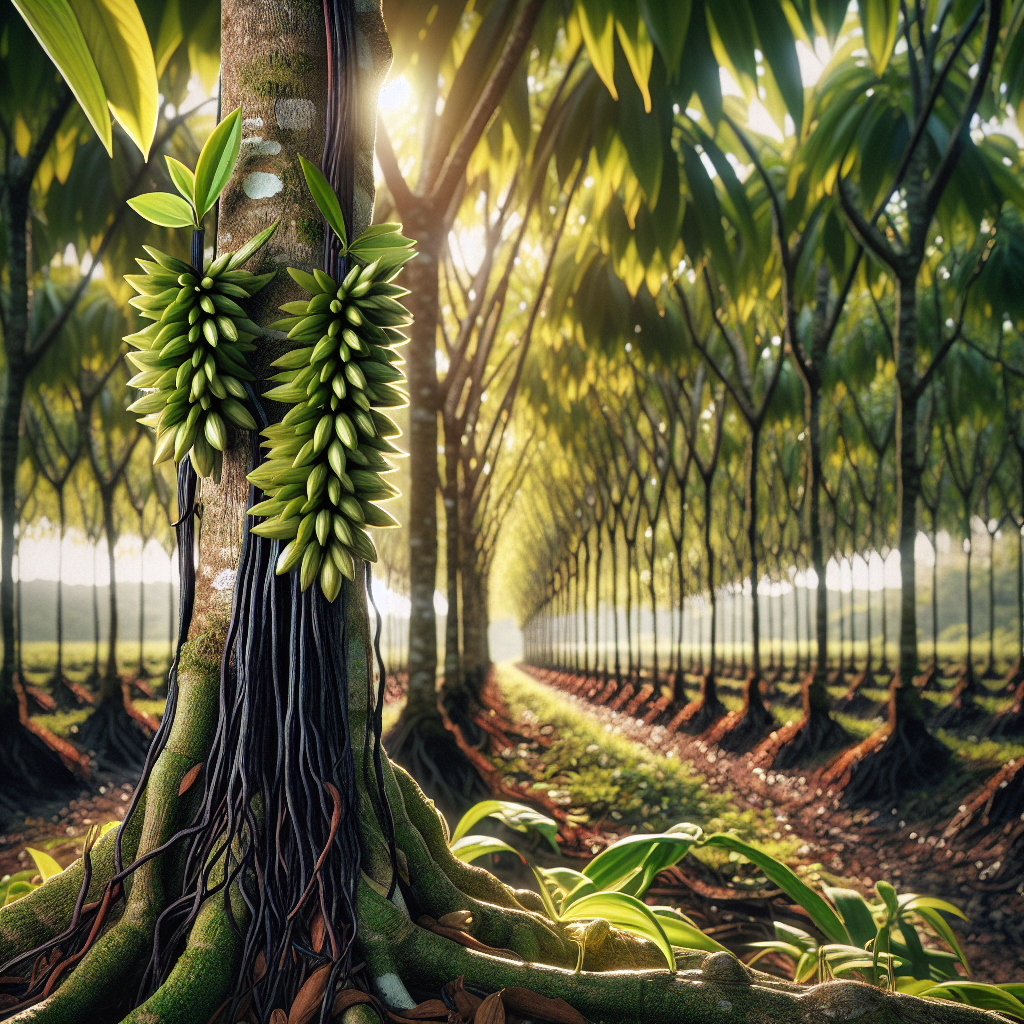
Introduction to Bourbon Vanilla
Among commercial spices, few crops combine botanical fascination and economic value as dramatically as Bourbon Vanilla. Despite the name, it is not related to bourbon whiskey; “Bourbon” refers to the historical designation of vanilla produced on Île Bourbon, now Réunion, and later across Madagascar, Comoros, and neighboring Indian Ocean regions. In trade, the term is often used for the classic cured beans of Vanilla planifolia with a rich, creamy, sweet aroma dominated by vanillin, heliotropin-like softness, and warm balsamic undertones.
This crop is an orchid vine, not a shrub or tree, and its agronomy reflects that difference. It climbs, roots from nodes, demands filtered tropical light, and performs best where humidity is high but air circulation remains steady. Commercial success depends on synchronizing vegetative vigor with controlled flowering, daily hand pollination during bloom, and a disciplined curing process after harvest. Growers who treat it like a standard vine often fail; growers who understand its orchid physiology can produce exceptional beans.
Bourbon-type vanilla remains the benchmark against which other vanilla styles are judged. Compared with Tahitian Vanilla, Bourbon-type beans are generally thicker, more vanillin-forward, and preferred for many culinary and extract applications. Good results come from designing the growing system around root-zone oxygen, moderated shade, trellising support, and careful moisture management rather than simply maximizing fertilizer or irrigation.
Botanical Profile of Bourbon Vanilla
Vanilla planifolia is a perennial, monopodial, hemiepiphytic orchid native to Mesoamerica. In cultivation it behaves as a climbing vine with succulent, segmented stems that can exceed 10 meters if unmanaged. Each node can produce a fleshy leaf, an aerial root, and eventually lateral growth. The leaves are thick, strap-like to elliptic, glossy green, and function as important carbohydrate reserves. Stem tissue is also photosynthetic and stores water, which is one reason sudden overwatering can be especially damaging: the plant already carries internal moisture reserves and does not tolerate chronically saturated media.
The root system consists of two functional types. Aerial roots emerge at nodes and cling to living supports, rough stakes, or mulch-covered training poles. Terrestrial roots occupy the upper organic layer of soil and are relatively shallow, often concentrated in the top 10 to 20 cm where decomposing litter is abundant and oxygen levels remain high. This shallow, oxygen-demanding root pattern explains why deep cultivation around the plant is a mistake and why coarse organic mulches are more valuable than heavy soil hilling.
Inflorescences arise from mature nodes on vines that have achieved sufficient carbohydrate status and partial hanging or looping maturity. Flowers are pale yellow-green, short-lived, and typically open for only a few morning hours. Outside the crop’s native pollinator range, fruit set depends almost entirely on hand pollination. Each successfully pollinated flower develops into a long capsule commonly called a bean or pod, usually reaching harvest maturity in 8 to 9 months depending on temperature and plant condition.
Bourbon-type cured beans are prized for high vanillin content, supple texture, dark brown coloration, and an oily sheen when well processed. Bean length is influenced by genetics, pollination success, vine nutrition, and the number of pods retained per inflorescence. Excessive fruit load often reduces size and aromatic quality, so professional growers frequently cap the number of pollinated flowers per cluster.
Soil, pH, and Climate Requirements for Bourbon Vanilla
This crop thrives where day temperatures remain mostly between 24 and 32°C, night temperatures between 18 and 22°C, and relative humidity ranges from 70 to 90%. Sustained temperatures below 15°C slow metabolism sharply and can cause chilling injury, while temperatures above 35°C under low humidity can scorch leaves, desiccate aerial roots, and reduce flower retention. An annual rainfall range of roughly 1500 to 3000 mm is suitable if drainage is excellent and a short drier period helps encourage flowering.
Light should be filtered rather than direct. Target about 40 to 60% shade in warm tropical lowlands, reducing shade slightly in cloudier or cooler conditions. Too much shade gives elongated internodes, weak flowering, and soft tissue vulnerable to disease. Too much sun causes leaf yellowing, marginal scorch, stem wrinkling, and reduced root viability. Ideal leaves are medium green, not dark bluish green from excessive shade and not pale yellow-green from sun stress.
Soil should be loose, highly organic, and exceptionally well drained. The best root zone resembles forest-floor humus more than field topsoil. A suitable planting mix or bed may contain coarse composted bark, leaf mold, coconut husk chips, well-decomposed compost, and friable loam in a structure that drains quickly but remains evenly moist. If water stands at the root zone for even 24 to 48 hours, the risk of Fusarium, Phytophthora, and bacterial rot rises sharply.
Aim for a pH of 5.5 to 7.0, with 6.0 to 6.5 often ideal. Below pH 5.2, nutrient imbalance and root irritation become more likely, especially where manganese or aluminum availability rises. Above pH 7.2, micronutrients such as iron and manganese may become less available, leading to chlorosis in young growth. Regular additions of mature compost and leaf litter usually buffer pH gently while improving cation exchange and microbial life. For broader root-zone resilience and organic matter management, principles from soil health strategies apply especially well to vanilla systems.
Moisture management is more important than absolute irrigation volume. The media should stay uniformly damp but never sodden. In practical terms, the upper organic layer should feel cool and slightly moist when pressed, while free water should not ooze out. Warning signs of overwatering include sour odor in mulch, blackened root tips, translucent stem lesions near the base, yellowing lower leaves, and limp tissue despite wet media. Underwatering appears as leaf folding, reduced gloss, wrinkled stems, dry aerial roots, and abortion of developing flowers or young beans.
Step-by-Step Planting & Propagation
Propagation is almost always by cuttings because seed propagation is technically difficult and unsuitable for maintaining uniform commercial quality. Select disease-free, mature vines with plump nodes, healthy green leaves, and no signs of stem canker, sunken lesions, or Fusarium streaking. Cuttings 60 to 120 cm long are standard for faster establishment; shorter cuttings root but take longer to reach productive size.
After cutting, allow the basal end to callus in shade for 1 to 3 days. This step reduces immediate rot risk. In high-humidity environments, dusting the cut with a biological fungicide such as Trichoderma-based inoculant can be helpful. Avoid planting fresh, unhealed cuttings directly into wet media.
Prepare a support system before planting. Vanilla can be trained on living standards or inert supports. Good living supports include small-canopied trees with manageable roots and filtered shade. Gliricidia is widely used where available, but in mixed tropical plantings growers also use Cacao and Coffee as part of a layered system. The support must not cast dense shade or compete aggressively for shallow moisture.
To plant, bury only 2 to 3 basal nodes in loose organic media and leave the rest of the vine resting against mulch or tied gently to the support. Do not bury the entire cutting. Deep planting suffocates nodes and greatly increases rot. Secure the vine with soft ties, allowing nodes above ground to contact the support and emit aerial roots. If planting into raised beds, space plants roughly 1.5 to 2.5 meters apart depending on support architecture and labor access.
During the first 6 to 10 weeks, prioritize root initiation over top growth. Keep humidity high, shade at about 50 to 60%, and irrigation light but frequent enough that the basal media never dries completely. Once new roots and shoots appear, begin gradual training. Loop or drape long vines rather than letting them climb endlessly upward. Flowering is more likely on mature, somewhat pendant sections than on aggressively vertical juvenile growth.
A productive management cycle often includes:
- Establishment and vertical climb.
- Looping or bending mature vines back downward.
- Encouraging lateral branching on mature wood.
- Selective pruning after harvest to maintain reachable flowering zones.
Care & Maintenance regimes for Bourbon Vanilla
Fertilization should be moderate and frequent, not heavy and sporadic. Vanilla responds well to low-salt nutrition with emphasis on organic matter. Excess nitrogen drives lush vegetative growth at the expense of flowering and increases susceptibility to soft rot and sucking pests. In field systems, apply 3 to 6 kg of well-decomposed compost or leaf mold per plant annually, split into 2 to 4 applications, always kept as a surface mulch rather than dug in deeply.
If using soluble feeds, a light orchid-style program works well: dilute balanced nutrition during active growth, shifting slightly lower in nitrogen and relatively higher in potassium and calcium before the expected flowering period. Foliar feeds should be weak and applied in early morning under shade to avoid spotting. Watch leaf color and internode length closely; dark lush vines with long soft internodes usually indicate excess nitrogen or insufficient light.
Pruning and training are central to production. Keep productive vine loops between waist and chest height if possible so pollination and harvest are easy. Remove dead, rotted, or badly overcrowded sections immediately. After a heavy crop, thin exhausted lateral growth and retain healthy mature vines for the next cycle. Sanitize tools between plants to avoid spreading stem diseases.
Flower induction is associated with plant maturity, moderated moisture, and a slight seasonal reduction in rainfall or irrigation in some regions. Do not impose severe drought. A modest dry-down means allowing the surface mulch to approach dryness between waterings while preventing stem shrivel. Once flower spikes are visible, resume steadier moisture. Water stress during spike and early bean development can reduce set and produce short, poor-quality pods.
Hand pollination must be done on the morning the flowers open, often between sunrise and late morning. Use a thin splinter, grass stem, or small tool to lift the rostellum and press the anther onto the stigma. Pollinate only a controlled number of flowers per inflorescence, commonly 6 to 10 in vigorous vines, fewer on young or stressed plants. Over-pollination produces many beans but weakens the vine and reduces average bean quality.
Mulching is essential. Maintain 5 to 10 cm of coarse organic mulch such as leaf litter, coconut husk chips, or composted bark around the root zone, but keep it airy rather than compacted. Mulch stabilizes moisture, feeds beneficial microbes, and protects shallow roots from heat. Replace decomposed mulch regularly, since vanilla roots actively occupy this upper organic interface.
Pests, Diseases & Organic Management
The most serious problems in vanilla are usually fungal and bacterial rots rather than insect feeding. Fusarium root and stem rot is especially destructive. Symptoms include yellowing from the base upward, brown vascular discoloration inside stems, shriveled sections despite adequate moisture, and progressive vine collapse. Prevention is far more effective than cure: use clean cuttings, excellent drainage, airy mulch, sanitized tools, and avoid stem injury.
Phytophthora and other water-mold rots appear under overly wet, poorly ventilated conditions. Look for water-soaked lesions, rapid blackening at the stem base, and sudden collapse after heavy rain periods. Improve drainage immediately, reduce irrigation frequency, remove infected tissue well below visible symptoms, and apply approved biological controls where available.
Bacterial soft rot causes foul-smelling, mushy tissue that spreads quickly in warm humid weather, especially after wounds. Remove infected vines at once and disinfect tools after every cut. Never handle wet vines unnecessarily, since water films help spread bacteria.
Common insect pests include scales, mealybugs, mites, and sometimes snails or slugs on tender growth. mealybugs and scales cluster in leaf axils and on stems, sucking sap and producing honeydew that encourages sooty mold. Ant activity often signals their presence. Control ants first, then wash small infestations off with water or use repeated applications of insecticidal soap or horticultural oil, making sure coverage reaches concealed nodes. Oils should be used cautiously under high heat to avoid phytotoxicity.
mites are more problematic in drier, hotter conditions and cause stippled leaves, dull color, and fine webbing. Increase ambient humidity, reduce dust, and use biological or soap-based controls early. slugs and snails chew roots and tender tips; manage with sanitation, traps, and habitat reduction around supports.
Organic disease management depends on prevention through microclimate control. Key practices include:
- Never letting the root zone stay waterlogged.
- Keeping vine loops off soggy ground.
- Removing diseased tissue promptly.
- Improving airflow without dropping humidity excessively.
- Using composts and mulches that are fully decomposed, not sour or anaerobic.
- Inoculating with beneficial microbes such as Trichoderma where appropriate.
Harvesting, Curing & Optimal Storage
Harvest timing determines aroma potential. Beans are usually ready 8 to 9 months after pollination, when the distal end begins to yellow slightly and the pod reaches full length and thickness. Harvesting too early produces low aroma, poor curing response, and thinner beans. Waiting too long risks splitting on the vine, which reduces market value and complicates curing.
Harvest gently by hand, keeping pods clean and unbruised. Sort immediately by size and maturity. Curing transforms odorless green pods into aromatic vanilla through enzymatic conversion, moisture reduction, and controlled oxidation. A classic Bourbon-style curing sequence includes killing, sweating, drying, and conditioning.
Killing stops vegetative life and initiates enzymatic reactions. Traditional methods often use hot water dipping at roughly 63 to 65°C for a short, carefully controlled period, though timing varies with pod thickness. Underdone killing leads to uneven curing; overheating cooks the beans and damages aroma.
Sweating follows for several days to weeks. Beans are wrapped and held warm so enzymatic browning continues. During this phase, pods turn chocolate-brown and develop the first recognizable vanilla aroma. Daily inspection is critical; beans should feel supple and warm, not wet and moldy. If condensation becomes excessive, ventilation and shorter bundling periods are needed.
Drying is gradual and may take weeks. The goal is to lower moisture to about 25 to 30% in cured beans, enough to prevent spoilage while retaining flexibility. Beans that dry too fast become brittle and lose aromatic complexity. Beans that remain too wet mold in storage. Properly cured pods are dark brown, pliable, lightly oily, and strongly fragrant.
Conditioning is the final maturation stage. Packed in closed boxes or lined containers for one to several months, the aroma harmonizes and deepens. During storage, keep beans at cool room temperature, protected from light, with stable humidity. Avoid refrigeration unless carefully controlled, because condensation can trigger mold. Vacuum sealing is useful only when bean moisture is already correct; sealing overly wet beans traps a spoilage problem.
Commercially, top-grade Bourbon-style beans are long, moist but not wet, glossy, and free from splits, smoke taint, and mold. White crystals of vanillin may appear on some well-cured beans during storage and are not necessarily a defect when aroma remains clean and the beans are otherwise sound.
Companion Planting for Bourbon Vanilla
Vanilla performs best in a managed agroforestry setting rather than a conventional monocrop. The most useful companions are structural or microclimate partners that provide filtered shade, moderated humidity, organic matter, and diversified income. Cacao is one of the strongest companions in humid tropical systems because it occupies a compatible shade niche and helps create a stable understory environment. Coffee can function in slightly brighter strata nearby, contributing system diversity without excessive canopy density when spaced correctly.
Nasturtium can be used at the perimeter or in nearby managed beds as a trap and beneficial-insect support plant, though it should not be allowed to create dense, wet ground cover directly against vanilla root zones. Thai Basil is another useful nearby herb for attracting pollinators and predatory insects in mixed homestead systems, but like all understory companions it must be managed so airflow around vanilla remains open.
The guiding principle is compatibility with vanilla’s shallow roots and disease sensitivity. Avoid aggressive climbers, thirsty plants that compete heavily at the base, or companions that create stagnant humidity. Good companion design means open-rooted mulch zones under the vanilla, light-filtering support species above, and low, manageable biodiversity around but not smothering the vine.