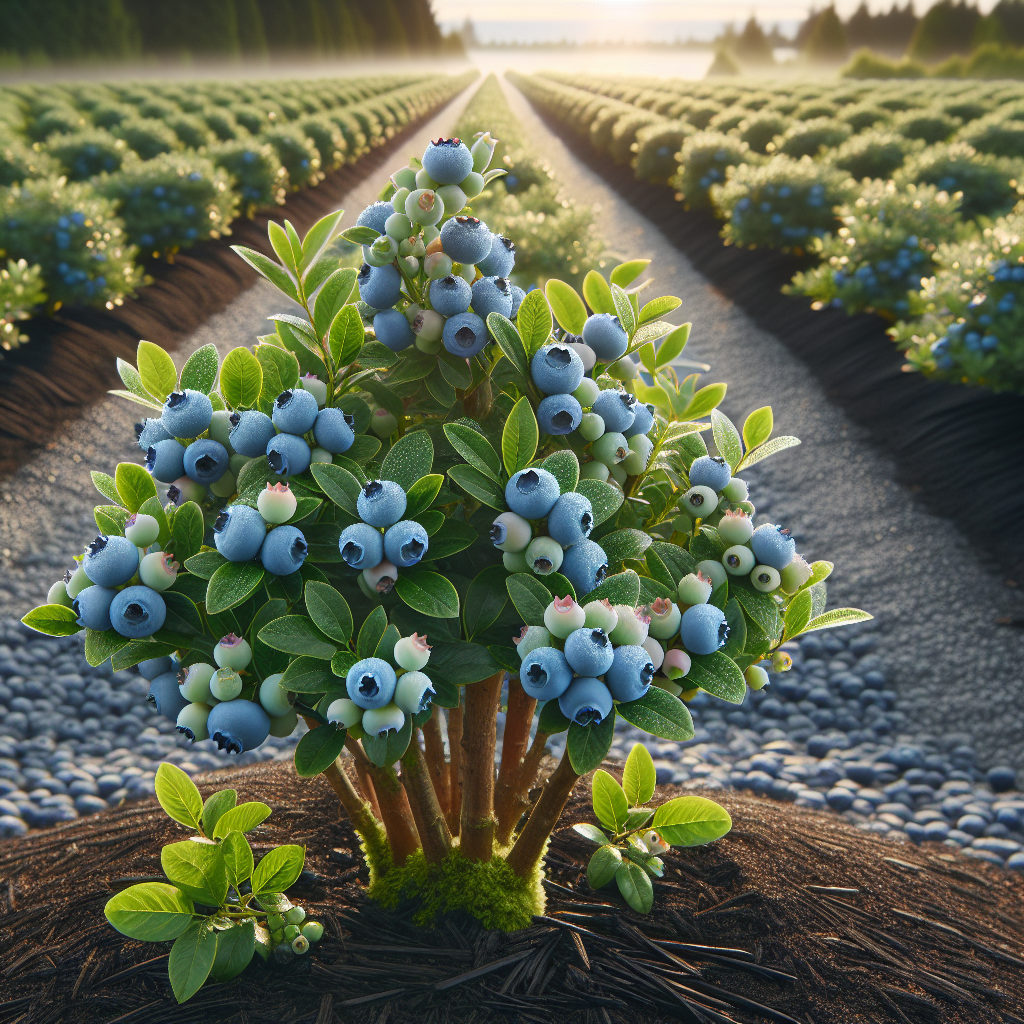
Introduction to Bluecrop Blueberry
Released in the mid-20th century from the U.S. highbush breeding programs, this cultivar became one of the benchmark blueberries against which many later varieties were judged. Growers value it for a combination that is surprisingly difficult to match in one plant: strong vigor, consistent productivity, good berry size, reliable cold tolerance, and a bush architecture that responds well to pruning.
It is a northern highbush blueberry, meaning it is best suited to regions with a true winter dormancy period and meaningful chilling accumulation. In many production areas, it ripens in midseason, often after early cultivars and before many late-fruiting types, which makes it useful for extending harvest windows. The fruit is medium to large, light blue with a good waxy bloom, and typically has a balanced sweet-acid flavor that improves noticeably when fully ripe.
Compared with some newer cultivars, it can be slightly less flashy in size or firmness under certain conditions, but its dependability is the reason it remains important. If managed correctly, a mature planting can remain productive for decades. For general species background, see our Blueberry guide. For broader long-term bed management principles, the ideas in soil health strategies are especially relevant to perennial berry systems.
Botanical Profile of Bluecrop Blueberry
This plant belongs to the Ericaceae, or heath family, which includes azalea, rhododendron, cranberry, and other acid-loving species. The cultivar is a selection of Vaccinium corymbosum, the northern highbush blueberry species native to eastern North America. Understanding that family relationship matters because it explains the plant's strong preference for acidic, organic, well-aerated soils and its intolerance of calcareous ground.
The bush is upright to slightly spreading, typically reaching 4 to 6 feet tall and often a similar width at maturity, though fertile soils and excellent irrigation can produce larger plants. Canes arise from the crown and renew over time. Productive wood is concentrated on one-year-old shoots borne from older canes, while very old wood gradually loses vigor and berry size.
Leaves are simple, alternate, and deciduous, usually medium green during the growing season before turning red, orange, burgundy, or purple in fall. Flower buds are formed on the previous season's growth, typically plumper and rounder than vegetative buds. In spring, clusters of urn-shaped white to pinkish flowers emerge before full leaf expansion. These flowers are insect-pollinated, and while the cultivar is self-fertile, cross-pollination usually improves fruit set, berry size, and harvest uniformity.
Fruit is a true berry with numerous tiny seeds. The epidermis develops a characteristic powdery wax bloom that protects fruit and contributes to its market appearance. Berry firmness and flavor are strongly influenced by crop load, soil moisture consistency, potassium balance, pruning severity, and especially harvest timing. Picking too early leads to bland fruit because external blue color develops before peak internal sugar and aroma compounds.
One notable characteristic is its tendency toward heavy cropping, which is both an advantage and a management challenge. If bushes are allowed to overbear, berry size can decline, ripening may spread out unevenly, and plants may put on less vegetative renewal growth. Pruning and balanced fertility are therefore not optional details but central to maintaining cultivar performance.
Soil, pH, and Climate Requirements for Bluecrop Blueberry
This cultivar performs best in highly acidic, well-drained, high-organic-matter soils. The optimal pH range is generally 4.5 to 5.2, with 4.8 to 5.0 often ideal in commercial systems. Once soil pH drifts above about 5.5, iron, manganese, and sometimes zinc availability drops, and plants begin to show chlorosis, weak shoot growth, and reduced yield. At pH 6.0 and above, performance typically declines sharply unless the bed has been heavily modified.
The root system is shallow, fibrous, and notably lacking in dense root hairs compared with many other crops. That means the plant is poor at scavenging water and nutrients from difficult soil. It needs a loose, porous root zone with stable moisture and abundant organic matter. The top 8 to 12 inches of soil are especially important because that is where most feeder roots remain concentrated.
Ideal soil texture is sandy loam to loam enriched with acidic organic materials such as pine bark fines, aged sawdust from untreated softwood, leaf mold, or peat-based amendments where appropriate. Heavy clay is not automatically impossible, but it must be transformed into a raised, oxygen-rich bed. In compacted, saturated clay, roots suffocate quickly and Phytophthora root rot becomes a major risk.
Drainage is critical. Blueberries need moisture, but they do not tolerate perched water tables. A simple rule is that after heavy rain, water should drain from the root zone within 24 hours. If soil remains sticky, airless, and saturated for several days, root decline is likely. In healthy soil, a squeezed handful from the root zone should feel cool and moist and barely hold together, not ooze water.
For irrigation management, aim to keep soil evenly moist but never waterlogged. During active growth and fruit fill, the root zone should generally remain around 60 to 80% of field capacity. In practical terms, the upper 3 to 4 inches should not be allowed to become powder-dry. Drought stress first appears as slowed shoot extension, smaller leaves, dull foliage, reduced berry sizing, and fruit that ripens prematurely with stronger acidity. Overwatering shows up differently: leaves may become pale despite wet soil, lower foliage may redden out of season, new growth may wilt paradoxically in hot weather because damaged roots cannot function, and the bed may smell sour or anaerobic.
Climate preference is temperate with cold winters. This cultivar is best adapted to USDA zones roughly 4 through 7, and in some cooler zone 8 sites with sufficient winter chill. It generally requires substantial chilling hours for uniform bud break and flowering. In areas with mild winters, flowering can become erratic and leaf-out weak. In very hot summer climates, especially where nights stay warm, berry quality and bush vigor may decline unless irrigation, mulch, and afternoon heat mitigation are excellent.
Full sun is strongly preferred, with at least 6 to 8 hours of direct light daily. In cooler northern regions, all-day sun maximizes sugar accumulation and wood ripening. In regions with intense summer heat, light afternoon shade can reduce heat stress, but too much shade leads to weak canes, lower flower bud formation, and softer fruit.
Step-by-Step Planting & Propagation
Start with high-quality, disease-free nursery stock, ideally 2- or 3-year-old container-grown plants. Bare-root plants can also establish well, but container plants usually experience less transplant shock if planted correctly. Select a site away from frost pockets if possible, because low spots can trap cold air during bloom.
Test soil at least several months before planting. Measure pH as well as organic matter and drainage characteristics. If pH is above the target range, acidify in advance, usually with elemental sulfur. Sulfur reacts slowly, so last-minute correction is rarely effective.
Build the planting zone, not just the hole. Blueberries fail when planted into a small amended pocket surrounded by unsuitable native soil. Prepare a bed at least 3 to 4 feet wide. Incorporate acidic organic matter into the full rooting area. In marginal drainage, form raised beds 8 to 12 inches high.
Space plants approximately 4 to 5 feet apart in-row, with 8 to 10 feet between rows for larger management systems. Home plantings can be somewhat tighter if pruning is disciplined.
Plant at the same depth they grew in the nursery or just slightly higher in heavy soils. Do not bury the crown deeply. Gently tease out circling roots on container plants so they grow into the surrounding bed.
Water thoroughly at planting to settle soil around roots, then apply 3 to 5 inches of mulch. Pine bark, pine needles, or aged sawdust are excellent choices. Keep mulch a few inches back from direct contact with the crown to reduce disease risk.
Remove most or all flowers during the first year. This is difficult emotionally but agronomically sound. Early fruiting diverts carbohydrates away from root establishment and cane development.
Install drip irrigation or micro-sprinklers immediately. Shallow roots are unforgiving of irregular watering.
Propagation is usually done by softwood cuttings, hardwood cuttings, tissue culture, or layering. For growers propagating their own plants, softwood cuttings taken from healthy current-season shoots in late spring to early summer root well under mist with bottom heat and a sterile acidic medium. Hardwood cuttings taken during dormancy are slower but practical in nursery settings. Layering low canes into acidic media can also produce replacement plants, though this is slower and less scalable.
Seed propagation is not appropriate if you want true-to-type plants, because seedlings will not reliably match cultivar characteristics.
Care & Maintenance regimes for Bluecrop Blueberry
Fertility should be approached conservatively and specifically for blueberries, which are sensitive both to overfertilization and to nitrate-dominant nitrogen sources. Ammonium-based forms are preferred, such as ammonium sulfate in mineral programs or acidic organic fertility sources in organic systems. Avoid manure-heavy amendments and high-salt fertilizers, especially around young roots.
In the establishment year, use light, split applications rather than one heavy feeding. A common pattern is feeding in early spring after bud swell and again 4 to 6 weeks later. Mature bushes are typically fertilized from early spring through early summer, with rates adjusted by leaf analysis, growth response, and soil organic matter. Excess nitrogen produces lush, late-season growth that is winter-tender and more disease-prone, while insufficient nitrogen gives pale foliage, short internodes, and weak renewal cane production.
Mulching is one of the most important routine practices. Maintain a 3- to 5-inch mulch layer continuously. Mulch moderates soil temperature, reduces evaporation, suppresses weeds, feeds soil biology, and gradually contributes organic matter. Replenish annually as materials decompose. Avoid deep cultivation because roots are very shallow and easily damaged.
Weed control is essential because blueberries compete poorly. Even modest grass pressure near the crown can drastically reduce establishment. Keep a weed-free zone at least 2 to 3 feet around each bush. Hand weeding, mulch, landscape fabric in some systems, and careful shallow hoeing at the margins are preferred. Do not repeatedly disturb the root zone.
Pruning begins at planting and evolves as the bush matures. In years 1 and 2, the goal is framework development: remove weak, twiggy, low, or damaged growth and discourage fruiting. In years 3 to 5, shape the bush by removing crossing canes, congested interior wood, and the weakest shoots. Once mature, remove one or two of the oldest canes each year at the base to stimulate strong new canes from the crown.
For this cultivar, pruning also serves to regulate crop load. Retain strong, well-placed canes and remove excessive fine twigging, especially in the upper canopy where small fruit often forms on overcropped bushes. Good pruning improves air movement, increases berry size, and concentrates ripening.
Irrigation demand rises sharply from bloom through harvest. Most mature bushes need roughly 1 to 2 inches of water per week from rainfall plus irrigation, but sandy soils, windy sites, and heavy crop loads may require more frequent applications. Drip irrigation is ideal because it delivers moisture slowly into the shallow root zone. In hot weather, it is better to water more often with smaller doses than to alternate between drought and saturation.
Pollination is improved by insect activity, especially bumblebees and other native bees that work effectively in cool spring weather. Even though self-fruitful, nearby compatible blueberry cultivars often improve yields. If planting a mixed berry block, Thyme, Clover, and Yarrow can help support beneficial insects around the system when managed so they do not compete directly with the root zone.
Bird protection is often mandatory. As fruit turns blue, install netting before major feeding begins. Birds quickly learn ripening schedules and can strip bushes in days.
Pests, Diseases & Organic Management
The most common problems are often environmental first and biological second. When soil pH is wrong, roots are stressed, drainage is poor, or bushes are overcropped, pest and disease pressure becomes much more damaging.
Mummy berry is a major fungal disease in many blueberry regions. It causes shoot blight early and later shriveled, pale berries that drop or remain mummified. Sanitation is critical: remove or bury mummified berries under mulch, maintain airflow, and avoid overhead irrigation during susceptible periods. Thick fresh mulch can physically suppress spore release from overwintered mummies.
Anthracnose fruit rot can cause soft berries and orange-pink spore masses, especially in warm, wet conditions near harvest. Open pruning, rapid postharvest cooling, clean picking practices, and not allowing overripe fruit to remain on bushes all help reduce losses.
Phytophthora root rot is one of the most serious issues in poorly drained sites. Symptoms include weak growth, small chlorotic leaves, red or bronze discoloration, dieback, and collapse despite moist soil. Prevention is vastly better than cure: raised beds, drainage improvement, and careful irrigation scheduling are the core organic strategies.
Stem cankers and Twig blights enter through wounds or stressed tissue. Prune during dry weather where possible, disinfect tools when disease is present, and remove infected wood below symptomatic tissue.
Spotted wing drosophila is a severe fruit pest in many regions because it lays eggs in ripening fruit rather than overripe fruit alone. Frequent harvesting, sanitation, exclusion netting, and trapping are key organic tactics. Harvest intervals should tighten as fruit color develops; in high-pressure periods, picking every 2 to 3 days is often justified.
Aphids may colonize tender shoots and can vector viruses. Strong water sprays on small plantings, promotion of beneficial insects, and insecticidal soaps can help when populations are detected early.
Scale insects, Blueberry maggot in some regions, Cranberry fruitworm, and Japanese beetles may also appear depending on geography. Monitor routinely rather than reacting after visible crop loss. Inspect flower clusters, underside of leaves, and ripening fruit weekly during peak risk windows.
Mammals such as rabbits and deer can damage young plants severely. Guard trunks and fence where pressure is high.
Organic disease management works best as a system: resistant site selection, acidic mulch, dry foliage, clean pruning, sanitation, biodiversity, and timely harvest. Curative sprays are much less effective if the agronomic foundation is weak.
Harvesting, Curing & Optimal Storage
Berries are ready when they are fully blue with no red or green around the stem end and detach easily with a gentle roll. However, true peak eating quality usually develops several days after the berry first turns blue. For fresh-market flavor, wait until fruit is fully colored and slightly softened but still firm. For shipping, harvest a bit earlier while maintaining full blue color and good firmness.
This cultivar often requires multiple pickings over 2 to 4 weeks, sometimes longer depending on weather and pruning. Selective hand harvesting is ideal because fruit within a cluster does not always ripen simultaneously. Pick during the cool part of the day, preferably after dew has dried but before afternoon heat.
Handle fruit gently. Blueberries bruise internally even when skin damage is not obvious. Shallow containers are better than deep buckets for premium fruit. Do not leave harvested berries in the sun.
There is no curing step in the sense used for onions or sweet potatoes, but there is a crucial postharvest conditioning step: rapid cooling. Remove field heat as quickly as possible, ideally within a few hours. Forced-air cooling to 32 to 34°F (0 to 1°C) dramatically improves shelf life. Relative humidity should stay high, around 90 to 95%, to limit shrivel without encouraging free surface moisture.
Well-harvested, properly cooled fruit can often store for 1 to 2 weeks, sometimes longer under excellent cold-chain conditions. Uncooled fruit may deteriorate in just a few days. Wash only just before use, not before storage, because excess moisture encourages decay.
For freezing, spread dry berries in a single layer first so they do not clump, then pack into airtight containers. Fruit intended for jam or baking can be harvested slightly softer than fruit intended for shipping.
Companion Planting for Bluecrop Blueberry
The best companions are those that tolerate acidic soil, do not aggressively invade the shallow root zone, and improve pollinator or beneficial insect activity rather than compete for fertility. Low-growing insectary plants planted at the edge of the bed or in adjacent alleys are more useful than companions planted directly against the crown.
Thyme works well in nearby drier margins because it attracts pollinators while staying relatively low and manageable. Yarrow is valuable for beneficial insects, including hoverflies and parasitic wasps, and can be planted just outside the main mulch ring. Clover is useful in row middles or alleyways as a living groundcover that supports pollinators and helps reduce erosion, though it should be kept from competing directly with young bushes.
Pine-based mulches and naturally acidic woodland-edge companions are generally more suitable than heavy-feeding vegetables. Avoid planting aggressive spreaders, deep cultivators, or crops that need alkaline conditions. Also avoid companions that force frequent irrigation changes incompatible with blueberry root health.
In commercial or serious backyard systems, think of companion planting less as crowding multiple species into one bed and more as designing a supportive ecology around the planting: flowering edges, permanent mulch, pollinator habitat, weed suppression, and reduced dust and erosion. That systems approach produces better results than ornamental interplanting alone.