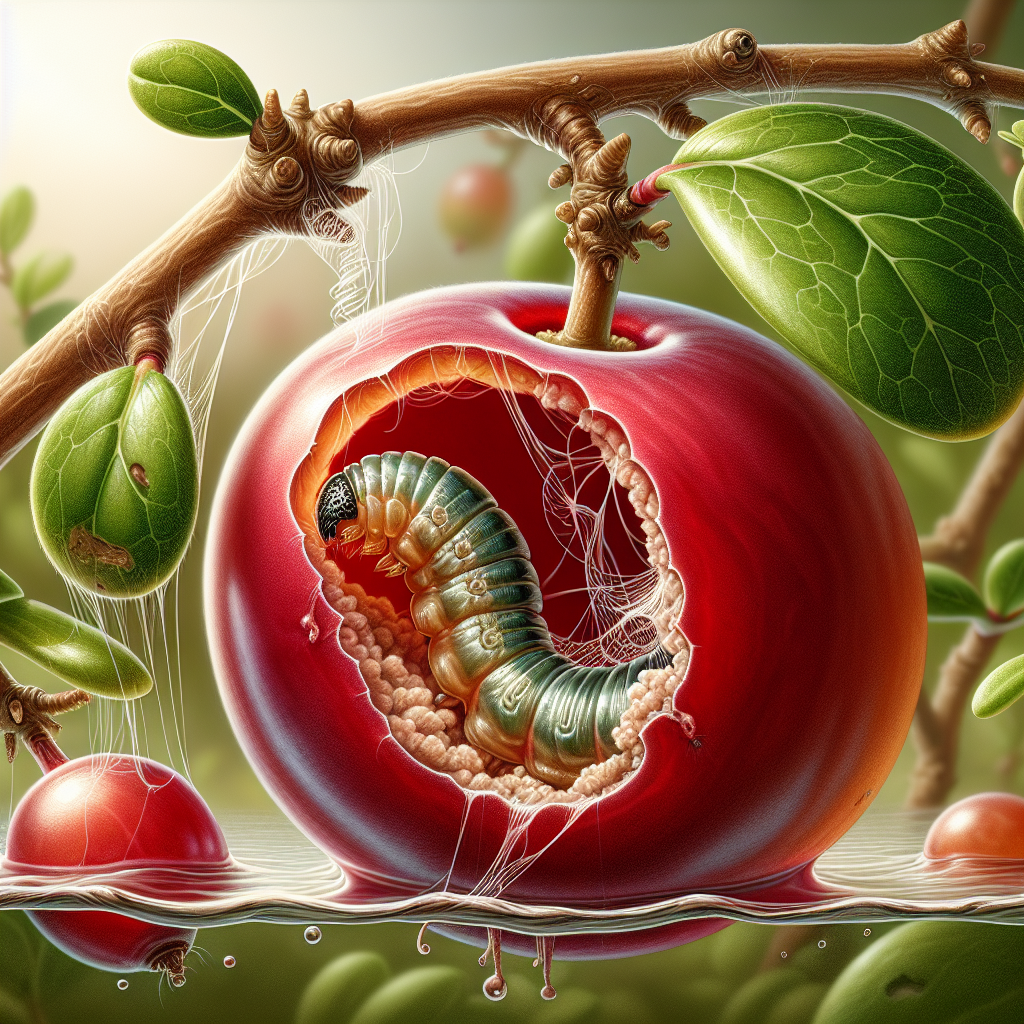
Introduction to Cranberry fruitworm
The cranberry fruitworm, scientifically known as Acrobasis vacinii, stands as one of the most notorious pests in cranberry production, particularly in North American bog systems. This moth species belongs to the Pyralidae family and has evolved to exploit the unique vulnerabilities of cranberry fruits (Vaccinium macrocarpon), tunneling into developing berries and rendering them unmarketable. First documented in the early 20th century in Massachusetts cranberry marshes, it has since spread across major production regions including Wisconsin, New Jersey, and Oregon, causing economic losses estimated in millions annually.
Adult moths emerge in late spring to early summer, laying eggs on foliage and fruit clusters. The resulting larvae, small cream-colored caterpillars with brown heads, are the primary damage agents, feeding voraciously inside berries. Infestations can reduce yields by 20-50% in severe cases, with webbing and frass (insect waste) serving as telltale signs. Understanding this pest's biology is crucial for growers aiming to maintain organic certification or minimize synthetic inputs. For more on related caterpillars, see our detailed wiki entry.
Cranberry fruitworm thrives in the acidic, water-managed environments of commercial bogs, where high humidity and dense vine canopies provide ideal conditions. Early detection through pheromone traps and degree-day modeling allows for precise interventions, preventing larval establishment. This guide equips farmers with professional-grade diagnostics, organic treatments, and long-term prevention strategies to safeguard crops. Recent studies from the University of Massachusetts Cranberry Station highlight integrated approaches yielding up to 90% control efficacy without residues.
Identifying Symptoms & Damage
Accurate identification of cranberry fruitworm damage is essential for timely management, as symptoms mimic other pests like sparganothis fruitworm or cutworms. Initial signs appear 10-14 days after petal fall, when small entry holes (1-2 mm) punctured by neonate larvae become visible on green berries. Affected fruits swell irregularly, turn pink prematurely, and contain silken tunnels packed with frass and webbing.
Examine vines closely: look for clusters of 5-20 berries with dark specks or 'pinprick' wounds. Larvae, reaching 12-15 mm, exit mature fruits to spin hibernacula (overwintering cocoons) on uprights or runners, appearing as small, reddish-brown cases (3-5 mm). Heavy infestations cause berries to drop prematurely, with up to 70% crop loss in untreated beds. Differentiate from Corn Earworm by the cranberry specialist's preference for fruit interiors over surface feeding.
Secondary symptoms include sooty mold growth on exudate and increased bird predation on weakened fruits. Use a 10x hand lens to confirm larval presence; healthy berries remain firm and uniformly colored. Scouting protocols recommend checking 25 locations per acre weekly, recording >2% infested fruit as action threshold. Digital imaging apps can aid remote diagnostics, enhancing accuracy for small-scale growers.
Lifecycle and Progression of Cranberry fruitworm
The cranberry fruitworm completes one generation per year, tightly synced with cranberry phenology. Adults, small grayish moths (10-12 mm wingspan) with wing fringes, overwinter as partially grown larvae in hibernacula attached to vines. Pupation occurs in May-June as soil temperatures exceed 15°C (59°F), with first flight peaking at 200-300 degree-days (base 10°C).
Females lay 50-100 eggs singly on leaves or calyces from late June to July. Eggs hatch in 7-10 days, and larvae bore directly into berries, molting four times over 4-6 weeks. Full-grown larvae (15 mm) exit to form new hibernacula by late August. Monitoring with pheromone traps captures moth flight; trap counts >10 per trap per week signal imminent egglaying.
Degree-day models, calibrated for Massachusetts (starting January 1), predict events: adult emergence at 250 DD, egg hatch at 400 DD, larval entry at 500 DD. Regional variations exist; Pacific Northwest bogs see delayed cycles due to cooler springs. Understanding this progression enables precise timing of controls, reducing unnecessary applications by 30-50%.
Environmental Triggers & Risk Factors
Cranberry fruitworm populations surge under specific conditions favoring survival and reproduction. Warm, humid summers (average >20°C, RH >70%) accelerate larval development, while mild winters (> -10°C minimums) boost hibernaculum survival to 80%. Bog flooding for winter sanitation kills 50-70% of overwintering larvae, but incomplete drainage leaves refugia.
High vine density (>200 uprights/m²) and excessive nitrogen promote tender growth, attracting oviposition. Adjacent woodlands harbor alternative hosts like blueberry, facilitating spillover infestations. Drought stress weakens plant defenses, increasing susceptibility; irrigation mismanagement correlates with 2x higher damage.
Climate change exacerbates risks, with earlier springs shifting phenology mismatches. For insights on weather impacts, check our blog on Why 80% of Small Farms Battle Weather Disasters - And How Hyper-Local AI Forecasts Can Save Your Harvest. Soil pH extremes (<4.0 or >5.5) indirectly favor pests by stressing vines.
Organic Control & Treatment Plans
Organic management emphasizes cultural, biological, and targeted inputs, achieving 85-95% control when integrated. Cultural: Sanding bogs in April-May buries 60-80% hibernacula, exposing them to desiccation. Post-harvest flooding (4-6 weeks at 45 cm depth) drowns larvae. Prune uprights to improve airflow, reducing humidity.
Biological: Introduce Trichogramma wasps (release 100,000/acre weekly during flight) for 40% parasitism. Bacillus thuringiensis (Bt) kurstaki applied at early larval stage (400-500 DD, 1-2 L/ha) provides 90% mortality; time with traps. Entrust SC (spinosad) at 0.2 L/ha offers knockdown with short pre-harvest interval (3 days).
Monitoring & Thresholds: Deploy 2-4 pheromone traps/acre; treat if >5 moths/trap/week or 2% fruit infestation. Scout fruits weekly from petal fall. Rotate modes to prevent resistance. Neem oil or insecticidal soaps suppress small larvae but require frequent reapplication. Combine with reflective mulches to deter adults. Efficacy data from Rutgers trials show IPM suites outperforming single tactics by 25%.
Preventing Cranberry fruitworm in the Future
Long-term prevention builds resilient systems through IPM foundations. Select resistant varieties like 'Stevens' or 'Ben Lear', which show 30% lower infestation. Maintain bog sanitation: annual sanding, timely flooding, and debris removal reduce overwintering sites by 70%.
Enhance biodiversity with hedgerows of nasturtium and native plants to attract predators like birds and spiders. Monitor degree-days via weather stations for predictive alerts. Crop rotation with non-hosts (e.g., grasses) every 5-7 years disrupts cycles, though challenging in perennial bogs.
Certify organic inputs and track applications for compliance. Community-wide trap networks suppress regional populations. Future tech like RNA interference baits shows promise in trials, offering species-specific control without residues.
Crops Most Affected by Cranberry fruitworm
Primarily targeting cranberry (Vaccinium macrocarpon), the fruitworm occasionally infests related Ericaceae like blueberry, strawberry, and lingonberry, especially in mixed plantings. Commercial losses concentrate in cranberry bogs, where dense monocultures amplify damage. Wild lowbush blueberries suffer sporadic outbreaks, but cultivated highbush varieties exhibit tolerance due to fruit size and chemistry. No significant impacts on non-Vaccinium crops.