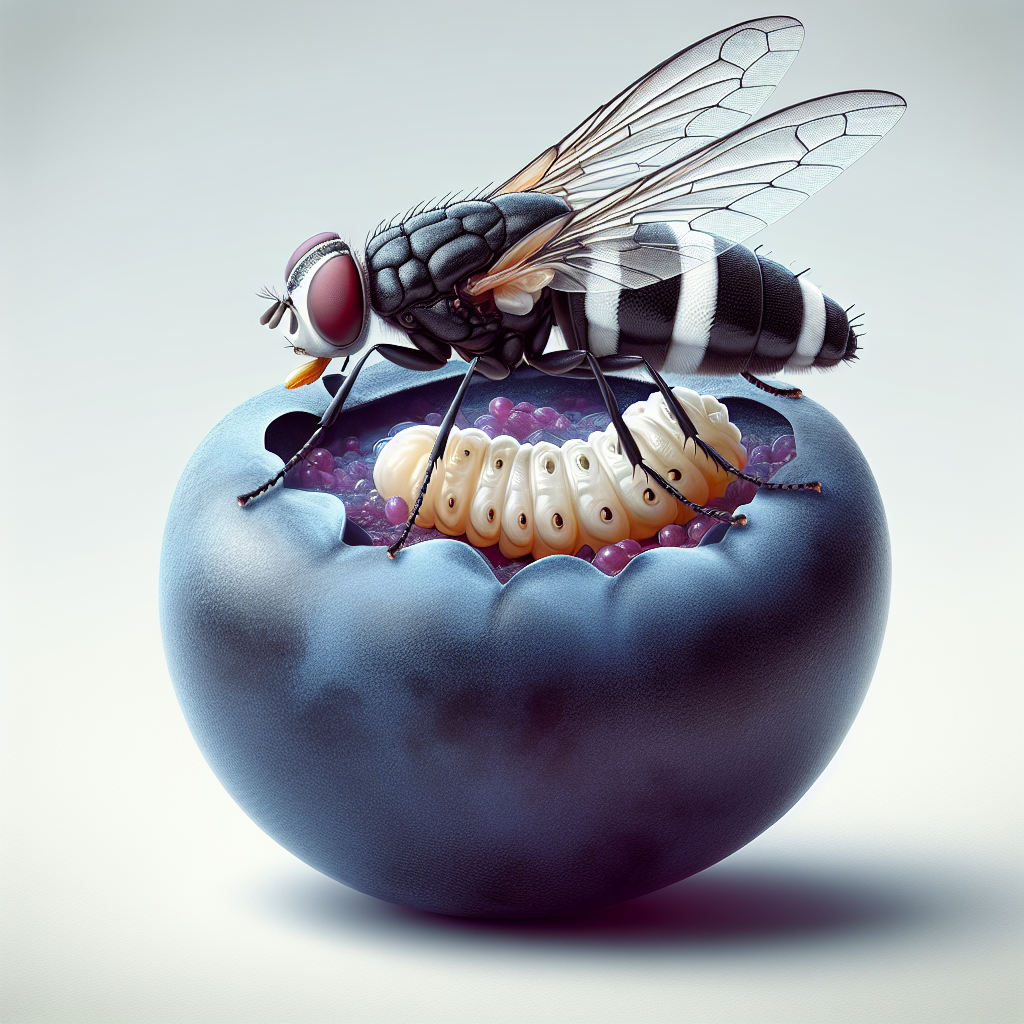
Introduction to Blueberry maggot
The blueberry maggot, scientifically known as Rhagoletis mendax, represents one of the most serious threats to commercial and homegrown Blueberry production across North America. Native to eastern North America, this pest has expanded its range with the growth of blueberry cultivation, now impacting farms from Maine to Michigan and beyond. Adult flies emerge in early summer, laying eggs in developing fruit, where larvae feed and cause berries to soften, rot, and drop prematurely. Infested fruit becomes unmarketable, leading to yield losses of up to 50-80% in unmanaged orchards.
Unlike broader fruit flies, blueberry maggots specifically target blueberries and occasionally related crops like Strawberry or Raspberry, distinguishing them from generalist pests such as apple maggot. Early detection is crucial, as larvae are nearly impossible to remove once inside the berry. This guide equips growers with professional diagnostic tools, lifecycle insights, and integrated management plans to protect harvests. For small farms, timely intervention using organic methods can preserve fruit quality and market value, especially in high-value u-pick operations. Understanding this pest's biology enables proactive defense, minimizing chemical inputs while maximizing berry integrity.
Blueberry maggots thrive in humid, temperate climates ideal for blueberries, making the Northeast U.S. and Canada prime hotspots. Adults are small (4-6 mm), with black bodies, white stripes on the thorax, and distinctive wing bands. Females use a sharp ovipositor to pierce fruit skin, depositing 1-2 eggs per berry. A single female can oviposit over 500 eggs, amplifying infestations rapidly. Economic thresholds vary, but even 1-5% infestation renders fruit unpalatable for fresh markets. Integrated pest management (IPM) combining monitoring, cultural controls, and targeted sprays forms the cornerstone of control. Recent research emphasizes yellow sticky traps for phenology-based timing, enhancing spray efficacy by 30-50%. Growers should scout weekly from petal fall, focusing on perimeter rows near woods where flies overwinter.
Identifying Symptoms & Damage
Diagnosing blueberry maggot infestations requires keen observation of fruit and subtle external signs. The most telling symptom is the presence of a small, white, legless maggot (larva) inside berries, typically 6-8 mm long with a hooked rear end for propulsion through pulp. Larvae tunnel randomly, leaving brown, watery frass and disintegrated flesh, causing berries to collapse and leak juice. Affected fruit darkens prematurely, shrivels, and falls to the ground, often harboring pupae that overwinter in soil.
External indicators include a tiny puncture scar (0.5 mm) from oviposition, sometimes with a reddish-brown halo, though these are hard to spot on dark-skinned varieties like Bluecrop Blueberry. Sting marks may appear as dimples or soft spots on green fruit turning pink. Heavy infestations cause cluster wilting and soil littering with infested berries. Differentiate from other pests: unlike birds or Japanese beetles, maggot damage is internal without surface chewing; anthracnose causes sunken lesions without larvae.
To confirm, slice open suspect berries under magnification. Healthy pulp is firm and white; infested shows creamy larvae or tunnels. Float test: infested berries sink in saltwater due to tissue breakdown. Damage peaks 2-4 weeks post-oviposition, aligning with fruit softening. Economic impact is severe: infested berries fetch 70-100% less value, prompting quarantines in some regions. Early-season scouting (yellow panels) detects adults before egg-laying, preventing 90% of damage.
Lifecycle and Progression of Blueberry maggot
Rhagoletis mendax completes one generation per year, tightly synced with blueberry phenology. Overwintering pupae (brown, 5 mm, seed-like) reside 2-6 inches in soil under host plants, emerging as adults from late June to August when air temperatures exceed 18°C (65°F). Emergence peaks at 400-600 degree-days (base 10°C), coinciding with fruit set.
Adults live 2-4 weeks, feeding on honeydew or exudate before mating. Females oviposit 5-20 eggs daily into fruit 7-12 mm diameter, preferring sunny exposures. Eggs hatch in 2-4 days into tiny larvae that burrow inward, feeding for 20-30 days through four instars. Mature larvae exit via 'jumping' or dropping, pupating in soil by late August. Development accelerates in warm, humid conditions; cooler climates extend cycles.
Pupae enter diapause triggered by short days, resuming in spring. Multiple broods occur in southern ranges. Monitoring degree-days and sticky traps predicts flights, enabling precise interventions. Lifecycle knowledge underpins IPM: target adults pre-oviposition, destroy dropped fruit to break pupal stage.
Environmental Triggers & Risk Factors
Blueberry maggot favors acidic, well-drained soils (pH 4.5-5.5) matching blueberry needs, with proximity to wild hosts amplifying risk. Key triggers include warm springs accelerating pupal development, high humidity (>70%) aiding adult activity, and mild winters reducing pupal mortality. Overripe or injured fruit attracts flies; dense canopies trap moisture, boosting survival.
Risk factors: wild blueberries or huckleberries nearby serve as reservoirs; abandoned orchards seed infestations. Poor sanitation leaves pupae; irrigation puddles create pupation sites. Climate change extends ranges northward, overlapping with Duke Blueberry districts. High-risk sites include woodland edges, where 80% of flies originate. Soil tillage disrupts pupae, but excessive disrupts mycorrhizae. Monitor weather: flights surge post-80°F days.
Organic Control & Treatment Plans
Organic management emphasizes IPM, starting with monitoring: deploy 1-2 yellow sticky traps per acre at bloom, baited with ammonium acetate. Treat at 5 flies/trap/week. Sanitation: harvest all fruit, rake and destroy drops (solarize or bury >6 inches). Tillage post-harvest exposes pupae to predators.
Approved sprays: spinosad (Entrust) at petal fall and 10-14 days later, targeting adults (80% control). Neem oil or pyrethrins as foliar sprays. Kaolin clay (Surround) repels oviposition. Beneficials: release Trichogramma wasps for egg parasitism; encourage birds with perches. For Spring Pest Patrol, integrate with companion plants like Nasturtium. Rotate modes to prevent resistance; scout weekly. Yields recover 90% with timely action.
Preventing Blueberry maggot in the Future
Prevention hinges on cultural barriers: plant certified stock away from woods; use row covers (0.25 mm mesh) from fruit set to harvest. Early cultivars escape peak flights. Prune for airflow, reducing humidity. Cover crops like buckwheat suppress soil pupae. Trap crops (early apples) divert flies. Annual soil solarization kills 70% pupae. Quarantine infested areas; hot-water dip fruit post-harvest. Long-term: resistant varieties like 'Elliott'. Monitor with Pherocon traps; destroy at threshold. Combined tactics sustain zero-tolerance in organics.
Crops Most Affected by Blueberry maggot
Primarily Blueberry (highbush, lowbush), with minor impacts on Raspberry, Blackberry, and huckleberry. Commercial losses hit $10-20M annually in Michigan alone. Home gardens suffer total crop failure without controls.