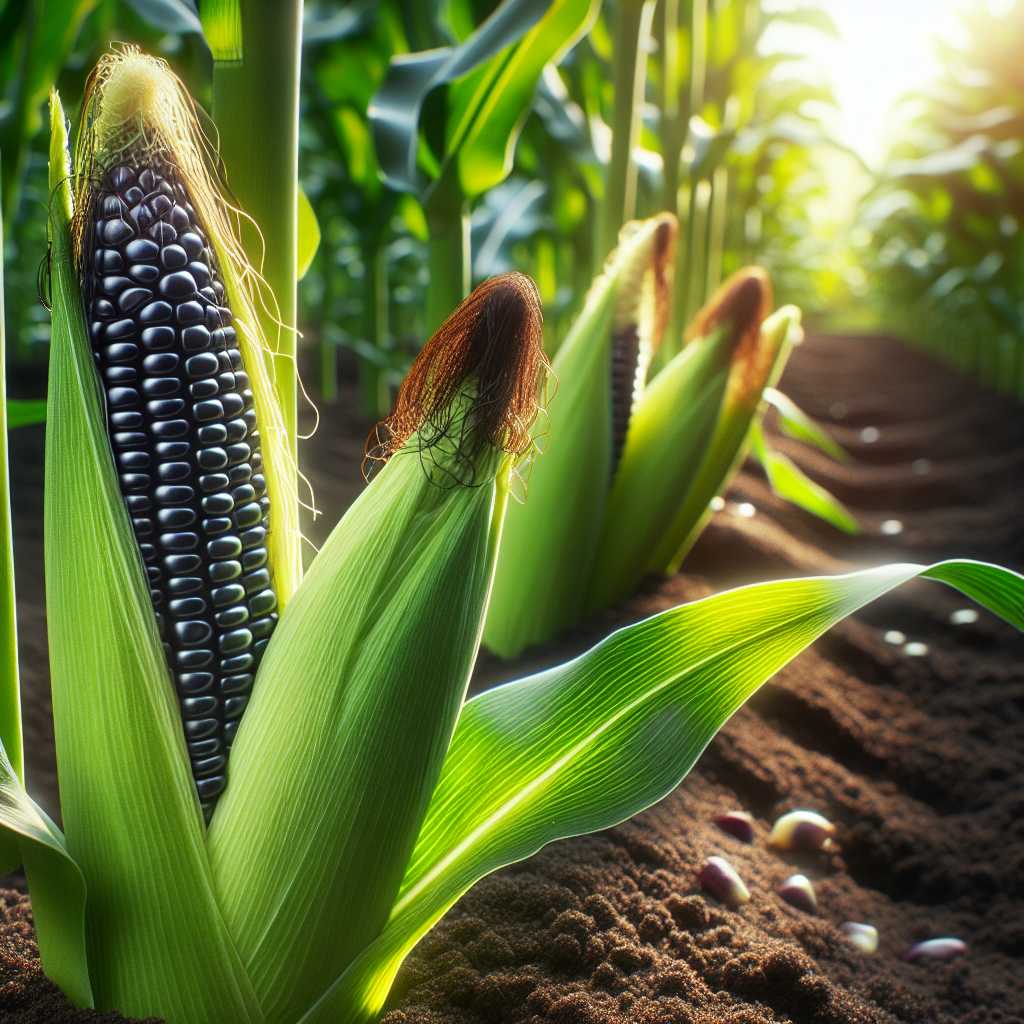
Introduction to Black Mexican Sweet Corn
An old heirloom sweet corn with deep historical roots, this variety is widely admired for being one of the finest-tasting sweet corns ever introduced to home gardens and market plots. It is generally harvested young for eating, when the kernels are creamy white to pale yellow and intensely sweet; if left longer on the plant, the kernels develop the dramatic bluish-black coloration that gives the variety its name. That visual transformation often causes confusion among growers who assume the ears should be eaten black, but the highest table quality is usually reached earlier, at the milk stage.
Black Mexican Sweet Corn is especially valued by gardeners who want flavor over industrial uniformity. Compared with many modern supersweet hybrids, it often has a richer, more old-fashioned corn taste, with pronounced sweetness balanced by true corn aroma and a notably tender kernel when picked at the proper stage. Because it is an heirloom, seed can be saved if isolation is maintained, making it attractive for seed stewards and small-scale growers focused on resilience, flavor, and historic cultivars.
For a broader overview of the species and production basics, see our Corn guide. For soil-building ideas that benefit heavy-feeding cereals, review soil health strategies.
Botanical Profile of Black Mexican Sweet Corn
This crop belongs to the grass family, Poaceae, and is a form of cultivated maize selected for sweet rather than starchy endosperm. Sweet corn types carry mutations that cause sugars to remain in the kernel longer before converting to starch. In heirloom sweet corns such as this one, sugar levels are often excellent but the post-harvest sugar-to-starch conversion is faster than in some modern sh2 supersweets, which is why rapid cooling after harvest matters so much.
Plants are usually more compact than large field corn types, commonly reaching about 4 to 6 feet tall, though local conditions, fertility, and sowing date can push height somewhat above or below that range. Ears are typically borne lower on the stalk than in taller dent corns. Expect one to two marketable ears per plant under good fertility and moisture, with ear size commonly around 5 to 7 inches. Kernel rows are often less uniform than modern hybrid sweet corn, which is normal for heirloom material.
Like all maize, it is monoecious: the tassel at the top produces pollen, while the ears lower on the stalk carry the silks, each silk connected to a potential kernel. Every kernel must be individually pollinated, so good block planting is far more important than single long rows. Poor pollination results in patchy ears with missing kernels, especially near the tip.
A defining cultivar trait is the kernel color shift. At ideal fresh-eating stage, kernels are pale and tender. As maturity advances, anthocyanin pigmentation and physiological changes deepen the kernel color toward slate, purple, or black. That characteristic makes Black Mexican Sweet Corn visually distinctive and historically notable among heirloom sweet corn varieties.
Soil, pH, and Climate Requirements for Black Mexican Sweet Corn
This variety performs best in deep, fertile, well-drained loam with high biological activity and a generous supply of available nitrogen. Sandy loams can work very well if irrigation and fertility are closely managed, while heavy clay soils can also produce excellent stands if drainage is improved and surface crusting is prevented. Avoid shallow, compacted, or chronically waterlogged ground; corn roots need oxygen as much as moisture.
Target a soil pH of 6.0 to 6.8, with 6.2 to 6.5 being especially comfortable for nutrient availability. Below pH 5.8, phosphorus can become less available and early growth may slow; calcium and magnesium may also be limiting in very acid soils. Above pH 7.2, micronutrient issues such as zinc deficiency become more likely, especially in cool spring soils. If soil tests show low organic matter, incorporate well-finished compost before planting, but do not rely on compost alone to meet nitrogen demand.
Black Mexican Sweet Corn is a warm-season annual and should be treated as frost-sensitive from germination onward. Soil temperature at seeding should be at least 60°F (16°C), with 65 to 86°F (18 to 30°C) ideal for prompt emergence. In cold soils, seed may rot or emerge unevenly. Air temperatures of 70 to 85°F (21 to 29°C) favor vigorous vegetative growth. Extended heat above 95°F (35°C), especially during silking, can reduce pollen viability and impair kernel set unless soil moisture is excellent.
Moisture management is critical. Corn needs roughly 1 to 1.5 inches of water per week in moderate weather, increasing to as much as 2 inches weekly in sandy soil, windy sites, or hot periods. The most critical stages are from knee-high growth through tasseling and especially silking. A moisture deficit during silking often causes poor ear fill because silks dry before full pollination occurs.
Professionally, the ideal soil moisture is evenly moist in the active root zone, not saturated. In practical terms, soil 2 to 4 inches below the surface should feel cool and form a weak ball in the hand, then crumble when pressed. Overwatered ground smells sour, stays shiny or sticky, and may produce pale plants with lower leaves yellowing from oxygen-starved roots. Underwatered plants roll their leaves into a tight inward curl during the morning, not just in the hottest late afternoon hours. Persistent leaf rolling before noon is a strong signal that irrigation is overdue.
Full sun is essential. Less than 8 hours of direct sun reduces stalk strength, sugar accumulation, and ear development. Shelter from extreme wind is helpful, but avoid boxed-in, humid corners with poor airflow, because foliar diseases intensify there.
Step-by-Step Planting & Propagation
Propagation is by seed only. Direct sowing is strongly preferred because corn transplants often suffer root disturbance and lag behind direct-seeded plants unless started in deep biodegradable cells and moved very young.
Prepare the bed 2 to 3 weeks before sowing. Remove perennial weeds, loosen soil to at least 8 to 10 inches, and incorporate compost plus any amendments indicated by a soil test. If fertility is low, work in a balanced pre-plant fertilizer, but avoid excessive fresh manure, which can create lush but weak growth.
Form broad beds or level rows in a block, not a single row. Planting in squares or short adjacent rows improves wind pollination. A minimum block of 4 rows is recommended; larger plantings pollinate more reliably.
Sow after frost danger has passed and the soil has warmed. Plant seeds 1 to 1.5 inches deep in heavier or moist soil, and up to 2 inches deep in lighter, drying soils. Shallow planting in hot, dry topsoil often causes erratic emergence.
Space seeds 8 to 12 inches apart within rows, with rows 24 to 36 inches apart depending on cultivation method. Closer spacing can work on fertile ground with irrigation, but overcrowding reduces ear size. For heirloom sweet corn, a practical target is around 24,000 to 30,000 plants per acre equivalent in intensive garden production.
Thin weak doubles or clusters early if over-seeded. Maintain the strongest, most uniform stand possible.
Succession sow every 10 to 14 days for staggered harvests, but remember that isolation from other corn is essential if seed saving matters. Different corn types cross readily. If another sweet corn, popcorn, or field corn sheds pollen nearby at the same time, eating quality and saved seed purity can both be affected.
If saving seed, isolate by distance or timing. Ideally, separate different corn varieties by several hundred feet to much farther depending on conditions, or ensure tasseling periods do not overlap. For small gardens, timing isolation is often more practical than distance.
Emergence typically occurs in 5 to 10 days in warm soil. If emergence is poor, dig ungerminated seed to diagnose. Soft, decayed seed suggests cold wet soil; hollowed seed may indicate seedcorn maggot or wireworm damage.
Care & Maintenance regimes for Black Mexican Sweet Corn
Feed this crop like the heavy feeder it is. Nitrogen drives leaf area, chlorophyll production, and ultimately ear development, but too much too late can delay maturity and promote lush growth at the expense of ear quality. A good professional schedule is to apply part of the nitrogen before planting and side-dress the rest when plants are about 12 to 18 inches tall, then again just before rapid stalk elongation if soils are light or rains are heavy.
Visual diagnosis helps refine feeding. Nitrogen deficiency usually begins as pale green plants and V-shaped yellowing from the tip down the midrib of older leaves. Phosphorus deficiency in cool soils may show as stunting with reddish or purplish tinting. Potassium deficiency often appears as marginal firing or scorching on older leaves. Because Black Mexican Sweet Corn is an heirloom rather than a modern highly buffered hybrid, nutritional imbalances may show more quickly under stress.
Irrigate deeply rather than lightly. Light frequent watering encourages shallow rooting and heightens drought stress between irrigations. Aim to wet the top 8 to 12 inches of soil, then allow the surface inch to begin drying before watering again. Drip irrigation is ideal because it keeps foliage dry and reduces disease pressure, but furrow irrigation can work if drainage is good.
Mulching is useful once soil has fully warmed. A light organic mulch suppresses weeds and evens moisture, but do not pile thick wet mulch directly against stalk bases in cool climates. Early in the season, corn benefits from warm soil; mulch too soon can slow growth.
Weed control is crucial during the first 4 to 6 weeks. Corn is a strong competitor once established, but young seedlings lose badly to fast annual weeds. Keep the bed clean with shallow hoeing or hand weeding. Avoid deep cultivation after plants reach knee height, because surface feeder roots are easily damaged.
Hilling a small amount of soil around the base when plants are 12 to 18 inches tall can improve anchorage, especially in windy sites. This is particularly helpful on lighter soils or where irrigation has exposed roots.
Pollination support can improve yields in small plantings. During peak pollen shed, usually in the morning, gently shake stalks every day or two if weather is still and plantings are small. This helps pollen fall from tassels onto receptive silks.
Because sugar declines quickly after harvest, plan your picking and cooling workflow before ears mature. Sweet corn quality is as much about post-harvest handling as field culture.
Pests, Diseases & Organic Management
The most common insect issue is Corn Earworm, which lays eggs on fresh silks. Larvae enter through the ear tip and feed on kernels. Organic management relies on timing and exclusion: monitor silk emergence, use mineral oil plus Bacillus thuringiensis applications to silk channels where appropriate, and harvest promptly. In small plots, clipping the worm-damaged tip is often enough for kitchen use.
European Corn Borer and similar stalk-boring caterpillars can weaken stems and reduce ear quality. Watch for shot-hole feeding in whorls and frass near stalk tunnels. Destroy crop residues after harvest to reduce overwintering sites. Healthy, fast-growing plants better tolerate light damage.
Cutworms may sever young seedlings at ground level shortly after emergence. Use collars in small gardens, keep weeds down before planting, and inspect at dusk if stand loss appears suddenly.
Sap-feeding pests such as Aphids occasionally build up on tassels and undersides of leaves, especially during dry spells. Strong water sprays, balanced fertility, and encouragement of beneficial insects usually keep them below damaging thresholds. Border plantings of Nasturtium and Thyme can help diversify insect habitat around a garden plot, though sanitation and crop vigor remain the primary defenses.
Raccoons, birds, and squirrels can be major non-insect pests, often more destructive than worms. Harvesting just as ears ripen, using fencing, and covering small patches with netting can prevent severe losses.
Among diseases, Common Rust, Northern Corn Leaf Blight, and Anthracnose may appear depending on region. Fungal leaf diseases are favored by leaf wetness, crowding, and poor airflow. Start with resistant seed stock where possible, rotate away from corn and other grasses, avoid overhead irrigation late in the day, and remove severely infected debris after harvest.
Seedling Blights and Root Rots are usually linked to cold wet soil or compaction. Prevention is better than cure: warm seedbeds, good drainage, and moderate irrigation are essential. If plants are stunted and roots appear brown instead of white and fibrous, reduce watering frequency and address soil structure.
A key organic principle is stress reduction. Corn under nutrient stress, moisture swings, or weed pressure emits stronger distress cues and tends to suffer greater pest and disease impacts. Uniform growth is one of the best protective strategies available.
Harvesting, Curing & Optimal Storage
There is no curing phase for sweet corn intended for fresh eating, but there is a precise harvest window. Ears are usually ready about 75 to 90 days from sowing, depending on local conditions. The best picking stage is the milk stage: silks have turned brown and dry, ear tips feel filled, and kernels release a milky juice when punctured with a fingernail. On this variety, do not wait for full black coloration if your goal is premium sweet-corn flavor. By then, sugars have already begun converting more strongly to starch.
Check several ears, not just one. Harvest in the cool of morning when sugar content is highest and field heat is lowest. Grasp the ear, twist downward, and snap cleanly from the stalk. Avoid tearing the stalk if later ears are still developing.
For peak quality, cool ears immediately after harvest. Even an hour or two in the sun can noticeably reduce sweetness in heirloom sweet corn. Move ears to shade, then refrigerate as soon as possible. If washing, dry surface moisture before cold storage to limit decay.
Fresh ears in husk usually hold acceptable quality for 1 to 3 days at room temperature, but premium eating quality drops fast. In refrigeration near 32 to 36°F (0 to 2°C) with high humidity, they may remain good for 5 to 7 days, though flavor is best within 24 to 48 hours of picking. For longer keeping, blanch kernels or whole ear sections and freeze promptly.
If the crop is being grown for seed, harvesting is different. Leave ears on the stalk until fully mature and dry down as much as weather allows. Husks should be papery, kernels hard, and black coloration well developed. Finish drying under cover with strong airflow until kernels are too hard to dent with a thumbnail. Shell only when fully dry, then store seed cool, dark, and dry.
Companion Planting for Black Mexican Sweet Corn
The most practical companions are those that either support nitrogen economy, suppress weeds, or attract beneficial insects without crowding the corn root zone. Traditional intercropping with climbing beans can work, but timing matters: beans should not overrun young corn before stalks are strong enough to support them. For growers using a classic polyculture, Peas are not the usual warm-season climbing partner, so warm-adapted beans are generally more suitable in practice; however, among available companions in many gardens, low-growing beneficial plants and later-sown legumes are safer choices than aggressive early climbers.
One reliable companion is Clover, used as a living mulch between wider rows after corn is established. It can reduce erosion, support soil biology, and contribute nitrogen over time, but sow it only after corn is well rooted so it does not compete during establishment.
Nasturtium is useful around bed edges, where it helps attract pollinators and beneficial insects while acting as a visual trap plant for some sap feeders. It should be kept on the margins rather than directly in the row.
Thyme fits as a perimeter herb in small gardens, especially in dry borders where it will not compete heavily for water. Its flowers support beneficial insects, and its compact habit makes it easy to integrate.
A fourth good partner is Sunflower, but use it carefully and only on the north or west edge of the plot in the northern hemisphere so it does not shade the corn. It increases beneficial insect activity and can serve as a wind filter, though excessive density will compete for water and nutrients.
Avoid pairing corn with heavy root competitors planted too close, especially large brassicas or sprawling cucurbits in tight beds, unless spacing is generous and fertility is high. The best companion system for Black Mexican Sweet Corn is one that preserves full sun, airflow, and the uninterrupted pollination block the crop requires.